 Back
The Cell Cycle and Mitosis: Structure, Regulation, and Cancer
Study Guide - Smart Notes
 Tailored notes based on your materials, expanded with key definitions, examples, and context.
The Cell Cycle: Overview
Phases of the Cell Cycle
The cell cycle is the series of events that cells undergo to grow and divide. It consists of two main phases:
Interphase: The non-dividing phase where cells grow, replicate DNA, and prepare for division. It includes G1 (first gap), S (synthesis), and G2 (second gap) phases.
M phase (Mitotic phase): The dividing phase where chromosomes are condensed and the cell undergoes mitosis and cytokinesis.
Key Point: Most cells spend the majority of their time in interphase, carrying out specialized functions and preparing for division. 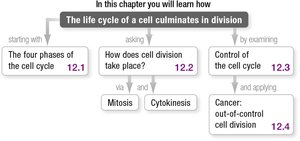
Cell Cycle Regulation
Cell cycle progression is tightly regulated by checkpoints and molecular signals.
G1 checkpoint: Ensures cell size, nutrients, and DNA integrity are adequate before DNA replication.
G2 checkpoint: Ensures DNA has been replicated correctly and the cell is ready for mitosis.
M checkpoint: Ensures chromosomes are properly attached to the spindle before separation.
Key Point: Regulatory molecules such as cyclins and cyclin-dependent kinases (Cdks) control cell cycle transitions.
Cell Division: Mitosis and Cytokinesis
Mitosis: Process and Phases
Mitosis is the process by which a eukaryotic cell divides its replicated chromosomes into two genetically identical daughter cells. It consists of five subphases:
Prophase: Chromosomes condense, spindle apparatus forms.
Prometaphase: Nuclear envelope breaks down, spindle microtubules attach to chromosomes at kinetochores.
Metaphase: Chromosomes align at the metaphase plate.
Anaphase: Sister chromatids separate and move to opposite poles.
Telophase: Nuclear envelope reforms, chromosomes decondense.
Example: During anaphase, the centromeres uncouple and sister chromatids are pulled apart by spindle fibers. 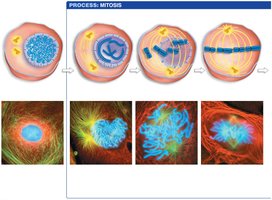
Cytokinesis: Animal vs Plant Cells
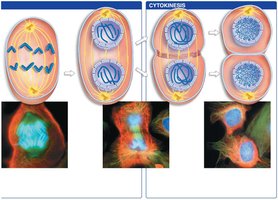
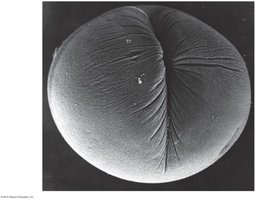
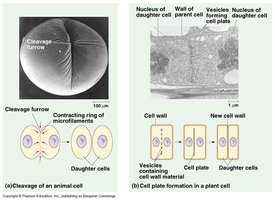
Cytokinesis is the division of the cytoplasm to form two daughter cells.
Animal cells: Cytokinesis occurs via a cleavage furrow, formed by a contracting ring of microfilaments (actin and myosin).
Plant cells: Cytokinesis occurs via formation of a cell plate, which develops into a new cell wall between daughter cells.
Chromosome Structure and Replication
Chromosomes and Chromatids
Chromosomes are structures composed of DNA and proteins (histones) that carry genetic information.
Unreplicated chromosome: Consists of a single DNA double helix.
Replicated chromosome: Consists of two sister chromatids joined at the centromere.
Homologous chromosomes: Chromosome pairs (one from each parent) with the same genes but possibly different alleles.
Key Point: During S phase, DNA is replicated, resulting in sister chromatids.
Cell Cycle Control and Cancer
Molecular Regulation of Cell Cycle
Mitosis Promoting Factor (MPF): A complex of cyclin and Cdk that triggers entry into M phase.
Regulation: MPF is activated by removal of inhibitory phosphate; cyclin is degraded to turn off MPF.
Key Point: Cell cycle checkpoints can arrest the cycle if conditions are not met, preventing damaged cells from dividing.
Cancer: Out-of-Control Cell Division
Cancer arises when cell cycle checkpoints fail, leading to uncontrolled cell division.
Tumor suppressor genes (e.g., p53): Normally halt the cell cycle or trigger apoptosis if DNA is damaged.
Benign tumors: Noncancerous, noninvasive growths.
Malignant tumors: Cancerous, invasive, can metastasize (spread to other tissues).
Example: Defects in p53 or other checkpoint proteins can lead to cancer.
Cell Division in Prokaryotes
Binary Fission
Prokaryotic cells (bacteria) divide by binary fission, a simpler process than mitosis.
DNA is replicated and attached to the cell membrane.
Cell elongates and divides into two genetically identical daughter cells.
Summary Table: Cell Cycle Phases
Phase | Main Events |
|---|---|
G1 | Cell growth, preparation for DNA replication |
S | DNA synthesis (replication) |
G2 | Preparation for mitosis, error checking |
M | Mitosis and cytokinesis |
Key Terms and Definitions
Cell division: The process by which a cell splits into two daughter cells.
Gametes: Reproductive cells (sperm and egg).
Mitosis: Division of somatic cells to produce identical daughter cells.
Meiosis: Division to produce gametes with half the DNA content.
Somatic cells: Body cells (non-reproductive).
Cytokinesis: Division of cytoplasm.
Chromosome: DNA-protein structure carrying genetic information.
Histone: Protein that helps package DNA.
Gene: Segment of DNA coding for a protein.
Chromatid: One of two identical halves of a replicated chromosome.
Centromere: Region joining sister chromatids.
Spindle apparatus: Structure that separates chromosomes during mitosis.
Metaphase plate: Region where chromosomes align during metaphase.
Cleavage furrow: Indentation in animal cells during cytokinesis.
Cell plate: Structure in plant cells during cytokinesis.
Binary fission: Prokaryotic cell division.
MPF: Mitosis promoting factor.
Cyclin-dependent kinase (Cdk): Enzyme regulating cell cycle.
Tumor: Abnormal cell growth.
Tumor suppressor: Gene preventing uncontrolled division.
Cancer: Disease of uncontrolled cell division.
Malignant: Cancerous, invasive.
Benign: Noncancerous, noninvasive.
Metastasis: Spread of cancer to new locations.
Growth factors: Signals promoting cell division.
Equations and Formulas
DNA Replication: MPF Activation: Chromosome Number After Mitosis:
Summary
The cell cycle is a fundamental process in biology, ensuring proper growth, development, and maintenance of organisms. Its regulation is crucial for preventing diseases such as cancer, and understanding its phases and molecular control is essential for all biology students.
