 Back
The Cell Cycle and Mitosis: Structure, Function, and Stages
Study Guide - Smart Notes
 Tailored notes based on your materials, expanded with key definitions, examples, and context.
The Cell Cycle
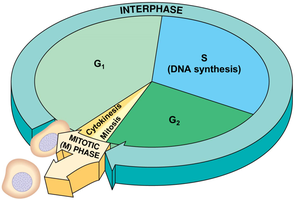
Overview of the Cell Cycle
The cell cycle is an ordered sequence of events that describes the life of a cell, from its formation to its division into two daughter cells. It is essential for growth, development, tissue repair, and asexual reproduction in multicellular organisms.
Main Phases: The cell cycle consists of two main parts: Interphase and M-Phase (Mitotic Phase).
Interphase: The period when the cell is not dividing, but is metabolically active and preparing for division.
M-Phase: The period of nuclear and cytoplasmic division, including mitosis and cytokinesis.
Functions of the Cell Cycle
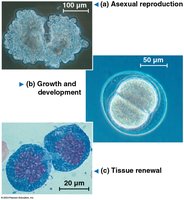
Asexual Reproduction: Produces genetically identical offspring.
Growth and Development: Enables organisms to grow and develop from a single cell.
Tissue Renewal: Replaces damaged or dead cells in tissues.
Interphase
Stages of Interphase
Interphase is divided into three main stages (sometimes four, including G0), during which the cell grows, performs normal functions, and prepares for division.
G0 Phase: A resting phase where cells exit the cycle and do not actively prepare for division. Cells may remain in G0 temporarily or permanently.
G1 Phase (First Gap): Cell growth and normal cellular functions occur. The cell increases in size and synthesizes proteins and organelles.
S Phase (Synthesis): DNA is replicated, resulting in two identical sets of chromosomes.
G2 Phase (Second Gap): Further cell growth and final preparations for nuclear and cytoplasmic division. The cell checks for DNA errors and repairs them.
Criteria for Each Stage:
G1: Cell grows, performs normal functions.
S: DNA synthesis (replication).
G2: Cell grows, prepares for division.
M-Phase (Mitotic Phase)
Overview of M-Phase
The M-Phase includes both nuclear division (mitosis) and cytoplasmic division (cytokinesis).
Mitosis: Division of the nucleus, resulting in two genetically identical daughter nuclei.
Cytokinesis: Division of the cytoplasm, resulting in two separate daughter cells.
Mitosis
Phases of Mitosis
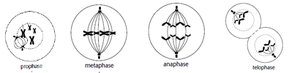
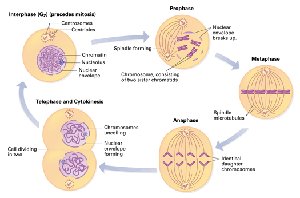
Mitosis is a process that conserves the chromosome number of a cell and is divided into four main stages:
Prophase: Chromosomes condense and become visible. Sister chromatids are connected. Spindle fibers begin to form and attach to kinetochores. The nuclear envelope fragments and disappears.
Metaphase: Chromosomes are fully condensed and align at the metaphase plate (center of the cell). Spindle fibers hold chromosomes at the kinetochores.
Anaphase: Sister chromatids separate and move toward opposite poles. Chromosomes remain fully condensed.
Telophase: Chromatids reach opposite poles. Nuclear envelope reforms. Chromosomes begin to decondense. Spindle fibers disappear.
Microscopic Identification of Mitosis
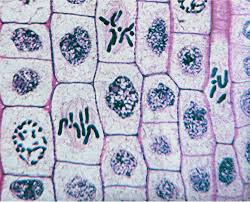
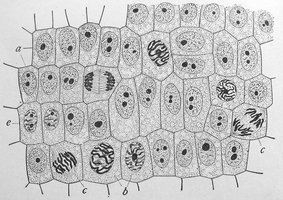
Mitosis can be observed in cells using a microscope, where the distinct stages are visible based on chromosome arrangement and cell structure.
Prophase: Chromosomes condense, nuclear envelope disappears.
Metaphase: Chromosomes align at the cell's equator.
Anaphase: Chromatids separate and move to poles.
Telophase: Chromatids reach poles, nuclear envelope reforms.
Cytokinesis
Cytokinesis in Animal Cells
Cytokinesis is the division of the cytoplasm, occurring after mitosis. In animal cells, it begins with the formation of a cleavage furrow—a shallow groove near the metaphase plate. The cell pinches in two, resulting in two separate cells.
Cleavage Furrow: The indentation that forms as the cell membrane is drawn inward by contractile proteins.
Cytokinesis in Plant Cells
In plant cells, cytokinesis occurs by the formation of a cell plate at the midline of the dividing cell. The cell plate grows outward, eventually fusing with the cell membrane and forming a new cell wall, separating the two daughter cells.
Cell Plate: A structure that holds new cell wall material and divides the cell.
Summary Table: Stages of the Cell Cycle
Stage | Main Event | DNA Status | Key Features |
|---|---|---|---|
G0 | Resting phase | Unchanged | Cell not preparing for division |
G1 | Cell growth | Unchanged | Normal functions, organelle synthesis |
S | DNA replication | Duplicated | Chromosomes copied |
G2 | Preparation for division | Duplicated | Growth, error checking |
Mitosis | Nuclear division | Separated | Chromosomes distributed |
Cytokinesis | Cytoplasmic division | Separated | Two daughter cells formed |
Key Terms and Concepts
Chromosome: A structure made of DNA and proteins that carries genetic information.
Sister Chromatids: Two identical copies of a chromosome connected by a centromere.
Spindle Fibers: Microtubules that help separate chromosomes during mitosis.
Metaphase Plate: Imaginary line at the cell's equator where chromosomes align during metaphase.
Cleavage Furrow: Indentation in animal cells during cytokinesis.
Cell Plate: Structure in plant cells that forms during cytokinesis.
Equations and Academic Context
Chromosome Number Conservation
During mitosis, the chromosome number is conserved:
Parent cell (2n) → Two daughter cells (2n)
DNA Replication Formula
After S phase:
Predicting Cell Cycle Outcomes
If mitosis occurs without cytokinesis, the result is a cell with multiple nuclei (a multinucleated cell).
If a stage fails, cell division may be incomplete or abnormal, leading to disease or cell death.
Additional info: The cell cycle is tightly regulated by checkpoints to ensure proper division and prevent errors that could lead to cancer or other diseases. ----------------------------------------
