 Back
The Cell Cycle and Molecular Biology of Cancer: Study Notes
Study Guide - Smart Notes
 Tailored notes based on your materials, expanded with key definitions, examples, and context.
Chapter 12: The Cell Cycle
Big Idea
Understanding cell division is fundamental for grasping the mechanisms of human reproduction and the generation of life in other organisms. Cell division is the process by which a single cell gives rise to two genetically identical daughter cells, ensuring continuity of life.
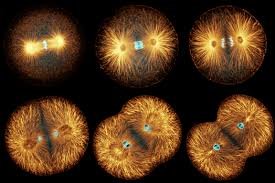
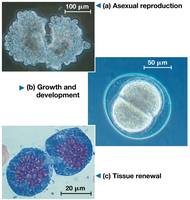
Key Roles of Cell Division
Asexual reproduction: Single-celled organisms reproduce by cell division.
Growth and development: Multicellular organisms develop from a single cell through repeated cell divisions.
Tissue renewal: Cell division repairs and renews tissues in multicellular organisms.
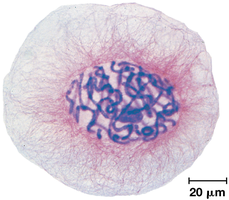
Cellular Organization of Genetic Material
Genome: All DNA in a cell; prokaryotes typically have a single DNA molecule, eukaryotes have multiple.
Chromosomes: DNA molecules packaged with proteins; carry genes.
Chromatin: Complex of DNA and protein in eukaryotic chromosomes; condenses during cell division.
Somatic cells: Non-reproductive cells with two sets of chromosomes.
Gametes: Reproductive cells (sperm and eggs) with half the chromosome number of somatic cells.
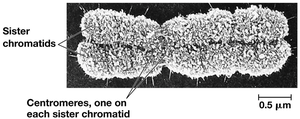
Distribution of Chromosomes During Eukaryotic Cell Division
DNA is replicated before cell division; chromosomes condense.
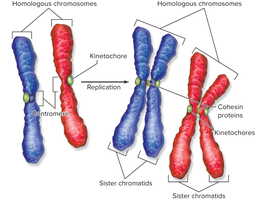
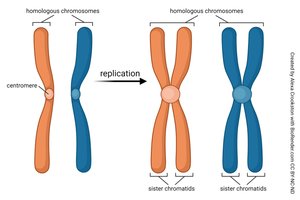
Each duplicated chromosome has two sister chromatids joined by cohesins.
The centromere is the region where chromatids are most closely attached.
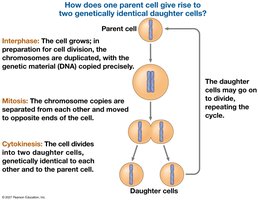
How One Parent Cell Gives Rise to Two Genetically Identical Daughter Cells
Interphase: Cell grows, chromosomes are duplicated, DNA is copied precisely.
Mitosis: Chromosome copies are separated to opposite ends of the cell.
Cytokinesis: Cell divides into two daughter cells, each genetically identical to the parent.
Phases of the Cell Cycle
Interphase
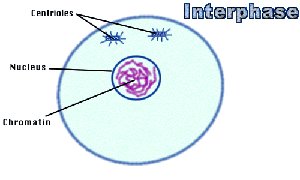
Interphase is the longest phase of the cell cycle, comprising G1, S, and G2 phases. The cell grows, replicates DNA, and prepares for division.
G1 phase: Major cell growth.
S phase: DNA replication.
G2 phase: Preparation for mitosis; chromosomes coil tightly, centrioles replicate, tubulin synthesis increases.
Mitosis
Mitosis is conventionally divided into five stages: prophase, prometaphase, metaphase, anaphase, and telophase. Each stage is characterized by specific events that ensure accurate chromosome segregation.
Prophase: Chromosomes condense, spindle apparatus assembles, nuclear envelope breaks down.
Prometaphase: Nuclear envelope disassembles, microtubules attach to kinetochores, chromosomes begin to move.
Metaphase: Chromosomes align at the metaphase plate.
Anaphase: Centromeres split, sister chromatids are pulled to opposite poles.
Telophase: Spindle disassembles, nuclear envelope reforms, chromosomes uncoil.
Cytokinesis
Animal cells: Cytokinesis occurs by cleavage, forming a cleavage furrow.
Plant cells: Cytokinesis occurs by formation of a cell plate.
Binary Fission in Bacteria
Prokaryotes reproduce by binary fission, a simpler process than mitosis. The chromosome replicates, and the cell divides into two.
Cell Cycle Regulation
Checkpoints and Control System
The cell cycle is regulated by checkpoints, cyclins, cyclin-dependent kinases (Cdks), and maturation-promoting factor (MPF). These ensure proper progression and prevent errors.
G1 checkpoint: Determines if cell will proceed to division or enter G0 (non-dividing state).
G2 checkpoint: Ensures DNA is replicated and undamaged.
M checkpoint: Ensures all chromatids are properly attached to spindle microtubules.
Cyclins: Proteins with cyclically fluctuating concentrations.
Cdks: Kinases that must bind cyclins to be active.
MPF: Cyclin-Cdk complex that triggers passage past G2 checkpoint.
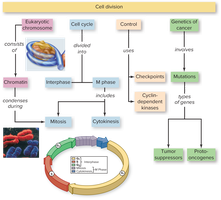
Loss of Cell Cycle Controls in Cancer Cells
Cancer and Cell Cycle Regulation
Cancer cells ignore normal cell cycle controls, divide indefinitely, and form tumors.
Benign tumors: Remain at original site.
Malignant tumors: Invade tissues, undergo metastasis, and may form secondary tumors.
Cancer treatments target rapidly dividing cells, often affecting normal cells as well.
Molecular Biology of Cancer
Types of Genes Associated with Cancer
Proto-oncogenes: Normal genes that stimulate cell growth and division.
Oncogenes: Mutated proto-oncogenes that cause excessive cell division.
Tumor-suppressor genes: Inhibit cell division; mutations can lead to cancer.
Key Mutations in Cancer
Ras proto-oncogene: Mutations lead to hyperactive Ras protein and increased cell division.
p53 tumor-suppressor gene: Mutations prevent suppression of cell cycle, allow damaged cells to proliferate.
Multistep Model of Cancer Development
Multiple mutations are required for cancer; incidence increases with age.
Inherited mutations (e.g., BRCA1/BRCA2) can predispose individuals to certain cancers.
Summary Table: Cell Cycle and Cancer Genes
Gene Type | Normal Function | Effect of Mutation |
|---|---|---|
Proto-oncogene | Stimulates cell growth | Oncogene causes excessive division |
Tumor-suppressor | Inhibits cell division, repairs DNA | Loss leads to uncontrolled growth |
Ras | Signal transduction for growth | Hyperactive Ras increases division |
p53 | Suppresses cell cycle, repairs DNA | Loss allows damaged cells to divide |
Key Terms and Concepts
Chromosome: DNA molecule with genetic information.
Chromatid: One of two identical halves of a duplicated chromosome.
Chromatin: DNA-protein complex in chromosomes.
Centromere: Region joining sister chromatids.
Kinetochore: Protein complex at centromere for spindle attachment.
Cohesin: Protein holding sister chromatids together.
Interphase: Cell growth and DNA replication phase.
Mitosis: Nuclear division phase.
Cytokinesis: Cytoplasmic division phase.
Binary fission: Prokaryotic cell division.
Checkpoint: Control point in cell cycle.
Cyclin/Cdk: Regulatory proteins for cell cycle.
MPF: Maturation-promoting factor.
Oncogene: Cancer-causing gene.
Tumor-suppressor gene: Gene inhibiting cell division.
Equations and Formulas
Chromosome Number Change:
Cell Cycle Regulation:
Summary
The cell cycle is a highly regulated process essential for growth, development, and tissue maintenance. Errors in regulation can lead to cancer, which is driven by mutations in proto-oncogenes, oncogenes, and tumor-suppressor genes. Understanding these mechanisms is crucial for biology students and for advances in medical science.
