 Back
The Cell Cycle and Molecular Biology of Cancer: Study Notes
Study Guide - Smart Notes
 Tailored notes based on your materials, expanded with key definitions, examples, and context.
The Cell Cycle
Overview of Cell Division
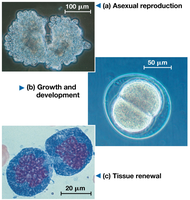
Cell division is a fundamental process in biology, enabling reproduction, growth, and repair in organisms. It ensures the accurate distribution of genetic material to daughter cells. - Cell division is essential for asexual reproduction, growth, development, and tissue renewal. - Multicellular organisms begin as a single cell that divides repeatedly. - Genetic material is copied and distributed precisely during cell division. 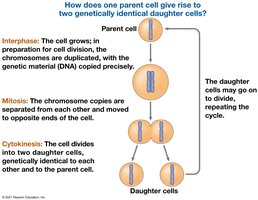
Cellular Organization of Genetic Material
The genome of a cell consists of all its DNA, organized into chromosomes. - Prokaryotic cells typically have a single DNA molecule. - Eukaryotic cells have multiple DNA molecules, packaged into chromosomes. - Chromatin is the complex of DNA and protein found in eukaryotic chromosomes. - Somatic cells have two sets of chromosomes; gametes have one set. 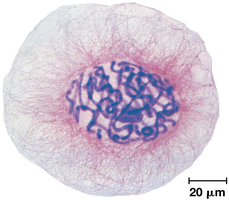
Chromosome Structure and Replication
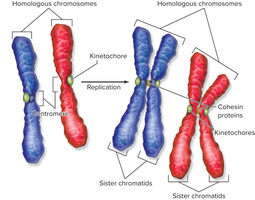
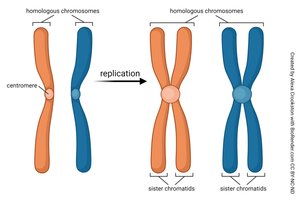
Chromosomes are duplicated before cell division, forming sister chromatids joined at the centromere. - Sister chromatids are identical copies of a chromosome, joined by cohesin proteins. - Centromere is the region where chromatids are most closely attached. - After separation, chromatids are considered individual chromosomes. 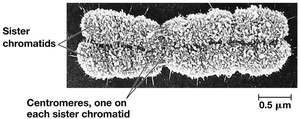
Phases of the Cell Cycle
Interphase
Interphase is the longest phase of the cell cycle, consisting of G1, S, and G2 phases. - G1 phase: Cell grows and carries out normal functions. - S phase: DNA is replicated. - G2 phase: Cell prepares for division; chromosomes condense, centrioles replicate, and tubulin is synthesized. 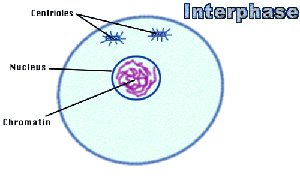
Mitotic (M) Phase
The M phase includes mitosis (division of the nucleus) and cytokinesis (division of the cytoplasm). Mitosis is conventionally divided into five stages: 1. Prophase: Chromosomes condense, spindle apparatus assembles, nuclear envelope breaks down. 2. Prometaphase: Nuclear envelope disassembles, microtubules attach to kinetochores, chromosomes begin to move. 3. Metaphase: Chromosomes align at the metaphase plate. 4. Anaphase: Centromeres split, sister chromatids are pulled to opposite poles. 5. Telophase: Spindle disassembles, nuclear envelope reforms, chromosomes uncoil. 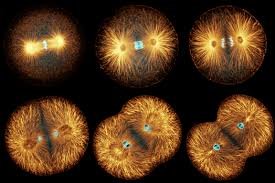
Regulation of the Cell Cycle
Cell Cycle Control System
The cell cycle is regulated by checkpoints, cyclins, and cyclin-dependent kinases (Cdks). - Checkpoints (G1, G2, M) ensure proper progression and integrity of the cell cycle. - Cyclins are proteins whose concentrations fluctuate cyclically. - Cdk (cyclin-dependent kinases) are enzymes that must bind cyclins to be active. - MPF (maturation-promoting factor) is a cyclin-Cdk complex that triggers entry into M phase.
Internal and External Signals
- Internal signals ensure chromosomes are properly attached before anaphase. - External signals include growth factors, such as PDGF, which stimulate cell division.
Loss of Cell Cycle Control and Cancer
Cancer and Cell Cycle Regulation
Cancer results from genetic changes that disrupt normal cell cycle control. - Oncogenes are mutated proto-oncogenes that promote excessive cell division. - Tumor-suppressor genes normally inhibit cell division; mutations can lead to cancer. - Ras proto-oncogene mutations produce hyperactive Ras protein, stimulating cell division. - p53 tumor suppressor gene mutations prevent cell cycle suppression and DNA repair, leading to uncontrolled growth. - Multiple mutations are typically required for cancer development.
Summary Table: Cell Cycle Regulation and Cancer
Component | Normal Function | Cancer Effect |
|---|---|---|
Proto-oncogene | Stimulates cell growth | Mutation leads to oncogene, excessive division |
Tumor-suppressor gene | Inhibits cell division, repairs DNA | Mutation disables inhibition, allows uncontrolled growth |
Checkpoints | Ensure proper cell cycle progression | Loss leads to abnormal division |
Cyclins/Cdks | Regulate cell cycle transitions | Abnormal activity disrupts cycle |
Summary Diagram: Cell Cycle and Cancer Genetics
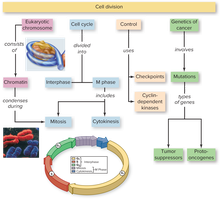
Key Terms and Concepts
- Chromosome: DNA molecule carrying genetic information. - Chromatid: One of two identical halves of a duplicated chromosome. - Chromatin: DNA-protein complex in eukaryotic chromosomes. - Centromere: Region joining sister chromatids. - Mitotic spindle: Structure controlling chromosome movement. - Kinetochore: Protein complex at centromere for spindle attachment. - Binary fission: Prokaryotic cell division. - Oncogene: Mutated gene promoting cancer. - Tumor-suppressor gene: Gene inhibiting cell division. Equation: Cell cycle progression can be modeled as: Example: Mutations in the p53 gene can lead to loss of cell cycle control, resulting in cancer. Additional info: The cell cycle is tightly regulated to prevent errors in DNA replication and division, which can lead to genetic diseases or cancer.
