 Back
The Cell Cycle and Molecular Biology of Cancer: Study Notes
Study Guide - Smart Notes
 Tailored notes based on your materials, expanded with key definitions, examples, and context.
Chapter 12: The Cell Cycle
Big Idea
The cell cycle is fundamental to understanding how organisms grow, reproduce, and maintain their tissues. Cell division is the process by which a single cell gives rise to two genetically identical daughter cells, ensuring continuity of life and accurate transmission of genetic material.
Key Roles of Cell Division
Functions of Cell Division
Asexual reproduction: Single-celled organisms reproduce by dividing, creating new organisms.
Growth and development: Multicellular organisms develop from a single cell through repeated cell divisions.
Tissue renewal and repair: Cell division replaces damaged or dead cells in multicellular organisms.
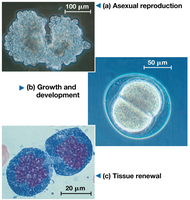
Cellular Organization of Genetic Material
Genome and Chromosomes
Genome: All the DNA in a cell; prokaryotes typically have a single DNA molecule, while eukaryotes have multiple.
Chromosomes: DNA molecules packaged with proteins; each chromosome contains many genes.
Chromatin: The complex of DNA and protein in eukaryotic chromosomes, which condenses during cell division.
Somatic cells: Non-reproductive cells with two sets of chromosomes.
Gametes: Reproductive cells (sperm and eggs) with half the chromosome number of somatic cells.
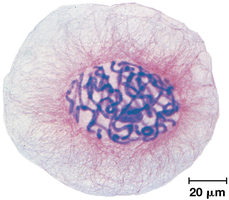
Distribution of Chromosomes During Eukaryotic Cell Division
Chromosome Replication and Separation
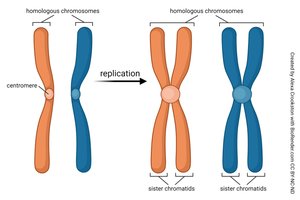
Before cell division, DNA is replicated and chromosomes condense.
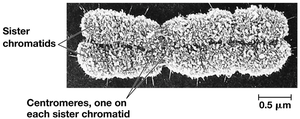
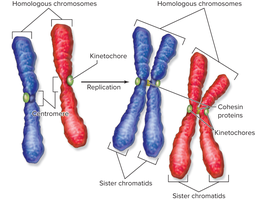
Each duplicated chromosome consists of two sister chromatids joined by cohesins.
The centromere is the region where chromatids are most closely attached.
During cell division, sister chromatids separate and become individual chromosomes.
Phases of the Cell Cycle
Interphase and M Phase
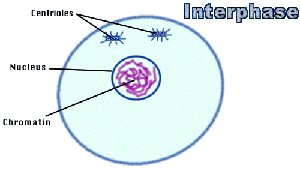
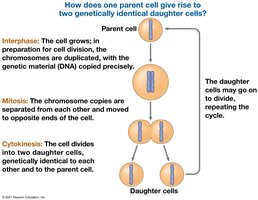
Interphase: Consists of G1 (growth), S (DNA replication), and G2 (preparation for division).
M phase: Includes mitosis (division of genetic material) and cytokinesis (division of cytoplasm).
Sequence of Events in the Cell Cycle
G1 phase: Cell grows and prepares for DNA replication.
S phase: DNA is replicated.
G2 phase: Cell prepares for mitosis; centrioles replicate.
Mitosis: Chromosomes are separated into two nuclei.
Cytokinesis: Cytoplasm divides, forming two daughter cells.
Mitosis: Stages and Key Events
Stages of Mitosis
Prophase: Chromosomes condense, spindle apparatus forms, nuclear envelope breaks down.
Prometaphase: Microtubules attach to kinetochores, chromosomes begin moving to cell center.
Metaphase: Chromosomes align at the metaphase plate.
Anaphase: Centromeres split, sister chromatids are pulled to opposite poles.
Telophase: Spindle disassembles, nuclear envelope reforms, chromosomes uncoil.
Mitotic Spindle and Chromosome Movement
Mitotic Spindle Structure
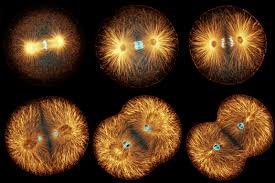
The spindle is made of microtubules and controls chromosome movement.
Centrosomes organize spindle microtubules and replicate during interphase.
Each sister chromatid has a kinetochore for microtubule attachment.
Cytokinesis
Differences in Animals and Plants
Animal cells: Cytokinesis occurs by cleavage, forming a cleavage furrow.
Plant cells: Cytokinesis occurs by formation of a cell plate.
Binary Fission in Bacteria
Prokaryotic Cell Division
Bacteria reproduce by binary fission, where the chromosome replicates and the cell divides.
This process is simpler than eukaryotic mitosis and may have been the evolutionary precursor to mitosis.
Cell Cycle Regulation
Checkpoints and Control System
The cell cycle is regulated by checkpoints (G1, G2, M) that ensure proper division.
Cyclins and Cyclin-dependent kinases (Cdks) are key regulatory proteins.
MPF (Maturation-promoting factor): Cyclin-Cdk complex that triggers entry into M phase.
Internal and external signals influence checkpoint decisions.
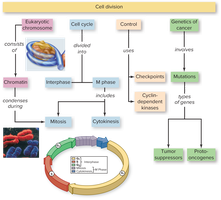
Loss of Cell Cycle Controls in Cancer
Cancer Cell Characteristics
Cancer cells ignore normal cell cycle controls and divide uncontrollably.
They may form tumors, which can be benign (localized) or malignant (invasive and metastatic).
Malignant tumors can spread (metastasize) to other parts of the body.
Molecular Biology of Cancer
Genetic Changes Leading to Cancer
Proto-oncogenes: Normal genes that promote cell growth; mutations convert them to oncogenes (cancer-causing).
Tumor-suppressor genes: Inhibit cell division; mutations reduce their function, contributing to cancer.
Mutations in ras proto-oncogene and p53 tumor-suppressor gene are common in cancers.
Multiple mutations are usually required for cancer development.
Inherited mutations (e.g., BRCA1/BRCA2) can predispose individuals to certain cancers.
Summary Table: Cell Cycle and Cancer Genes
Gene Type | Normal Function | Effect of Mutation |
|---|---|---|
Proto-oncogene | Stimulates cell growth and division | Becomes oncogene, causes excessive cell division |
Tumor-suppressor gene | Inhibits cell division, repairs DNA | Loss of function, uncontrolled cell growth |
ras gene | Cell signaling for growth | Hyperactive Ras protein, increased division |
p53 gene | DNA repair, cell cycle arrest, apoptosis | Loss of suppression, accumulation of mutations |
Key Terms and Definitions
Chromosome: DNA molecule with associated proteins, carrying genetic information.
Chromatid: One of two identical halves of a duplicated chromosome.
Chromatin: DNA-protein complex in eukaryotic cells.
Centromere: Region joining sister chromatids.
Kinetochore: Protein complex at the centromere for spindle attachment.
Mitotic spindle: Structure of microtubules guiding chromosome movement.
Checkpoints: Regulatory points in the cell cycle.
Cyclin/Cdk: Proteins regulating cell cycle progression.
Oncogene: Mutated gene causing cancer.
Tumor-suppressor gene: Gene inhibiting cell division.
Key Equations and Concepts
Chromosome Number Changes
During mitosis, chromosome number remains constant in somatic cells. During meiosis, chromosome number is halved in gametes.
Cell Cycle Regulation Equation
The activity of a Cdk is dependent on cyclin concentration:
Summary of Cell Cycle Phases
Summary of Mitosis Stages
Binary Fission Equation
Cancer Development Model
Additional info: Academic context was added to clarify the stages of mitosis, cell cycle regulation, and the molecular basis of cancer, as well as to provide definitions and equations for exam preparation.
