 Back
The Cell Cycle and Molecular Biology of Cancer: Study Notes for General Biology
Study Guide - Smart Notes
 Tailored notes based on your materials, expanded with key definitions, examples, and context.
Chapter 12: The Cell Cycle
Big Idea and Overview
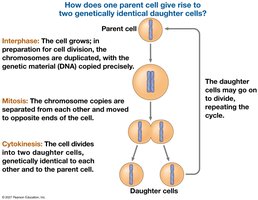
The cell cycle is fundamental to understanding how organisms grow, reproduce, and maintain their tissues. Cell division is the process by which a single cell gives rise to two genetically identical daughter cells, ensuring continuity of life and accurate transmission of genetic material.
Key Roles of Cell Division
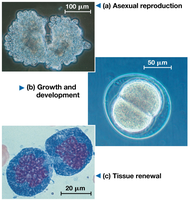
Asexual reproduction: Single-celled organisms reproduce by cell division.
Growth and development: Multicellular organisms develop from a single cell through repeated cell divisions.
Tissue renewal: Cell division repairs and renews tissues in multicellular organisms.
Cellular Organization of Genetic Material
Genome, Chromosomes, and Chromatin
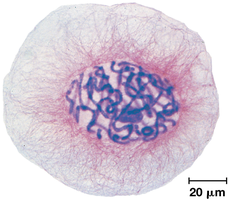
All the DNA in a cell constitutes its genome. In prokaryotes, the genome is usually a single DNA molecule, while in eukaryotes, it consists of multiple DNA molecules packaged into chromosomes. Chromatin is the complex of DNA and protein that condenses to form chromosomes during cell division.
Somatic cells: Nonreproductive cells with two sets of chromosomes.
Gametes: Reproductive cells (sperm and eggs) with half the chromosome number of somatic cells.
Chromosome Structure and Replication
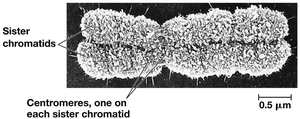
Each duplicated chromosome consists of two sister chromatids joined at a centromere. Chromatids are separated during cell division, becoming individual chromosomes.
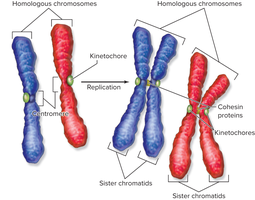
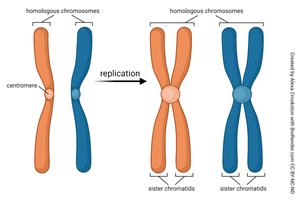
Distribution of Chromosomes During Eukaryotic Cell Division
Process of Cell Division
Mitosis: Division of the genetic material in the nucleus.
Cytokinesis: Division of the cytoplasm, resulting in two daughter cells.
Meiosis: Specialized cell division producing gametes with half the chromosome number.
Phases of the Cell Cycle
Interphase and M Phase
The cell cycle consists of interphase (cell growth and chromosome duplication) and mitotic (M) phase (mitosis and cytokinesis).
G1 phase: Cell growth.
S phase: DNA replication.
G2 phase: Preparation for mitosis; chromosomes condense, centrioles replicate.
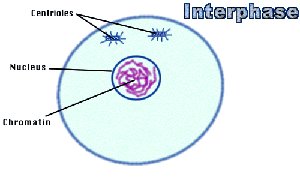
Mitosis: Five Stages
Prophase: Chromosomes condense, spindle apparatus assembles, nuclear envelope breaks down.
Prometaphase: Microtubules attach to kinetochores, chromosomes begin moving to the cell center.
Metaphase: Chromosomes align along the metaphase plate.
Anaphase: Centromeres split, sister chromatids are pulled to opposite poles.
Telophase: Spindle disassembles, nuclear envelope reforms, chromosomes uncoil.
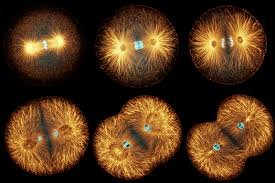
The Mitotic Spindle and Chromosome Movement
Mitotic Spindle Structure
The mitotic spindle is made of microtubules and controls chromosome movement. In animal cells, spindle assembly begins at the centrosome, which replicates and migrates to opposite poles.
Kinetochore and Chromatid Separation
Kinetochore: Protein complex at the centromere where spindle microtubules attach.
Separase: Enzyme that cleaves cohesins, allowing sister chromatids to separate.
Depolymerization: Microtubules shorten as chromatids move toward poles.
Cytokinesis and Binary Fission
Cytokinesis in Animals and Plants
Animal cells: Cytokinesis occurs by cleavage, forming a cleavage furrow.
Plant cells: Cytokinesis occurs by formation of a cell plate.
Binary Fission in Bacteria
Prokaryotes reproduce by binary fission, where the chromosome replicates and the cell divides into two.
Regulation of the Cell Cycle
Cell Cycle Control System and Checkpoints
The cell cycle is regulated by a control system with checkpoints at G1, G2, and M phases. Cyclins and cyclin-dependent kinases (Cdks) are key regulatory proteins. MPF (maturation-promoting factor) triggers passage past the G2 checkpoint.
G1 checkpoint: Determines if the cell will proceed or enter G0 (nondividing state).
G2 checkpoint: Ensures DNA replication is complete and undamaged.
M checkpoint: Ensures all chromatids are properly attached to spindle microtubules.
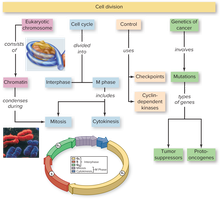
Loss of Cell Cycle Controls and Cancer
Cancer Cell Characteristics
Cancer cells ignore normal cell cycle controls and continue dividing.
They may produce their own growth factors or have abnormal control systems.
Transformation allows cells to divide indefinitely, forming tumors.
Benign tumors: Remain at the original site.
Malignant tumors: Invade tissues and can metastasize.
Molecular Biology of Cancer
Proto-oncogenes, Oncogenes, and Tumor Suppressor Genes
Proto-oncogenes: Genes that stimulate normal cell growth and division.
Oncogenes: Mutated proto-oncogenes that cause excessive cell division.
Tumor-suppressor genes: Inhibit cell division; mutations can lead to cancer.
Key Mutations in Cancer
Ras proto-oncogene: Mutations produce hyperactive Ras protein, stimulating cell division.
p53 tumor suppressor gene: Mutations prevent suppression of the cell cycle, allowing damaged cells to proliferate.
Multistep Model of Cancer Development
Multiple mutations are required for cancer; incidence increases with age.
Inherited mutations (e.g., BRCA1/BRCA2) can predispose individuals to certain cancers.
Summary Table: Cell Cycle and Cancer Genes
Gene Type | Normal Function | Cancer Effect |
|---|---|---|
Proto-oncogene | Stimulates cell growth | Mutation leads to oncogene, causing excessive division |
Tumor-suppressor gene | Inhibits cell division, repairs DNA | Mutation removes inhibition, allowing uncontrolled growth |
Ras gene | Cell signaling for division | Mutation produces hyperactive protein |
p53 gene | Suppresses cell cycle, repairs DNA | Mutation prevents suppression, increases mutation risk |
Conclusion
Understanding the cell cycle and its regulation is essential for grasping how organisms grow, reproduce, and maintain their tissues. Disruptions in cell cycle control can lead to cancer, highlighting the importance of molecular checkpoints and genetic regulation.
