 Back
BackThe Cell Cycle and Transmission of Genetic Information
Study Guide - Smart Notes
 Tailored notes based on your materials, expanded with key definitions, examples, and context.
Cell Division and Genetic Information Transmission
Overview of Genetic Material
The transmission of genetic information to daughter cells is a fundamental process in all living organisms. This process ensures that each new cell receives a complete set of genetic instructions, which is essential for growth, development, and maintenance of life.
DNA Function: DNA stores genetic information necessary for the structure and function of cells.
DNA Replication: The process by which DNA is copied before cell division, ensuring each daughter cell receives identical genetic material.
Cell Division: The process by which a parent cell divides to produce two daughter cells, each inheriting a complete genome.
Key Terms
Genome: All the DNA that makes up an organism; the complete set of genetic instructions.
Chromosome: Long, thread-like structures made of DNA and proteins, carrying genes.
Gene: A segment of DNA that encodes instructions for a specific trait or function.
Biomacromolecules in Chromosomes
DNA: Stores genetic information.
Proteins: Organize and regulate DNA structure and function (e.g., histones).
Chromosome Structure and Replication States
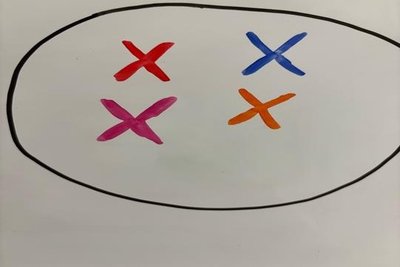
Chromosomes can exist in unreplicated, replicated, or condensed forms, depending on the cell cycle stage.
Each chromosome contains many genes but only one DNA molecule per chromatid.
Example: In eukaryotic cells, chromosomes are linear and found in the nucleus, while in prokaryotic cells, the genome is typically a single circular DNA molecule.
The Cell Cycle
Phases of the Eukaryotic Cell Cycle
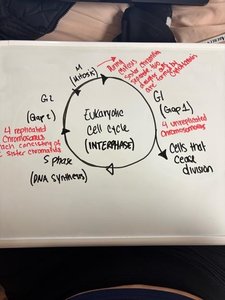
The cell cycle describes the sequence of events in the life of a cell, from its formation to its division into two daughter cells. It is divided into interphase (G1, S, G2) and the mitotic phase (M phase).
G1 (Gap 1): Cell grows and synthesizes new organelles and proteins.
S (Synthesis): DNA is replicated, resulting in duplicated chromosomes.
G2 (Gap 2): Cell checks for DNA replication errors and prepares for division.
Mitosis (M): Chromosomes are separated into two nuclei.
Cytokinesis: The cytoplasm divides, producing two daughter cells.
Importance of DNA Replication Before Division
If DNA replication does not occur before cell division, daughter cells will lack complete genetic information, leading to malfunction or cell death.
Cell Cycle Checkpoints and Human Health
Checkpoints ensure the cell only proceeds to the next phase if conditions are correct.
Failure of checkpoints can lead to uncontrolled cell division, as seen in cancer.
Example: Studying the cell cycle helps us understand diseases like cancer and develop targeted therapies.
Mitosis and Cytokinesis
Stages of Mitosis
Mitosis is the process by which a eukaryotic cell divides its replicated chromosomes into two identical nuclei. It is followed by cytokinesis, which divides the cytoplasm.
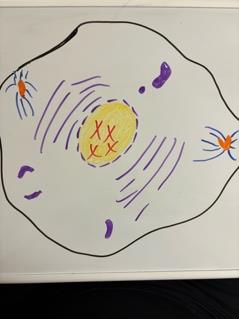
Prophase: Chromosomes condense and become visible; nuclear envelope breaks down; centrosomes move to opposite poles.
Prometaphase/Metaphase: Chromosomes attach to spindle fibers at kinetochores and align at the metaphase plate.
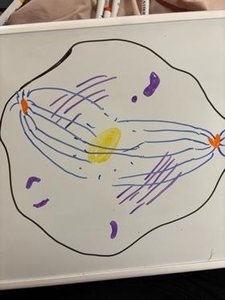
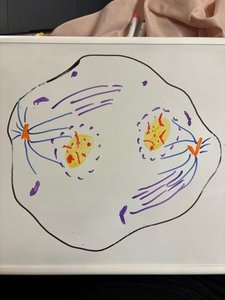
Anaphase: Sister chromatids separate and move toward opposite poles.
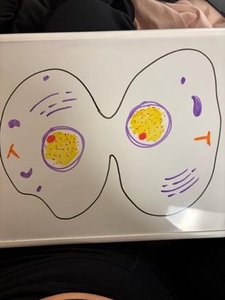
Telophase: Chromosomes arrive at poles, decondense, and are surrounded by new nuclear envelopes.
Cytokinesis: Division of the cytoplasm; in animal cells, a cleavage furrow forms, while in plant cells, a cell plate develops.
Genetic Consistency in Daughter Cells
Each daughter cell receives the same amount of DNA as the original parent cell before replication, ensuring genetic continuity.
Cell Division in Prokaryotes: Binary Fission
Prokaryotic cells, such as bacteria, divide by binary fission, a simpler process than mitosis. DNA is replicated, segregated, and the cell splits without the formation of a mitotic spindle.
Binary Fission: Involves DNA replication, segregation, and division of the cell into two genetically identical cells.
Comparison Table: Mitosis vs. Binary Fission
Feature | Mitosis (Eukaryotes) | Binary Fission (Prokaryotes) |
|---|---|---|
Chromosome Structure | Linear, multiple | Circular, usually one |
Spindle Apparatus | Present | Absent |
Phases | Multiple (prophase, metaphase, etc.) | No distinct phases |
Outcome | Two identical daughter cells | Two identical daughter cells |
Study Tips for Using Models
Focus on key features only; avoid unnecessary details.
Use consistent symbols and labels for clarity.
Remember that symbols (e.g., arrows) may have different meanings in different contexts.
Example: When drawing chromosomes, use clear and consistent shapes to represent different states (unreplicated, replicated, condensed).
