 Back
The Cell Cycle: Mechanisms and Regulation
Study Guide - Smart Notes
 Tailored notes based on your materials, expanded with key definitions, examples, and context.
The Cell Cycle
Introduction to the Cell Cycle
The cell cycle is the series of events that cells go through as they grow and divide. Cell division is essential for growth, development, and repair in multicellular organisms. There are two main types of cell division: meiosis, which produces reproductive cells (gametes), and mitosis, which produces all other cell types (somatic cells).
Meiosis: Generates gametes (sperm and egg cells) with half the chromosome number of the parent cell.
Mitosis: Produces somatic cells, resulting in two genetically identical daughter cells.
Phases of the Cell Cycle
The cell cycle is divided into four main phases, ensuring accurate DNA replication and cell division:
M phase (Mitotic phase): The phase where mitosis and cytokinesis occur.
Interphase: The period between cell divisions, consisting of three subphases:
G1 phase (Gap 1): Cell grows and performs normal functions.
S phase (Synthesis): DNA replication occurs, resulting in duplicated chromosomes.
G2 phase (Gap 2): Cell prepares for mitosis.
Cells of multicellular organisms perform their functional roles during interphase, with DNA replication specifically occurring in the S phase.
M Phase: Mitosis and Cytokinesis
Events in Mitosis
Mitosis is a continuous process divided into five subphases, each with distinct events that ensure equal distribution of chromosomes:
Prophase: Chromosomes condense and become visible; spindle apparatus begins to form.
Prometaphase: Nuclear envelope breaks down; spindle fibers attach to chromosomes.
Metaphase: Chromosomes align at the cell's equatorial plate.
Anaphase: Sister chromatids are pulled apart toward opposite poles.
Telophase: Nuclear envelopes reform around the two sets of chromosomes, which decondense.
After mitosis, cytokinesis divides the cytoplasm, resulting in two daughter cells.
Cytokinesis in Eukaryotes
The mechanism of cytokinesis varies between plant and animal cells:
Plant cells: A cell plate forms in the center of the cell, eventually developing into a new cell wall.
Animal cells: An actin-myosin contractile ring pinches the cell membrane, forming a cleavage furrow that divides the cell.
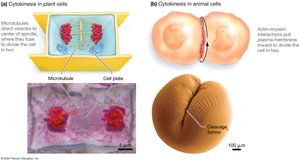
Example: In animal cells, the cleavage furrow is visible as the cell membrane is pinched inward, while in plant cells, vesicles fuse to form the cell plate.
Bacterial Cell Replication
Bacteria divide by a process called binary fission, which is functionally similar to the M phase in eukaryotes but does not involve mitosis. The bacterial chromosome is replicated, and protein filaments help segregate the chromosomes. The cytoplasm is then divided by other proteins, resulting in two genetically identical cells.
Regulation of the Cell Cycle
Cell-Cycle Checkpoints
Cell-cycle checkpoints are critical control points where regulatory molecules determine whether the cell can proceed to the next phase. These checkpoints ensure that each phase is completed accurately before the next begins. If regulatory molecules are defective, checkpoints may fail, leading to uncontrolled cell division.
G1 checkpoint: Checks for cell size, nutrients, growth factors, and DNA damage.
G2 checkpoint: Ensures DNA replication is complete and checks for DNA damage.
M checkpoint (Spindle checkpoint): Ensures all chromosomes are attached to the spindle before anaphase.
Additional checkpoints: May exist depending on cell type and organism.
Example: If DNA damage is detected at the G1 checkpoint, the cell cycle is halted for repair or the cell undergoes apoptosis (programmed cell death).
Cancer: Out-of-Control Cell Division
Cancer is a complex family of diseases characterized by uncontrolled cell division, invasion of nearby tissues, and the ability to spread (metastasize) to other parts of the body. All cancers arise from cells in which cell-cycle checkpoints have failed, allowing abnormal cells to proliferate.
It is estimated that 40% of Americans will develop cancer during their lifetime.
There are over 200 types of cancer, each with unique characteristics.
Key Point: The failure of cell-cycle regulation is a fundamental cause of cancer development.
