 Back
The Cell Cycle: Mechanisms and Regulation of Cell Division
Study Guide - Smart Notes
 Tailored notes based on your materials, expanded with key definitions, examples, and context.
The Cell Cycle and Cell Division
Introduction to the Cell Cycle
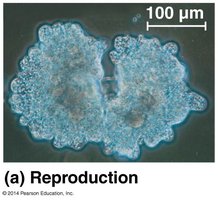
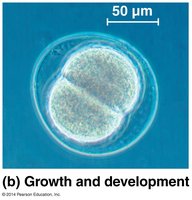
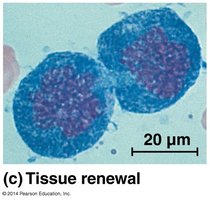
The cell cycle is a fundamental process by which cells grow, replicate their DNA, and divide to produce new cells. This process is essential for reproduction, growth, development, and tissue maintenance in all living organisms.
Cell division ensures the continuity of life from one generation to the next.
In unicellular organisms, cell division is the primary means of reproduction.
In multicellular organisms, it is crucial for growth, development, and tissue renewal.
Overview of the Cell Cycle
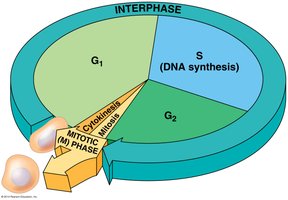
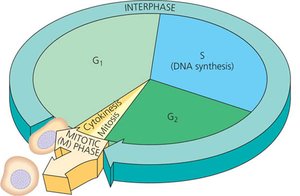
The cell cycle consists of two main phases: Interphase and the Mitotic (M) phase. Interphase is subdivided into G1, S, and G2 phases, while the M phase includes mitosis and cytokinesis.
G1 phase: Cell grows and synthesizes proteins and organelles.
S phase: DNA replication occurs, resulting in duplicated chromosomes.
G2 phase: Cell prepares for mitosis by producing necessary components.
M phase: Includes mitosis (nuclear division) and cytokinesis (cytoplasmic division).
DNA, Chromosomes, and Chromosome Structure
DNA Organization
Genetic information is stored in the form of DNA, which is organized into chromosomes. The structure and number of chromosomes differ between prokaryotes and eukaryotes.
Genome: The complete set of genetic material in a cell.
Chromatin: The diffuse, uncondensed form of DNA found during interphase.
Chromosomes: Condensed structures composed of DNA and proteins, visible during cell division.
Prokaryotes typically have a single, circular chromosome; eukaryotes have multiple, linear chromosomes.
Chromosome Number in Eukaryotes
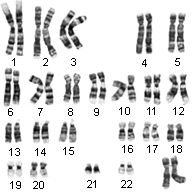
Eukaryotic organisms have species-specific numbers of chromosomes, usually in pairs. For example, humans have 23 pairs (46 total).
Each pair consists of one chromosome from each parent, which is important for genetic diversity.
Mechanisms of Cell Division
Prokaryotic Cell Division: Binary Fission
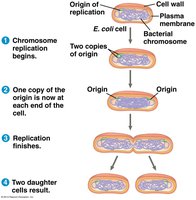
Prokaryotes reproduce by binary fission, a form of asexual reproduction resulting in two genetically identical cells.
DNA replication begins at the origin and proceeds bidirectionally.
Each daughter cell receives one copy of the chromosome.
Eukaryotic Cell Division: Mitosis and Cytokinesis
Eukaryotic cell division involves two main processes:
Mitosis: Division of the nucleus and genetic material.
Cytokinesis: Division of the cytoplasm, resulting in two daughter cells.
Phases of the Cell Cycle
The cell cycle alternates between interphase (G1, S, G2) and the mitotic phase (mitosis and cytokinesis).
Interphase
During interphase, the cell grows, replicates its DNA, and prepares for division. It is divided into three subphases:
G1: Cell growth and preparation for DNA synthesis.
S: DNA replication, resulting in sister chromatids.
G2: Preparation for mitosis, including synthesis of proteins and organelles.
Mitosis: Stages and Key Events
Overview of Mitosis
Mitosis is conventionally divided into five phases: prophase, prometaphase, metaphase, anaphase, and telophase. Cytokinesis usually overlaps with telophase.
Prophase: Chromatin condenses into visible chromosomes; mitotic spindle begins to form.
Prometaphase: Nuclear envelope fragments; spindle microtubules attach to kinetochores.
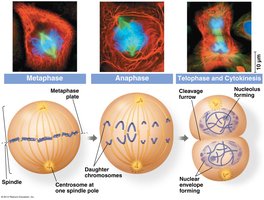
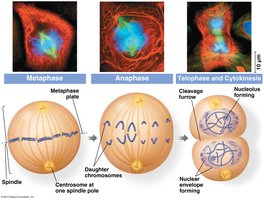
Metaphase: Chromosomes align at the metaphase plate.
Anaphase: Sister chromatids separate and move toward opposite poles.
Telophase: Nuclear envelopes reform; chromosomes decondense.
Cytokinesis: Division of the cytoplasm, forming two daughter cells.
Detailed Stages of Mitosis
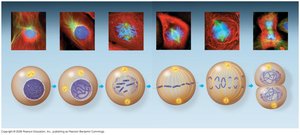
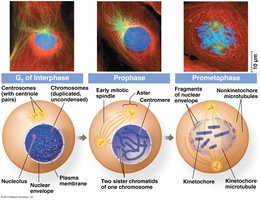
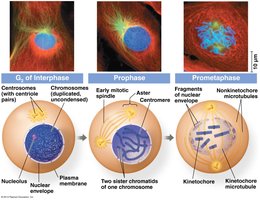
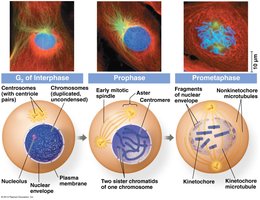
G2 of Interphase: Chromosomes are duplicated but not yet condensed; centrosomes are present.
Prophase: Chromosomes condense; spindle apparatus forms; nucleoli disappear.
Prometaphase: Nuclear envelope breaks down; microtubules attach to kinetochores.
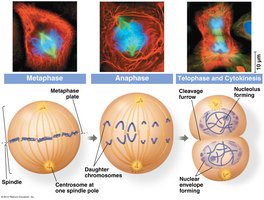
Metaphase: Chromosomes align at the metaphase plate; spindle is fully formed.
Anaphase: Sister chromatids separate and move to opposite poles; cell elongates.
Telophase and Cytokinesis: Nuclear envelopes reform; chromosomes decondense; cytoplasm divides.
Mechanisms of Chromosome Movement
Mitotic Spindle and Chromosome Movement
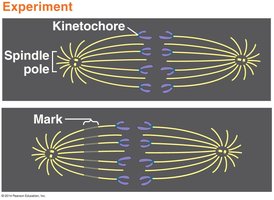
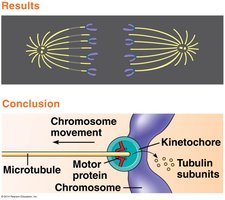
The mitotic spindle, composed of microtubules, is responsible for moving chromosomes during mitosis. Microtubules attach to kinetochores at the centromere region of each chromosome.
During anaphase, kinetochore microtubules shorten, pulling sister chromatids apart.
Motor proteins at the kinetochore help depolymerize microtubules, facilitating movement.
Cytokinesis: Animal vs. Plant Cells
Cytokinesis in Animal Cells
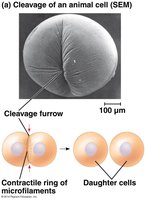
In animal cells, cytokinesis occurs via cleavage, forming a cleavage furrow that pinches the cell into two.
A contractile ring of actin microfilaments contracts, dividing the cell.
Cytokinesis in Plant Cells
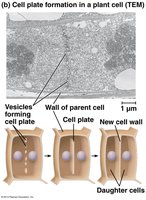
In plant cells, cytokinesis involves the formation of a cell plate from vesicles derived from the Golgi apparatus. The cell plate grows until it fuses with the cell membrane, forming a new cell wall between the daughter cells.
Regulation of the Cell Cycle
Cell Cycle Control System
The cell cycle is regulated by a control system with checkpoints at critical stages (G1, G2, and M phases). These checkpoints ensure that key processes are completed before the cell proceeds to the next phase.
Cyclins and cyclin-dependent kinases (Cdks) are key regulatory proteins.
MPF (Maturation Promoting Factor) is a cyclin-Cdk complex that triggers entry into mitosis.
Checkpoints prevent errors and uncontrolled cell division.
External and Internal Signals
External signals: Growth factors such as PDGF stimulate cell division.
Internal signals: Protein complexes like the anaphase-promoting complex (APC) ensure proper chromosome attachment before separation.
Density-dependent inhibition and anchorage dependence regulate cell division in multicellular organisms.
Cancer: Loss of Cell Cycle Control
Characteristics of Cancer Cells
Cancer results from the loss of normal cell cycle regulation, leading to uncontrolled cell growth and division.
Cancer cells do not exhibit density-dependent inhibition or anchorage dependence.
They may ignore stop signals, produce their own growth factors, or evade apoptosis (programmed cell death).
Transformation converts normal cells into cancerous cells, which can form tumors.
Benign tumors remain localized, while malignant tumors invade tissues and can metastasize.
Cancer Therapy
Cancer treatments target rapidly dividing cells and may include surgery, radiation, and chemotherapy. These therapies can also affect normal dividing cells, leading to side effects.
Summary Table: Key Differences in Cell Division
Feature | Prokaryotes (Binary Fission) | Eukaryotes (Mitosis) |
|---|---|---|
Chromosome Structure | Single, circular | Multiple, linear |
Division Process | Binary fission | Mitosis + Cytokinesis |
Genetic Outcome | Identical daughter cells | Identical daughter cells |
Regulation | Less complex | Highly regulated (checkpoints, cyclins, Cdks) |
