 Back
BackThe Cell Cycle: Mechanisms and Regulation
Study Guide - Smart Notes
 Tailored notes based on your materials, expanded with key definitions, examples, and context.
The Cell Cycle
Introduction to the Cell Cycle
The cell cycle is the series of events that cells go through as they grow and divide. It is fundamental to the continuity of life, allowing organisms to grow, repair tissues, and reproduce. Cell division occurs through two main processes: mitosis and meiosis.
Mitosis produces somatic cells (all body cells except gametes).
Meiosis produces gametes (reproductive cells such as sperm and eggs).
Phases of the Cell Cycle
The cell cycle is divided into four main phases, ensuring accurate duplication and division of genetic material:
M phase (Mitotic phase): The phase where the cell divides its nucleus (mitosis) and cytoplasm (cytokinesis).
Interphase: The period between cell divisions, consisting of three subphases:
G1 phase (Gap 1): Cell grows and performs normal functions.
S phase (Synthesis): DNA replication occurs, doubling the genetic material.
G2 phase (Gap 2): Cell prepares for mitosis by producing necessary proteins and organelles.
Cells of multicellular organisms perform their specialized functions during interphase.
M Phase: Mitosis and Cytokinesis
Events in Mitosis
Mitosis is a continuous process divided into five subphases, ensuring equal distribution of chromosomes to daughter cells:
Prophase: Chromosomes condense and become visible; spindle apparatus begins to form.
Prometaphase: Nuclear envelope breaks down; spindle fibers attach to chromosomes.
Metaphase: Chromosomes align at the cell's equatorial plate.
Anaphase: Sister chromatids are pulled apart toward opposite poles.
Telophase: Nuclear envelopes reform around the two sets of chromosomes, which decondense.
Cytokinesis
Cytokinesis is the division of the cytoplasm, resulting in two separate daughter cells. The mechanism of cytokinesis varies among eukaryotes:
Animal cells: Actin-myosin interactions pinch the membrane to form a cleavage furrow.
Plant cells: Microtubules direct vesicles to the center of the spindle, where they fuse to form the cell plate.
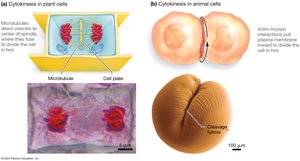
Example: In animal cells, the cleavage furrow deepens until the cell is pinched in two; in plant cells, the cell plate develops into a new cell wall separating the daughter cells.
Bacterial Cell Replication
Binary Fission
Bacteria replicate by a process called binary fission, which is functionally similar to the M phase in eukaryotes but simpler in mechanism:
Bacterial chromosomes are replicated.
Protein filaments attach to the replicated chromosomes and pull them apart.
Other proteins divide the cytoplasm, resulting in two genetically identical cells.
Additional info: Unlike eukaryotic mitosis, binary fission does not involve a mitotic spindle or nuclear envelope breakdown.
Regulation of the Cell Cycle
Cell-Cycle Checkpoints
The cell cycle is tightly regulated by cell-cycle checkpoints—critical control points where the cell assesses whether to proceed with division:
Regulatory molecules at each checkpoint determine if the cell is ready to advance to the next phase.
If these molecules are defective, checkpoints may fail, leading to uncontrolled cell division.
There are four main checkpoints in the cell cycle.
Example: The G1 checkpoint ensures the cell is large enough and has undamaged DNA before DNA replication.
Cancer: Out-of-Control Cell Division
Characteristics of Cancer
Cancer is a complex family of diseases characterized by uncontrolled cell division, invasion of nearby tissues, and the ability to spread (metastasize) to other parts of the body. All cancers arise from cells in which cell-cycle checkpoints have failed.
It is estimated that 40% of Americans will develop cancer.
There are over 200 types of cancer, each with unique characteristics.
Key Point: The failure of cell-cycle regulation is a fundamental cause of cancer development.
