 Back
BackThe Cell Cycle: Mechanisms and Regulation
Study Guide - Smart Notes
 Tailored notes based on your materials, expanded with key definitions, examples, and context.
The Cell Cycle
Introduction to Cell Division
The ability of organisms to reproduce their own kind is a defining feature of life. Cell division is the process by which cells reproduce, ensuring the continuity of life. In unicellular organisms, cell division produces new individuals, while in multicellular organisms, it is essential for development, growth, and tissue repair.
Cell division is the process by which a parent cell divides into two or more daughter cells.
Most cell division results in genetically identical daughter cells, except for meiosis, which produces gametes (sperm and eggs) with half the genetic material.
Key Roles of Cell Division
Development from a fertilized cell
Growth of an organism
Repair of damaged tissues
Cellular Organization of Genetic Material
Genome, Chromosomes, and Chromatin
All the DNA in a cell constitutes its genome. In prokaryotes, the genome is typically a single DNA molecule, while in eukaryotes, it consists of multiple DNA molecules packaged into chromosomes.
Chromosomes are structures that carry genetic information.
Chromatin is the complex of DNA and proteins (mainly histones) that condenses to form chromosomes during cell division.
Nucleosomes are the basic units of DNA packaging, where DNA is wrapped around histone proteins.
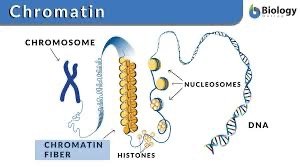
Additional info: DNA packaging not only compacts the genome but also regulates gene expression and protects DNA from damage.
Chromatin vs. Chromosomes
During most of the cell cycle, DNA exists as chromatin. Before cell division, chromatin condenses to form visible chromosomes.
DNA wraps around histones → forms nucleosomes → coils into chromatin → condenses into chromosomes.
Chromosome Number and Cell Types
Each eukaryotic species has a characteristic number of chromosomes. Somatic cells (non-reproductive) have two sets of chromosomes, while gametes (reproductive cells) have one set.
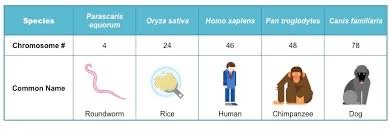
Distribution of Chromosomes During Eukaryotic Cell Division
Chromosome Duplication and Structure
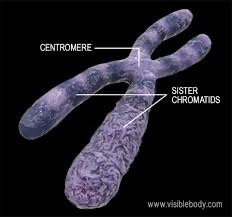
Before cell division, DNA is replicated, and chromosomes condense. Each duplicated chromosome consists of two sister chromatids joined at a region called the centromere.
Sister chromatids: Identical copies of a chromosome, joined by cohesin proteins.
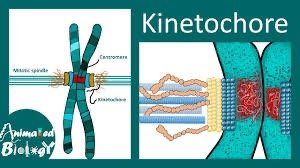
Centromere: The region where sister chromatids are most closely attached.
The Cell Cycle: Phases and Regulation
Phases of the Cell Cycle
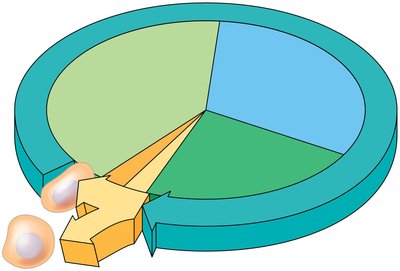
The cell cycle consists of interphase (G1, S, G2) and the mitotic (M) phase. Interphase accounts for about 90% of the cycle and includes cell growth and DNA replication.
G1 phase: Cell growth before DNA replication.
S phase: DNA synthesis and chromosome duplication.
G2 phase: Preparation for cell division.
M phase: Mitosis and cytokinesis.
Mitosis: Stages and Key Events
Mitosis is the division of the nucleus, followed by cytokinesis (division of the cytoplasm). It ensures that each daughter cell receives an identical set of chromosomes.
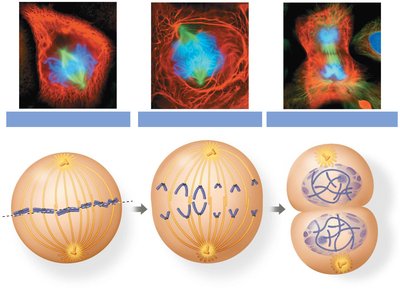
Prophase: Chromatin condenses into chromosomes, spindle forms, nuclear envelope breaks down.
Prometaphase: Nuclear envelope disappears, spindle fibers attach to kinetochores.
Metaphase: Chromosomes align at the metaphase plate, spindle checkpoint ensures proper attachment.
Anaphase: Sister chromatids separate and move to opposite poles.
Telophase: Chromosomes decondense, nuclear envelope reforms, cytokinesis begins.
The Mitotic Spindle and Chromosome Movement
The mitotic spindle is a structure made of microtubules that orchestrates chromosome movement during mitosis. It consists of three types of fibers:
Kinetochore microtubules: Attach to chromosomes at kinetochores and pull chromatids apart.
Non-kinetochore microtubules: Overlap and push against each other to elongate the cell.
Astral microtubules: Anchor the spindle to the cell membrane.
Cytokinesis
Cytokinesis divides the cytoplasm, producing two daughter cells. In animal cells, this occurs by cleavage (formation of a cleavage furrow), while in plant cells, a cell plate forms.
Regulation of the Cell Cycle
Cell Cycle Control System
The cell cycle is regulated by a control system with checkpoints (G1, G2, M) that ensure proper progression. Internal and external signals determine whether the cell proceeds through the cycle.
Cyclins: Proteins whose levels fluctuate during the cell cycle; they activate Cdks.
Cyclin-dependent kinases (Cdks): Enzymes that phosphorylate target proteins to drive the cell cycle.
MPF (Maturation-Promoting Factor): A cyclin-Cdk complex that triggers entry into mitosis.
Checkpoints:
G1 checkpoint: Checks cell size, nutrients, DNA damage; decision to divide or enter G0 (non-dividing state).
G2 checkpoint: Ensures DNA replication is complete and checks for DNA damage.
M checkpoint: Ensures all chromosomes are properly attached to the spindle before anaphase.
External Regulation and Cancer
External factors such as growth factors, density-dependent inhibition, and anchorage dependence influence cell division. Cancer cells lose these regulatory mechanisms, leading to uncontrolled growth and tumor formation.
Transformation: The process by which a normal cell becomes cancerous.
Benign tumor: Abnormal cells remain at the original site.
Malignant tumor: Cells invade surrounding tissues and can metastasize to other parts of the body.
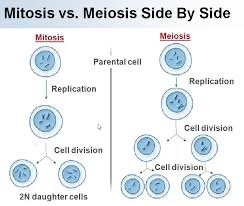
Summary Table: Key Differences Between Mitosis and Meiosis
Feature | Mitosis | Meiosis |
|---|---|---|
Number of divisions | 1 | 2 |
Daughter cells | 2 (identical) | 4 (genetically unique) |
Chromosome number | Diploid (2N) | Haploid (N) |
Function | Growth, repair, asexual reproduction | Sexual reproduction (gametes) |
Key Terms and Concepts
Genome: The complete set of genetic material in an organism.
Chromosome: A DNA molecule with associated proteins, carrying genetic information.
Chromatin: The complex of DNA and proteins in the nucleus.
Sister chromatids: Two identical copies of a chromosome, joined at the centromere.
Centromere: The region where sister chromatids are joined.
Mitotic spindle: Structure that separates chromosomes during mitosis.
Kinetochore: Protein structure on chromatids where spindle fibers attach.
Cytokinesis: Division of the cytoplasm.
Checkpoints: Control points in the cell cycle where stop and go-ahead signals regulate progression.
Cyclins and Cdks: Proteins and enzymes that regulate the cell cycle.
MPF: Cyclin-Cdk complex that triggers mitosis.
Transformation: Conversion of a normal cell to a cancer cell.
Metastasis: Spread of cancer cells to other parts of the body.
