 Back
BackThe Cell Cycle: Mechanisms and Regulation
Study Guide - Smart Notes
 Tailored notes based on your materials, expanded with key definitions, examples, and context.
The Cell Cycle
Introduction to the Cell Cycle
The cell cycle is the series of events that cells go through as they grow and divide. It is fundamental to the continuity of life, enabling organisms to reproduce, grow, and repair tissues. The cell cycle ensures that genetic material is accurately duplicated and distributed to daughter cells.
Cell division distinguishes living organisms from nonliving matter.
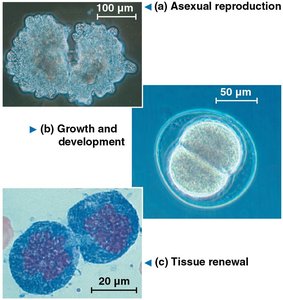
It is essential for reproduction, growth, development, and tissue renewal.
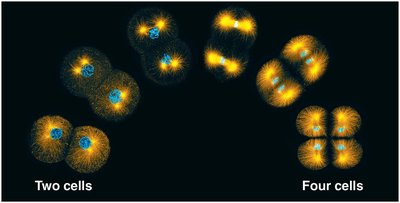
Key Roles of Cell Division
Single-celled organisms reproduce by cell division.
Multicellular eukaryotes use cell division for embryonic development, growth, and tissue repair.
Cell division is highly accurate in passing DNA from one generation to the next.
Cellular Organization of Genetic Material
Chromosomes and Chromatin
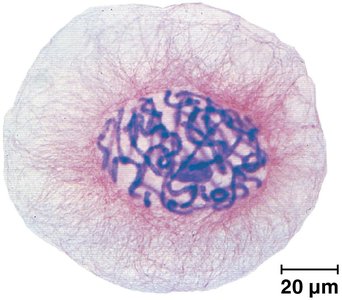
All the DNA in a cell constitutes its genome. In eukaryotes, DNA is organized into multiple linear chromosomes, each consisting of chromatin—a complex of DNA and protein.
Somatic cells have two sets of chromosomes.
Gametes (sperm and eggs) have one set of chromosomes.
Chromosome Duplication and Distribution
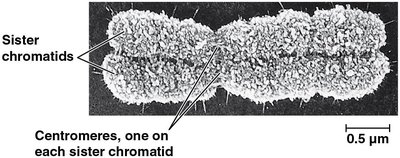
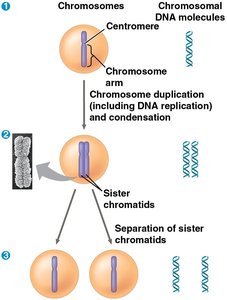
Before cell division, chromosomes are duplicated, resulting in two sister chromatids joined at a region called the centromere. During division, sister chromatids separate, ensuring each daughter cell receives an identical set of chromosomes.
Phases of the Cell Cycle
Overview of the Cell Cycle
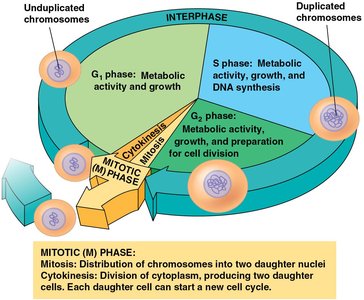
The cell cycle consists of two main phases: Mitotic (M) phase and Interphase. Interphase is subdivided into G1, S, and G2 phases.
G1 phase: Cell growth and normal metabolic roles.
S phase: DNA replication (chromosome duplication).
G2 phase: Preparation for mitosis.
M phase: Mitosis (nuclear division) and cytokinesis (cytoplasmic division).
Mitosis: The Division of the Nucleus
Stages of Mitosis
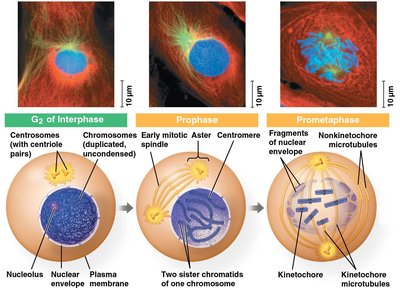
Mitosis is conventionally divided into five stages:
Prophase
Prometaphase
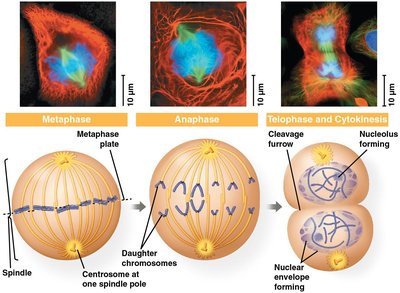
Metaphase
Anaphase
Telophase
The Mitotic Spindle
The mitotic spindle is a structure made of microtubules that orchestrates the movement of chromosomes during mitosis. It forms from centrosomes, which replicate and move to opposite poles of the cell.
Each sister chromatid has a kinetochore, a protein complex at the centromere.
Spindle microtubules attach to kinetochores and move chromosomes.
At metaphase, chromosomes align at the metaphase plate.
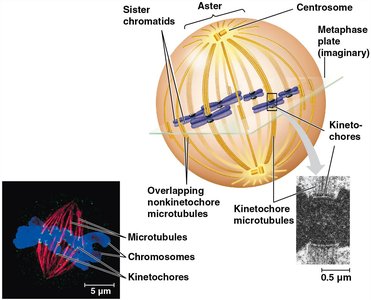
Mechanisms of Chromosome Movement
During anaphase, separase cleaves cohesins, allowing sister chromatids to separate. Chromosomes move toward spindle poles by motor proteins and microtubule depolymerization (the "Pac-man" mechanism).
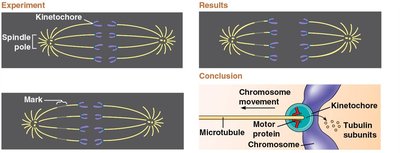
Cytokinesis
Cytokinesis is the division of the cytoplasm, which follows mitosis. In animal cells, it occurs by cleavage, forming a cleavage furrow. In plant cells, a cell plate forms, eventually becoming the new cell wall.
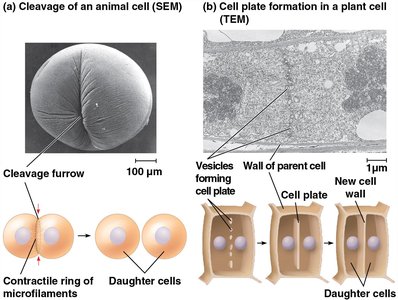
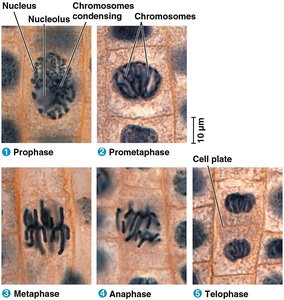
Cell Division in Prokaryotes: Binary Fission
Binary Fission
Prokaryotes (bacteria and archaea) divide by binary fission. The chromosome replicates, and the cell splits into two genetically identical daughter cells.
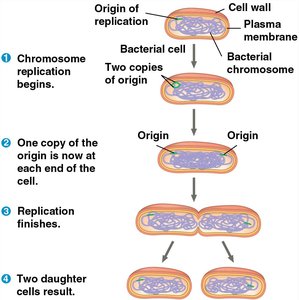
Evolution of Mitosis
Mitosis likely evolved from binary fission. Some unicellular eukaryotes show intermediate forms of cell division.
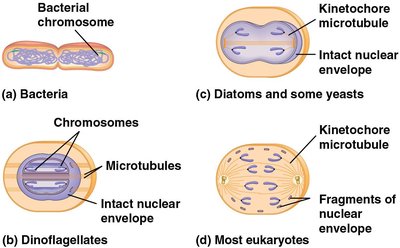
Regulation of the Cell Cycle
Cell Cycle Control System
The cell cycle is regulated by a molecular control system with checkpoints at G1, G2, and M phases. Progression through the cycle depends on internal and external signals.
Cyclins and cyclin-dependent kinases (Cdks) are key regulatory proteins.
MPF (maturation-promoting factor) is a cyclin-Cdk complex that triggers passage into M phase.
Checkpoint | Main Function |
|---|---|
G1 | Checks for cell size, nutrients, growth factors, DNA damage |
G2 | Checks for DNA replication completion, DNA damage |
M | Checks for chromosome attachment to spindle |
Additional info: The G1 checkpoint is often called the "restriction point" in animal cells.
Internal and External Signals
Cells will not begin anaphase until all chromosomes are properly attached to the spindle.
Growth factors stimulate cell division; e.g., PDGF (platelet-derived growth factor).
Density-dependent inhibition and anchorage dependence regulate normal cell growth.
Loss of Cell Cycle Control in Cancer
Cancer cells do not respond to normal cell cycle controls. They may divide uncontrollably, form tumors, and invade other tissues (metastasis). Treatments include radiation and chemotherapy, which target dividing cells.
Benign tumors remain at the original site.
Malignant tumors invade tissues and can spread (metastasize).
Additional info: Cancer research is increasingly focused on personalized medicine, targeting specific cell-signaling pathways in tumors.
