 Back
The Cell Cycle: Mechanisms and Regulation
Study Guide - Smart Notes
 Tailored notes based on your materials, expanded with key definitions, examples, and context.
The Cell Cycle
Introduction to the Cell Cycle
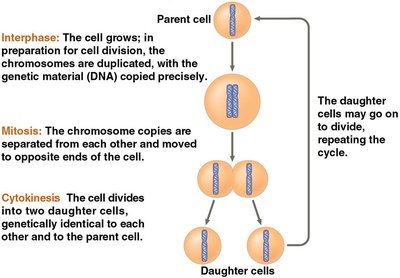
The cell cycle is the series of events that cells go through as they grow and divide. It is fundamental to the continuity of life, enabling organisms to grow, develop, repair tissues, and reproduce. The cycle consists of interphase (cell growth and DNA replication) and the mitotic (M) phase (mitosis and cytokinesis).
Cell division is the process by which a parent cell divides into two genetically identical daughter cells.
Genome refers to all the DNA in a cell.
Chromosomes are structures that package DNA molecules.
Chromatin is the complex of DNA and proteins that condenses to form chromosomes during cell division.
Functions and Types of Cell Division
Biological Roles of Cell Division
Cell division serves several essential functions in living organisms:
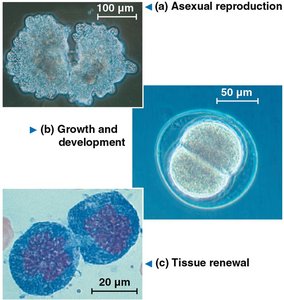
Asexual reproduction: Produces offspring genetically identical to the parent.
Growth and development: Increases the number of cells in multicellular organisms.
Tissue renewal: Replaces dead or damaged cells.
Organization of Genetic Material
Chromosomes and Chromatin
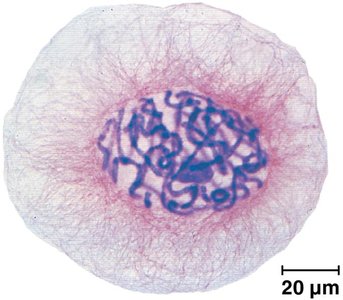
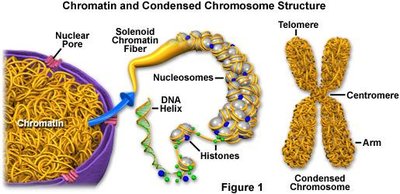
Genetic material in eukaryotic cells is organized into chromosomes, which are composed of chromatin. Chromatin consists of DNA wrapped around histone proteins, forming nucleosomes and further condensing into chromosomes during cell division.
Each species has a characteristic number of chromosomes.
Somatic cells have two sets of chromosomes (diploid), while gametes (sperm and eggs) have one set (haploid).
Chromosome Duplication and Distribution
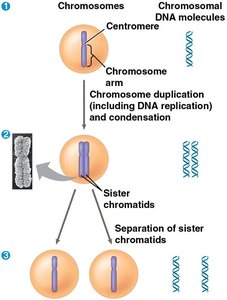
Before a cell divides, its DNA is replicated, resulting in duplicated chromosomes composed of two sister chromatids joined at a region called the centromere. During cell division, sister chromatids separate and are distributed to two daughter cells.
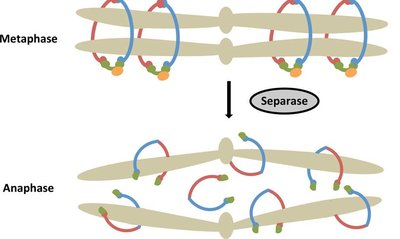
Cohesins are protein complexes that hold sister chromatids together.
Once separated, chromatids are considered individual chromosomes.
Phases of the Cell Cycle
Overview of the Cell Cycle
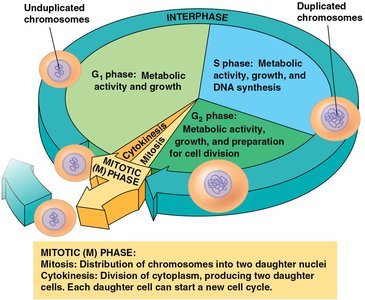
The cell cycle is divided into interphase and the mitotic (M) phase:
Interphase (about 90% of the cycle): Includes G1 (first gap), S (synthesis), and G2 (second gap) phases.
M phase: Includes mitosis (nuclear division) and cytokinesis (cytoplasmic division).
Interphase
During interphase, the cell grows and prepares for division:
G1 phase: Cell growth and normal metabolic roles.
S phase: DNA replication occurs; chromosomes are duplicated.
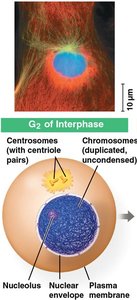
G2 phase: Further growth and preparation for mitosis.
Mitosis: Stages and Mechanisms
Stages of Mitosis
Mitosis is conventionally divided into five stages:
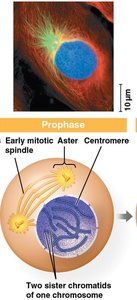
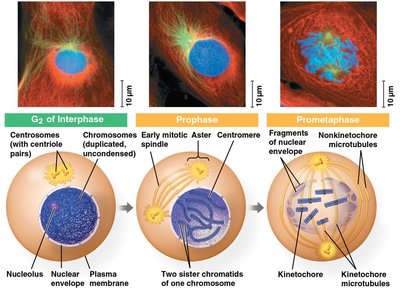
Prophase: Chromosomes condense, spindle apparatus begins to form.
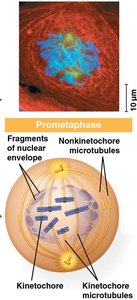
Prometaphase: Nuclear envelope fragments, spindle fibers attach to kinetochores.
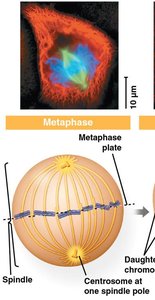
Metaphase: Chromosomes align at the metaphase plate.
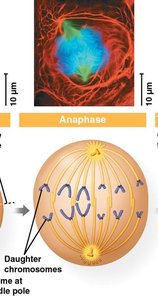
Anaphase: Sister chromatids separate and move toward opposite poles.
Telophase: Nuclear envelopes reform, chromosomes decondense.
The Mitotic Spindle and Chromosome Movement
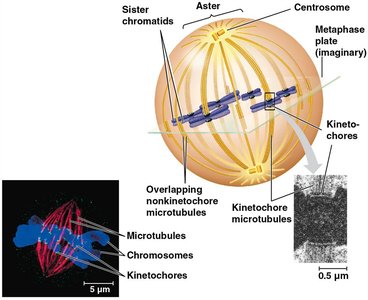
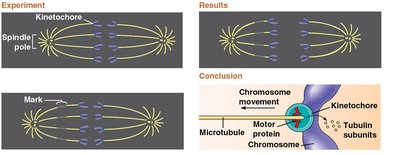
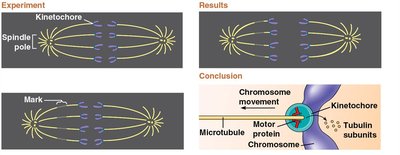
The mitotic spindle is a structure made of microtubules that orchestrates chromosome movement during mitosis. The spindle originates from centrosomes, which replicate and move to opposite poles of the cell. Each sister chromatid has a kinetochore, a protein complex at the centromere, where spindle fibers attach.
During metaphase, chromosomes align at the metaphase plate.
During anaphase, separase cleaves cohesins, allowing sister chromatids to separate.
Motor proteins and microtubule depolymerization drive chromatid movement (the "Pac-man" mechanism).
Telophase and Cytokinesis
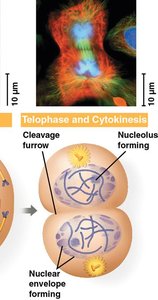
In telophase, nuclear envelopes reform around the separated chromosomes, and the chromosomes begin to decondense. Cytokinesis is the division of the cytoplasm, resulting in two separate daughter cells.
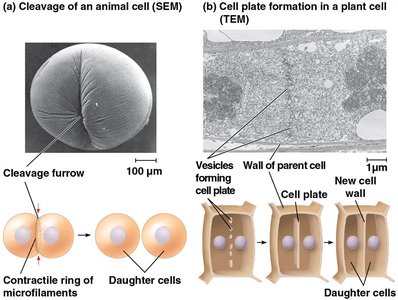
In animal cells, cytokinesis occurs via a cleavage furrow formed by a contractile ring of microfilaments.
In plant cells, a cell plate forms, eventually developing into a new cell wall.
Binary Fission in Prokaryotes
Mechanism of Binary Fission
Prokaryotes (bacteria and archaea) reproduce by binary fission, a simpler process than mitosis. The single, circular chromosome replicates, and the two copies move apart as the cell elongates. The plasma membrane then pinches inward, dividing the cell into two genetically identical daughter cells.
Regulation of the Cell Cycle
Cell Cycle Control System
The cell cycle is regulated by a molecular control system involving internal and external signals. Checkpoints at G1, G2, and M phases ensure proper progression. If a cell does not receive the appropriate signals, it may enter a nondividing state called G0 (quiescence).
Cyclins and cyclin-dependent kinases (CDKs) are key regulatory proteins.
MPF (Maturation-Promoting Factor) is a cyclin-CDK complex that triggers the G2-to-M transition.
External factors such as growth factors, density-dependent inhibition, and anchorage dependence also regulate cell division.
Loss of Cell Cycle Control and Cancer
Cancer cells evade normal cell cycle controls, dividing uncontrollably. Tumors can be benign (non-invasive) or malignant (invasive and capable of metastasis, spreading to other tissues).
Summary Table: Key Terms and Concepts
Term | Definition |
|---|---|
Genome | All the DNA in a cell |
Chromosome | DNA molecule packaged with proteins |
Chromatin | Complex of DNA and proteins forming chromosomes |
Sister Chromatids | Identical copies of a chromosome joined at the centromere |
Centromere | Region where sister chromatids are most closely attached |
Cytokinesis | Division of the cytoplasm |
Binary Fission | Prokaryotic cell division |
MPF | Cyclin-CDK complex triggering mitosis |
Benign Tumor | Non-invasive mass of abnormal cells |
Malignant Tumor | Invasive, cancerous mass capable of metastasis |
