 Back
The Cell Cycle: Mechanisms and Regulation
Study Guide - Smart Notes
 Tailored notes based on your materials, expanded with key definitions, examples, and context.
Chapter 12: The Cell Cycle
Introduction to the Cell Cycle
The cell cycle is the series of events that cells go through as they grow and divide. Cell division is fundamental for growth, development, and reproduction in all living organisms. There are two main types of cell division: mitosis (which produces somatic cells) and meiosis (which produces gametes or reproductive cells). Both processes are usually accompanied by cytokinesis, the division of the cytoplasm.
Mitosis: Produces genetically identical daughter cells to the parent cell and to each other.
Meiosis: Produces daughter cells with half the hereditary material of the parent cell, genetically distinct from each other.
Cytokinesis: Division of the cytoplasm, resulting in two separate cells.
12.1 How Do Cells Replicate?
Cellular replication is essential for life. The basic steps in cellular replication are:
Copying DNA
Separating the copies
Dividing the cytoplasm to create two complete cells
What Is a Chromosome?
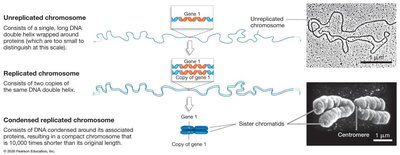
A chromosome is a single, long double helix of DNA wrapped around proteins called histones. Chromosomes carry genetic information in the form of genes. A gene is a region of DNA that codes for a specific RNA and, consequently, a specific protein.
Before mitosis, each chromosome is replicated, forming two identical DNA molecules called chromatids.
Chromatids are attached along their length by proteins called cohesions and at a region called the centromere.
Two attached chromatids are called sister chromatids and are considered a single chromosome until they separate during mitosis.
Cells Alternate between M Phase and Interphase
Eukaryotic cells alternate between a dividing phase (M phase) and a non-dividing phase (interphase). During interphase, chromosomes are uncoiled, and cells are either growing, preparing to divide, or fulfilling specialized functions. Most of the cell's life is spent in interphase.
The Discovery of S Phase and Gap Phases
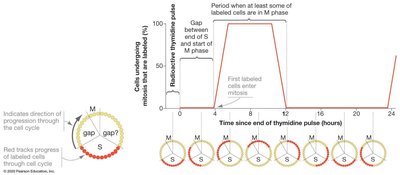
Chromosome replication occurs only during interphase, specifically in the S (synthesis) phase. The cell cycle consists of an orderly sequence of events from cell formation, through chromosome duplication, to cell division. Two gap phases (G1 and G2) exist where no DNA synthesis occurs, allowing the cell to grow and prepare for division.
The Cell Cycle Phases
The cell cycle is divided into four main phases:
M phase (mitosis and cytokinesis)
G1 phase (first gap)
S phase (DNA synthesis)
G2 phase (second gap)

12.2 What Happens during M Phase?
M phase consists of two main events:
Mitosis: Division of replicated chromosomes to form two daughter nuclei with identical genetic information.
Cytokinesis: Division of the cytoplasm to form two daughter cells.

Events in Mitosis
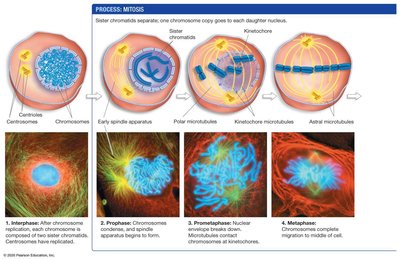
Mitosis is a continuous process divided into five subphases:
Prophase: Chromosomes condense and spindle apparatus forms.
Prometaphase: Nuclear envelope breaks down; microtubules attach to chromosomes at kinetochores.
Metaphase: Chromosomes align at the metaphase plate; spindle formation is complete.
Anaphase: Sister chromatids separate and are pulled to opposite poles.
Telophase: New nuclear envelopes form; chromosomes decondense.

Structures Involved in Mitosis
Structure | Definition |
|---|---|
Chromosome | A structure containing genetic information in the form of genes |
Chromatin | The material that makes up eukaryotic chromosomes; consists of a DNA molecule complexed with histone proteins |
Sister chromatids | The two attached, double-stranded DNA copies of a replicated chromosome |
Centromeres | Specialized regions where sister chromatids are most closely joined and the kinetochore assembles |
Kinetochores | Structures on sister chromatids where microtubules attach |
Centrosome | The microtubule-organizing center in animals and certain plants and fungi |
Microtubules | Cytoskeletal filaments that form the spindle apparatus |
Microtubule motor proteins | Dynein and kinesin motors that move chromosomes and spindle poles |
How Do Chromosomes Move during Anaphase?
During anaphase, kinetochore microtubules shorten as tubulin subunits are lost from their plus ends. Proteins from the kinetochore attach to a ring that moves along the microtubule as it disassembles, pulling the chromosome toward the spindle pole.
Cytokinesis
Cytokinesis divides the cytoplasm, resulting in two daughter cells. The mechanism differs between plants and animals:
Plants: Vesicles from the Golgi apparatus form a cell plate that develops into new cell walls.
Animals: A ring of actin and myosin filaments contracts, forming a cleavage furrow that pinches the cell in two.
Bacterial Cell Replication
Bacteria divide by binary fission, a process similar to eukaryotic M phase but without mitosis. The bacterial chromosome is replicated, and protein filaments pull the chromosomes apart before the cytoplasm divides.
12.3 Control of the Cell Cycle
The length of the cell cycle can vary among cell types, mainly due to differences in the duration of gap phases. The cell cycle is regulated by proteins such as cyclins and cyclin-dependent kinases (Cdks). The M phase-promoting factor (MPF) is a key regulator, composed of a cyclin and a Cdk subunit. MPF activity is controlled by cyclin concentration and phosphorylation status.
MPF is active only when cyclin is bound and one inhibitory phosphate is removed.
Deactivation of MPF involves negative feedback and targeted destruction of cyclin.
Cell-Cycle Checkpoints
There are four main cell-cycle checkpoints that regulate progression through the cycle:
G1 checkpoint: Determines if the cell will divide or enter a non-dividing state (G0).
G2 checkpoint: Ensures DNA replication is complete and undamaged before mitosis.
M-phase checkpoints: Ensure proper chromosome attachment and separation during mitosis.
Defects in checkpoint regulation can lead to uncontrolled cell division and cancer.
Cancer: Out-of-Control Cell Division
Cancer is a family of diseases characterized by uncontrolled cell division, invasion of nearby tissues, and metastasis (spread to other sites). Cancer arises from cells in which cell-cycle checkpoints have failed, often due to:
Activation of proteins that promote cell growth when they should not be active
Loss of function in tumor suppressor genes that normally inhibit the cell cycle
Malignant tumors: Cancerous, invasive, and capable of metastasis.
Benign tumors: Noncancerous and noninvasive.
How Does the G1 Checkpoint Work?
Growth factors stimulate the production of regulatory proteins such as E2F, which triggers the expression of genes required for S phase. The Rb protein acts as a gatekeeper, binding to E2F and preventing cell cycle progression. When growth factors are present, cyclin-Cdk complexes phosphorylate Rb, releasing E2F and allowing the cell to proceed to S phase.
How Do Social Controls and Cell-Cycle Checkpoints Fail?
Cancer can result from the failure of social controls and checkpoints. For example, overproduction of cyclin or defects in Rb can lead to continuous cell division, even in the absence of growth signals.
Key Equations and Concepts
MPF Activation: MPF is active when cyclin is bound to Cdk and one inhibitory phosphate is removed.
Negative Feedback: MPF deactivation is an example of negative feedback regulation.
Apoptosis: Programmed cell death, often initiated when DNA damage is detected and cannot be repaired (e.g., by p53 protein).
Summary Table: Structures Involved in Mitosis
Structure | Definition |
|---|---|
Chromosome | Structure containing genetic information in the form of genes |
Chromatin | Material making up eukaryotic chromosomes (DNA + histones) |
Sister chromatids | Two attached, identical DNA copies of a replicated chromosome |
Centromere | Region where sister chromatids are most closely joined |
Kinetochore | Protein structure where microtubules attach |
Centrosome | Microtubule-organizing center |
Microtubules | Cytoskeletal filaments forming the spindle apparatus |
Motor proteins | Dynein and kinesin, move chromosomes and spindle poles |
Additional info: The cell cycle is tightly regulated to ensure genetic stability and prevent diseases such as cancer. Understanding the molecular mechanisms of cell cycle control is fundamental in biology and medicine.
