 Back
The Cell Cycle, Mitosis, and Cancer: Study Guide
Study Guide - Smart Notes
 Tailored notes based on your materials, expanded with key definitions, examples, and context.
The Cell Cycle
Overview of the Cell Cycle
The cell cycle is the series of events that cells undergo as they grow and divide. It consists of interphase (G1, S, G2) and the mitotic (M) phase, which includes mitosis and cytokinesis. - Interphase: The non-dividing phase where cells grow, replicate DNA, and prepare for division. - M phase: The division phase, consisting of mitosis (nuclear division) and cytokinesis (cytoplasmic division). - Key Point: DNA replication occurs only during the S phase of interphase. 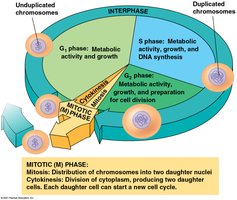
Cell Cycle Phases
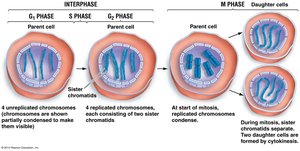
Cells alternate between interphase and the mitotic phase. - G1 phase: Cell growth and preparation for DNA synthesis. - S phase: DNA replication. - G2 phase: Preparation for mitosis; organelles replicate and cytoplasm increases. - M phase: Chromosome separation and cell division.
Chromosome Structure and Replication
Chromatin, Chromosomes, and Sister Chromatids
Chromosomes are composed of chromatin, a DNA-protein complex. Before mitosis, chromosomes replicate to form two identical sister chromatids joined at the centromere. - Chromatin: DNA-protein complex that forms chromosomes. - Chromosome: Structure containing genetic information. - Sister chromatids: Identical DNA copies joined at the centromere. - Replicated chromosome: Two sister chromatids still count as one chromosome. 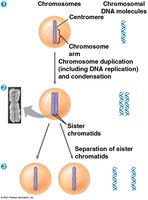
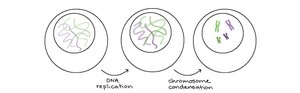
Chromosome Changes During the Cell Cycle
During S phase, chromosomes replicate and form two identical sister chromatids. At the start of mitosis, replicated chromosomes condense.
Mitosis and Cytokinesis
Mitosis Overview
Mitosis is the process by which a cell divides its nucleus and distributes chromosomes to two daughter cells. It consists of five subphases: prophase, prometaphase, metaphase, anaphase, and telophase. - Goal: Separate sister chromatids to form independent chromosomes. - Outcome: Two genetically identical daughter cells. 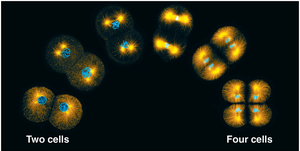
Prophase
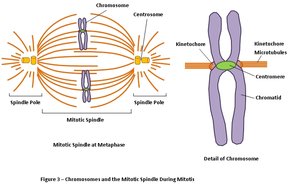
Chromosomes condense and become visible. The mitotic spindle forms from microtubules, with polar microtubules pushing cell poles apart and astral microtubules anchoring the spindle. The centrosome acts as the microtubule-organizing center. 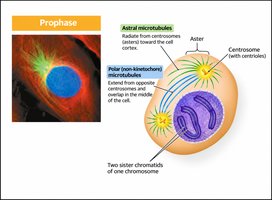
Prometaphase and Metaphase
- Prometaphase: Nuclear envelope breaks down; kinetochore microtubules attach to chromatids at the centromere. - Metaphase: Chromosomes align along the metaphase plate; motor proteins pull chromosomes from opposite poles. 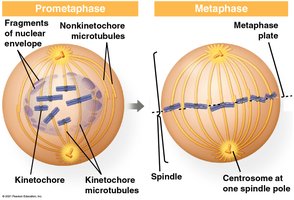
Anaphase, Telophase, and Cytokinesis
- Anaphase: Centromeres split; sister chromatids separate and are pulled to opposite poles. - Telophase: Nuclear envelopes reform; chromosomes decondense. - Cytokinesis: Division of cytoplasm, forming two daughter cells. 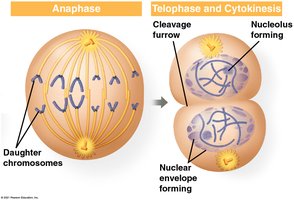
Anaphase Mechanisms
Cohesins holding sister chromatids together are cleaved by separase. Kinetochore microtubules shorten by depolymerizing at their ends, while polar microtubules push against each other, elongating the cell. 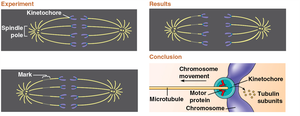
Structures Involved in Mitosis
Key Structures and Their Functions
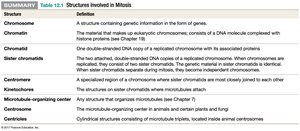
The following table summarizes the main structures involved in mitosis and their functions:
Structure | Definition |
|---|---|
Chromosome | A structure containing genetic information in the form of genes. |
Chromatin | Material that makes up eukaryotic chromosomes; consists of DNA and proteins. |
Chromatid | One double-stranded DNA copy of a replicated chromosome with its associated proteins. |
Sister chromatids | Two identical DNA copies of a replicated chromosome joined at the centromere. |
Centromere | Region where sister chromatids are joined and most closely paired. |
Kinetochore | Protein structure on chromatids where spindle fibers attach. |
Microtubule-organizing center | Organelle that organizes microtubules; includes centrosomes. |
Centrioles | Cylindrical structures inside centrosomes, involved in microtubule formation. |
Cell-Cycle Regulation and Checkpoints
Cell-Cycle Checkpoints
The cell cycle is regulated by checkpoints at G1, G2, and M phases. These checkpoints prevent division of damaged cells and allow mature cells to remain in G0. - G1 checkpoint: Determines if the cell will divide or enter G0. - G2 checkpoint: Ensures DNA is fully replicated and undamaged before mitosis. - M checkpoint: Ensures chromosomes are properly attached to the spindle before separation. 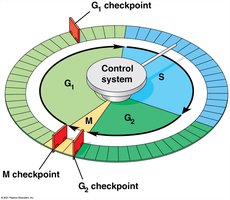
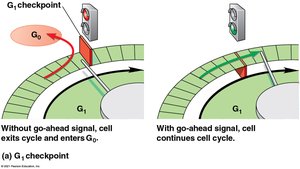
G1 Checkpoint: Regulation and Decision
The G1 checkpoint is a critical decision point. Four factors determine whether the cell passes: cell size, nutrient availability, social signals, and DNA integrity. The p53 protein detects DNA damage and can pause the cycle for repair or trigger apoptosis. 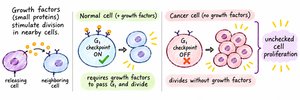
G1 Checkpoint: Role of Rb Protein
The Rb (retinoblastoma) protein enforces the G1 checkpoint by keeping cells in G0. Excessive growth factors can override Rb inhibition, triggering cyclin synthesis and activating cyclin–Cdk complexes, which initiate DNA replication. 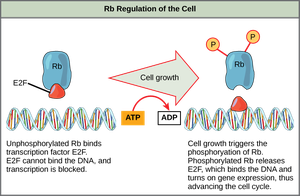
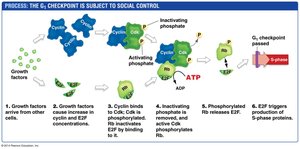
G1 Checkpoint: Cyclin Overproduction and Cancer
Overproduction of cyclin can lead to permanent activation of Cdk, forcing cells to bypass the G1 checkpoint and continue dividing, a hallmark of cancer.
G2 Checkpoint: M-Phase Promoting Factor (MPF)
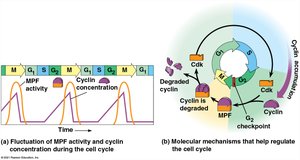
MPF is composed of cyclin and Cdk. It triggers mitosis when cyclin levels are high and Cdk is activated. Cyclin rises during interphase, peaks in M phase, and is degraded during anaphase, inactivating MPF and ending mitosis. 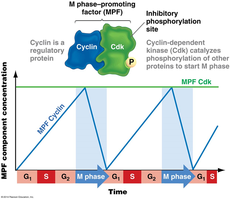
Metaphase Checkpoint
The metaphase checkpoint ensures chromosomes are properly attached to the spindle. Cell growth halts if attachment is incorrect, preventing unequal chromosome separation and aneuploidy. 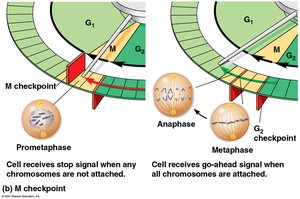
Cancer and the Cell Cycle
Cancer: Disruption of Cell-Cycle Regulation
Cancer results from mutations that disrupt cell-cycle control, leading to uncontrolled cell division. - Benign tumors: Noninvasive, localized. - Malignant tumors: Invasive, can spread (metastasis). - Oncogenes: Overactive proto-oncogenes cause excessive cell growth. - Tumor suppressor genes: Loss of function removes cell-cycle brakes (e.g., p53).
Key Cancer-Linked Genes
Mutations in ras and p53 are common in human cancers. - Ras: A G protein that relays signals from growth factor receptors, stimulating cell division. Mutant Ras stays active, causing constant growth signaling. - p53: Prevents damaged cells from dividing by activating DNA repair and apoptosis genes. Mutations in p53 remove these safeguards.
Cancer Treatment and Research
Chemotherapy targets rapidly dividing cells, but also affects normal fast-dividing cells, causing side effects. Research on cell-signaling pathways is expanding, and personalized medicine uses molecular profiling to tailor treatments.
Taxol: Nature’s Anti-Cancer Weapon
Taxol, discovered in the Pacific yew, stabilizes microtubules and prevents spindle disassembly, halting mitosis. It is especially effective against breast, ovarian, and lung cancers. Example: Taxol is a key example of a natural product inspiring modern chemotherapy.
Summary Table: Cell Cycle Checkpoints
Checkpoint | Main Function | Key Regulators |
|---|---|---|
G1 | Decides cell division or entry into G0 | p53, Rb, cyclin–Cdk |
G2 | Ensures DNA replication and repair | MPF (cyclin–Cdk) |
M | Ensures chromosome attachment to spindle | Spindle assembly checkpoint proteins |
Additional info: The notes expand on checkpoint regulation, cancer mechanisms, and mitosis phases for clarity and completeness.
