 Back
The Cell Cycle: Regulation, Checkpoints, and Molecular Mechanisms
Study Guide - Smart Notes
 Tailored notes based on your materials, expanded with key definitions, examples, and context.
The Cell Cycle
Overview of Cell Division
The cell cycle is the series of events that cells undergo to grow and divide. Different cell types vary in their division frequency, with some dividing frequently (e.g., intestinal cells), some rarely (e.g., liver cells), and others not at all (e.g., mature nerve and muscle cells, which are arrested in G1 and enter G0).
Cell division frequency: Depends on cell type and physiological conditions.
G0 phase: A resting state where cells are not actively dividing.
Regulation: Cells receive signals to divide or remain quiescent based on internal and external cues.
Example: Liver cells divide rapidly when damaged, then return to infrequent division once repaired.
Regulation of Cell Cycle Entry
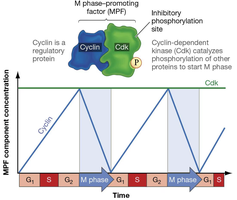
Cells "know" when to divide through regulatory factors that control progression from interphase to M phase. Experiments show that the factor promoting entry into M phase is located in the cytoplasm of dividing cells.
M-phase-promoting factor (MPF): A cytoplasmic factor that triggers mitosis when added to G2 cells.
Key experiment: Adding M phase cytoplasm to G2 cells induces mitosis, indicating the presence of MPF.
M-Phase-Promoting Factor (MPF)
Structure and Function of MPF
MPF is a protein complex composed of two subunits: cyclin and cyclin-dependent kinase (Cdk). MPF activity is tightly regulated by phosphorylation and cyclin degradation.
Cyclin: Regulatory protein whose concentration fluctuates during the cell cycle.
Cdk: Enzyme that is active only when bound to cyclin; contains two phosphorylation sites (one activating, one inhibitory).
Activation: Late in G2, a phosphatase removes the inhibitory phosphate, activating MPF.
Deactivation: During anaphase, cyclin is degraded, turning MPF off.
Cell Cycle Checkpoints
Definition and Importance
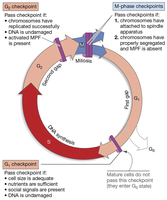
Cell cycle checkpoints are regulatory stages where the cell assesses whether to proceed with division. These checkpoints ensure genomic integrity and proper cell function.
G1 checkpoint: Checks for adequate cell size, nutrients, growth signals, and undamaged DNA.
G2 checkpoint: Ensures DNA is replicated correctly and undamaged; activated MPF must be present.
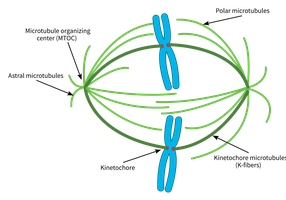
M-phase checkpoint: Ensures kinetochores are properly attached to microtubules from opposite poles.
p53: Tumor suppressor protein that activates genes to halt the cell cycle or induce apoptosis if DNA is damaged.
Mechanisms of Checkpoint Control
Checkpoint mechanisms involve regulatory proteins and complexes that monitor DNA integrity and chromosome attachment.
Phosphatase activity: If DNA is damaged, the phosphatase that activates Cdk is inactive, preventing cell cycle progression.
Mitotic checkpoint complex (MCC): Prevents separation of sister chromatids if kinetochores are not properly attached.
Aurora B kinase: Ensures tension at kinetochores, phosphorylates proteins to correct improper attachments.
G1 Checkpoint and Social Control
Role of Growth Factors and Molecular Pathways
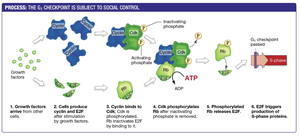
In multicellular organisms, cell division is regulated by signals from other cells, known as social control. The G1 checkpoint is subject to these signals, which influence cyclin and Cdk activity.
Growth factors: External signals that stimulate cell division.
Cyclin and Cdk: Different molecules regulate the G1 checkpoint compared to MPF.
Rb protein: Inhibits cell cycle progression by binding E2F; phosphorylation releases E2F, allowing S-phase entry.
M-Phase Checkpoint
Ensuring Proper Chromosome Segregation
The M-phase checkpoint ensures that all chromosomes are correctly attached to the spindle apparatus before proceeding with anaphase. This prevents errors in chromosome segregation.
MCC assembly: Occurs at unattached kinetochores; disassembles when microtubules dock.
Aurora B kinase: Checks tension and phosphorylates proteins to correct improper attachments.
End result: Destruction of cohesion and separation of sister chromatids if checkpoint is passed.
Cell Cycle Regulation and Cancer
Mutations and Uncontrolled Cell Growth
Mutations in cell cycle regulatory proteins can lead to uncontrolled cell growth and cancer. Key proteins include Rb, E2F, p53, and cyclins.
Mutated/nonfunctional Rb: Can lead to uncontrolled cell growth due to loss of inhibition of E2F.
Nonfunctional E2F: Prevents S-phase entry, inhibiting cell division.
Overproduction of p53: May cause excessive cell cycle arrest or apoptosis.
Cancer risk: Most likely when tumor suppressors (e.g., Rb) are underproduced or nonfunctional.
Protein | Normal Function | Effect of Mutation |
|---|---|---|
Rb | Inhibits E2F, prevents S-phase entry | Loss leads to uncontrolled division |
E2F | Promotes S-phase entry | Loss prevents division |
p53 | Halts cycle or induces apoptosis | Loss leads to unchecked division |
Cyclin | Regulates Cdk activity | Overproduction can cause uncontrolled division |
Summary Table: Cell Cycle Checkpoints
Checkpoint | Main Function | Key Regulators |
|---|---|---|
G1 | Checks cell size, nutrients, DNA damage | Cyclin, Cdk, Rb, E2F |
G2 | Checks DNA replication, damage | MPF, phosphatase |
M-phase | Checks kinetochore attachment | MCC, Aurora B kinase |
Key Terms and Concepts
Cell cycle: The ordered series of events for cell growth and division.
MPF: M-phase-promoting factor, triggers mitosis.
Cyclin: Regulatory protein, fluctuates during cycle.
Cdk: Cyclin-dependent kinase, active only with cyclin.
Checkpoint: Regulatory stage for cell cycle progression.
p53: Tumor suppressor, halts cycle or induces apoptosis.
Rb: Retinoblastoma protein, inhibits cell cycle progression.
E2F: Transcription factor, promotes S-phase entry.
MCC: Mitotic checkpoint complex, prevents premature chromatid separation.
Aurora B kinase: Ensures proper kinetochore-microtubule attachment.
Equations and Molecular Mechanisms
MPF activation:
Rb phosphorylation:
Example Application
Mutation in growth factor receptor: Constitutive cyclin production leads to elevated cell division, potentially causing cancer if mutation is inherited by descendants.
Checkpoint failure: Loss of p53 or Rb function increases risk of uncontrolled cell growth and tumor formation.
Additional info:
Cell cycle regulation is a central topic in cancer biology and developmental biology.
Checkpoint mechanisms are targets for cancer therapies.
