 Back
BackThe Cell Cycle: Structure, Function, and Regulation
Study Guide - Smart Notes
 Tailored notes based on your materials, expanded with key definitions, examples, and context.
The Cell Cycle
Overview: The Key Roles of Cell Division
Cell division is fundamental to life, enabling organisms to reproduce, grow, and repair tissues. In unicellular organisms, cell division produces new individuals, while in multicellular organisms, it is essential for development, growth, and maintenance.
Cell cycle: The sequence of events from a cell's formation to its own division.
Functions: Development, growth, and repair.
Reproduction: Unicellular organisms reproduce by cell division; multicellular organisms use it for tissue maintenance.
Genetic Material Organization
The genetic material of cells is organized into genomes, which are packaged as chromosomes. The structure and packaging differ between prokaryotes and eukaryotes.
Genome: All DNA in a cell.
Prokaryotes: Single DNA molecule.
Eukaryotes: Multiple DNA molecules, packaged as chromosomes.
Chromatin: DNA and protein complex; condenses into chromosomes during cell division.
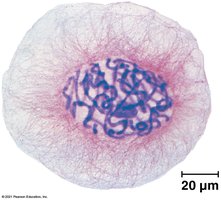
Cell Division Types: Mitosis and Meiosis
Cell division can produce genetically identical or nonidentical daughter cells, depending on the process.
Mitosis: Produces daughter cells with identical genetic information (somatic cells).
Meiosis: Produces gametes (sperm and eggs) with half the chromosome number of the parent cell.
Distribution of Chromosomes During Eukaryotic Cell Division
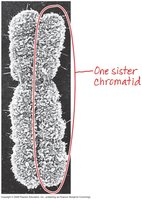
Before cell division, chromosomes are duplicated, forming sister chromatids held together by a centromere. During division, chromatids separate, ensuring each daughter cell receives a complete set of chromosomes.
Sister chromatids: Duplicated chromosomes joined at the centromere.
Centromere: Region holding chromatids together.
Phases of the Cell Cycle
Interphase
Interphase is the longest phase of the cell cycle, comprising cell growth and DNA replication. It is divided into three subphases:
G1 phase: Cell growth and organelle production.
S phase: DNA synthesis and chromosome duplication.
G2 phase: Further growth and preparation for division; includes a checkpoint for readiness.
Mitotic Phase
The mitotic phase includes mitosis (nuclear division) and cytokinesis (cytoplasmic division). Mitosis is conventionally divided into five phases:
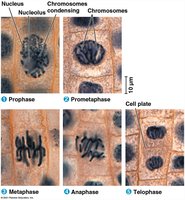
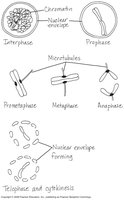
Prophase: Chromatin condenses, nucleoli disappear, centrosomes move apart.
Prometaphase: Nuclear envelope breaks down, spindle microtubules attach to chromosomes.
Metaphase: Chromosomes align at the metaphase plate.
Anaphase: Sister chromatids separate and move to opposite poles.
Telophase: Nuclei reform, chromosomes decondense.
Cytokinesis: Division of cytoplasm; cleavage furrow in animals, cell plate in plants.
The Mitotic Spindle
Structure and Function
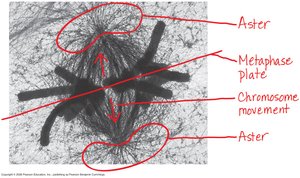
The mitotic spindle is a structure of microtubules that orchestrates chromosome movement during mitosis. It includes centrosomes, spindle microtubules, and asters.
Centrosome: Microtubule organizing center; replicates and migrates to cell poles.
Aster: Radial array of short microtubules.
Kinetochore microtubules: Attach to chromosomes and move them.
Nonkinetochore microtubules: Overlap and elongate the cell.
Cytokinesis: Animal vs. Plant Cells
Mechanisms of Cytokinesis
Cytokinesis differs between animal and plant cells. Animal cells form a cleavage furrow, while plant cells build a cell plate.
Animal cells: Cleavage furrow pinches the cell in two.
Plant cells: Cell plate forms, eventually becoming the new cell wall.
Binary Fission in Prokaryotes
Process and Evolutionary Context
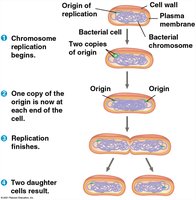
Prokaryotes reproduce by binary fission, a simpler process than mitosis. Chromosome replication begins at the origin, and daughter chromosomes move apart as the cell divides.
Binary fission: Chromosome replicates, cell divides into two.
Evolution: Eukaryotic mitosis may have evolved from prokaryotic binary fission.
Regulation of the Cell Cycle
Molecular Control System
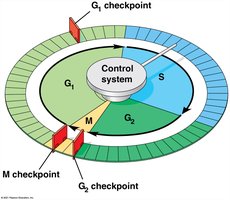
The cell cycle is regulated by a molecular control system, with checkpoints ensuring proper progression. Internal and external signals influence these checkpoints.
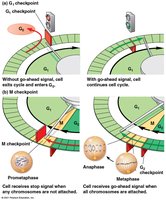
Checkpoints: G1, G2, and M checkpoints control cell cycle progression.
G1 checkpoint: Most important; determines if cell will divide or enter G0 (nondividing state).
Internal signals: Kinetochores not attached to spindle microtubules delay anaphase.
External signals: Growth factors, density-dependent inhibition, anchorage dependence.
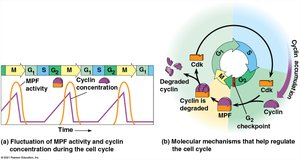
Cyclins and Cyclin-Dependent Kinases (Cdks)
Cyclins and Cdks are key regulatory proteins. Their activity fluctuates during the cell cycle, controlling transitions between phases.
Cyclins: Proteins whose concentration cycles during the cell cycle.
Cdk: Cyclin-dependent kinase; active only when bound to cyclin.
MPF: Maturation-promoting factor; triggers passage past G2 checkpoint into M phase.
Loss of Cell Cycle Controls in Cancer Cells
Cancer Cell Characteristics
Cancer cells escape normal cell cycle controls, leading to uncontrolled division and tumor formation. They may produce their own growth factors or have abnormal control systems.
Transformation: Conversion of a normal cell to a cancerous cell.
Benign tumor: Abnormal cells remain at original site.
Malignant tumor: Invades surrounding tissues; can metastasize.
Metastasis: Spread of cancer cells to distant sites.
Summary Table: Cell Cycle Phases and Events
Phase | Main Events |
|---|---|
G1 | Cell growth, organelle production |
S | DNA synthesis, chromosome duplication |
G2 | Further growth, checkpoint |
Mitosis | Nuclear division (prophase, prometaphase, metaphase, anaphase, telophase) |
Cytokinesis | Cytoplasmic division |
Summary Table: Comparison of Cell Division Types
Type | Result | Chromosome Number |
|---|---|---|
Mitosis | Genetically identical daughter cells | Same as parent |
Meiosis | Genetically nonidentical gametes | Half of parent |
Binary Fission | Identical daughter cells | Same as parent |
Key Equations and Concepts
Chromosome number after mitosis:
Chromosome number after meiosis:
Things to Know
Structural organization of prokaryotic and eukaryotic genomes
Phases of the cell cycle and sequence of events
Phases of mitosis and characteristic events
Mitotic spindle structure and function
Comparison of cytokinesis in animals and plants
Binary fission in bacteria and its evolutionary significance
Abnormal cell division in cancer and escape from cell cycle controls
Distinction between benign, malignant, and metastatic tumors
