 Back
The Cell Cycle: Structure, Function, and Regulation
Study Guide - Smart Notes
 Tailored notes based on your materials, expanded with key definitions, examples, and context.
Chapter 12: The Cell Cycle
Overview of the Cell Cycle
The cell cycle is a fundamental process in biology, enabling cells to grow, replicate their DNA, and divide. It consists of a series of phases that ensure accurate duplication and distribution of genetic material. Understanding the cell cycle is essential for grasping how organisms develop, maintain tissues, and how errors in this process can lead to diseases such as cancer.
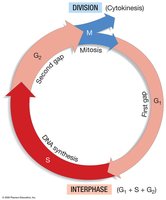
Four Phases: The cell cycle includes G1 (first gap), S (synthesis), G2 (second gap), and M (mitosis/cytokinesis).
Interphase: Comprises G1, S, and G2 phases, where the cell grows, replicates DNA, and prepares for division.
M Phase: Includes mitosis (nuclear division) and cytokinesis (cytoplasmic division).
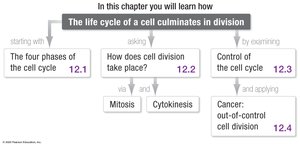
Cell Division: Mitosis and Meiosis
Cell division is the process by which new cells are formed. There are two main types: mitosis and meiosis. Mitosis produces genetically identical somatic cells, while meiosis generates gametes with half the genetic material, ensuring genetic diversity in sexually reproducing organisms.
Mitosis: Produces two daughter cells identical to the parent cell.
Meiosis: Produces four genetically distinct gametes with half the chromosome number.
Cytokinesis: Division of the cytoplasm, completing cell division.
12.1 How Do Cells Replicate?
Chromosome Structure and Replication
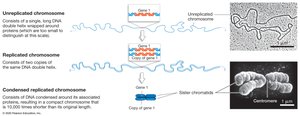
Chromosomes are the carriers of genetic information. Before cell division, chromosomes are replicated, ensuring each daughter cell receives a complete set of genes. Chromosomes consist of DNA wrapped around histone proteins, forming chromatin.
Chromosome: A single, long double helix of DNA wrapped around histones.
Gene: A region of DNA coding for RNA and proteins.
Chromatid: Each double-stranded DNA copy after replication.
Sister Chromatids: Chromatid copies attached at the centromere, considered a single chromosome until separated.
Phases of the Cell Cycle
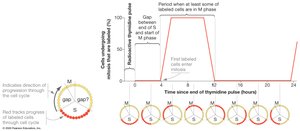
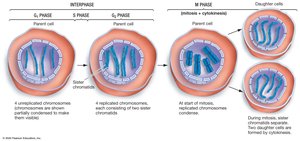
The cell cycle alternates between a dividing phase (M phase) and a non-dividing phase (interphase). Chromosome replication occurs only during interphase, specifically in the S phase. Gap phases (G1 and G2) allow cells to grow and prepare for division.
G1 Phase: Cell grows and decides whether to replicate.
S Phase: DNA synthesis and chromosome replication.
G2 Phase: Preparation for mitosis.
M Phase: Chromosome separation and cell division.
12.2 What Happens during M Phase?
Mitosis and Cytokinesis
M phase consists of mitosis and cytokinesis. Mitosis is the division of replicated chromosomes, forming two daughter nuclei. Cytokinesis is the division of the cytoplasm, resulting in two daughter cells.
Chromatin: DNA-histone complex, relaxed during interphase.
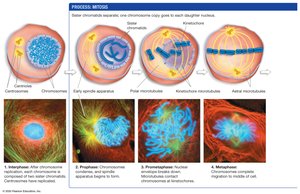
Five Subphases of Mitosis: Prophase, Prometaphase, Metaphase, Anaphase, Telophase.
Detailed Events of Mitosis
Prophase: Chromosomes condense; spindle apparatus forms from microtubule-organizing centers (MTOCs).
Prometaphase: Nuclear envelope breaks down; microtubules attach to kinetochores at centromeres.
Metaphase: Chromosomes align at metaphase plate; spindle is fully formed.
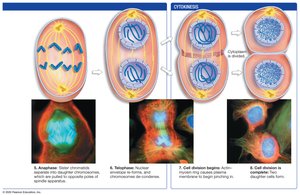
Anaphase: Cohesions split; sister chromatids are pulled to opposite poles by spindle fibers.
Telophase: Nuclear envelope reforms; chromosomes decondense; mitosis completes.
Mechanisms of Chromosome Movement
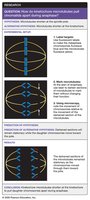
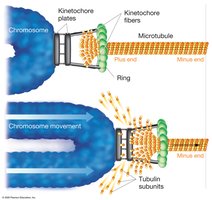
During anaphase, kinetochore microtubules shorten, pulling chromosomes toward spindle poles. Motor proteins and microtubule dynamics are essential for this process.
Kinetochore: Protein complex at centromere, attaches to microtubules.
Microtubule Shortening: Tubulin subunits are lost from plus ends, moving chromosomes.
Cytokinesis in Plants and Animals
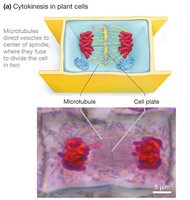
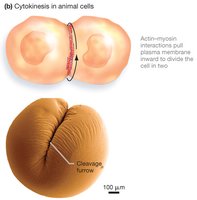
Cytokinesis differs between plant and animal cells. In plants, vesicles form a cell plate; in animals, a contractile ring forms a cleavage furrow.
Plant Cells: Vesicles from Golgi apparatus fuse to form cell plate.
Animal Cells: Actin and myosin filaments contract, forming cleavage furrow.
Bacterial Cell Division
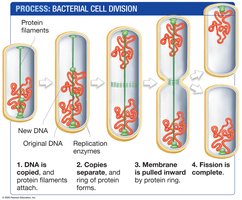
Bacteria divide by binary fission, a process similar to eukaryotic M phase but without mitosis. Chromosomes are replicated, and protein filaments pull them apart before cytoplasmic division.
Binary Fission: DNA is copied, separated, and the cell divides.
12.3 Control of the Cell Cycle
Regulation and Checkpoints
Cell-cycle length varies among cell types, primarily due to differences in G1 phase. Regulatory molecules and checkpoints ensure proper progression and prevent uncontrolled division.
G0 State: Nondividing cells are arrested in G1.
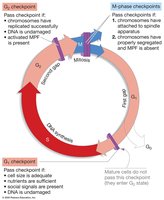
Checkpoints: G1, G2, and M-phase checkpoints regulate cycle progression.
Discovery of Cell-Cycle Regulatory Molecules
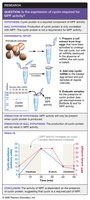
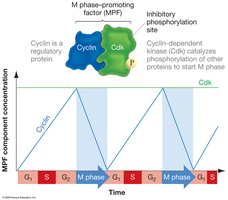
Experiments showed that cytoplasm from M-phase cells can induce interphase cells to enter M phase. The key regulatory molecule is M-phase-promoting factor (MPF), composed of cyclin and cyclin-dependent kinase (Cdk).
MPF: Activates mitosis when cyclin binds to Cdk.
Cyclin: Protein whose concentration fluctuates during the cell cycle.
Cdk: Protein kinase active only when bound to cyclin.
Activation and Deactivation of MPF
MPF is regulated by phosphorylation and negative feedback. Destruction of cyclin deactivates MPF, ensuring proper cell-cycle control.
Activation: Removal of inhibitory phosphate activates Cdk.
Deactivation: Cyclin is marked for destruction during anaphase.
Cell-Cycle Checkpoints
Checkpoints are critical for preventing division of damaged cells. The G1 checkpoint is the most important, influenced by cell size, nutrients, social signals, and DNA damage. The G2 checkpoint ensures proper DNA replication, and M-phase checkpoints ensure correct chromosome separation.
G1 Checkpoint: p53 protein can pause cycle or initiate apoptosis if DNA is damaged.
G2 Checkpoint: Prevents entry into M phase if DNA replication is incomplete.
M-Phase Checkpoints: Ensure proper chromosome attachment and separation.
12.4 Cancer: Out-of-Control Cell Division
Cancer and Cell-Cycle Control
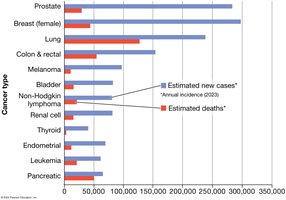
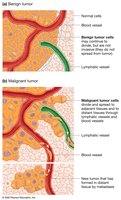
Cancer arises from defects in cell-cycle regulation, leading to uncontrolled cell division and invasion of tissues. Tumors can be benign (noninvasive) or malignant (invasive and metastatic).
Defects: Activation of growth proteins or loss of tumor suppressor function.
Malignant Tumors: Can spread via blood or lymph, forming secondary tumors (metastasis).
Benign Tumors: Noncancerous and noninvasive.
Loss of Cell-Cycle Control in Cancer
Many cancers involve defects in the G1 checkpoint. Social control mechanisms, such as growth factors, normally regulate cell division. Cancer cells often divide without these signals, leading to unchecked proliferation.
Growth Factors: Small proteins that stimulate cell division.
Social Control: Ensures division benefits the organism; lost in cancer cells.
Summary Table: Cell Cycle Phases and Key Events
Phase | Main Event | Key Structures |
|---|---|---|
G1 | Cell growth, preparation for DNA replication | Chromatin, nucleus |
S | DNA synthesis, chromosome replication | Chromosomes, DNA polymerase |
G2 | Preparation for mitosis | Chromatin, centrosomes |
M | Mitosis and cytokinesis | Spindle apparatus, kinetochores, actin/myosin |
Additional info: The notes expand on brief points with academic context, including definitions, examples, and mechanisms, to provide a comprehensive study guide for General Biology students.
