 Back
The Cell Cycle: Structure, Function, and Regulation
Study Guide - Smart Notes
 Tailored notes based on your materials, expanded with key definitions, examples, and context.
The Cell Cycle
Overview of the Cell Cycle
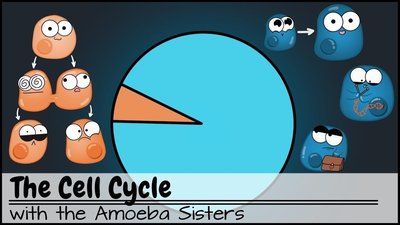
The cell cycle is an ordered sequence of events that leads to cell division and the production of genetically identical daughter cells. It is essential for growth, development, tissue repair, and reproduction in multicellular organisms. The cell cycle alternates between the mitotic phase and interphase, with precise regulation to ensure proper cell function.
Key Point: Most cell division results in genetically identical daughter cells.
Key Point: The mitotic phase alternates with interphase.
Key Point: The eukaryotic cell cycle is regulated by a molecular control system.
Functions of Cell Division
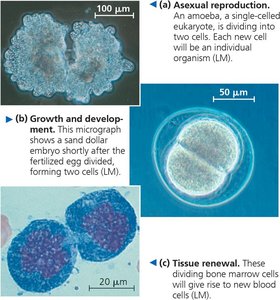
Cell division is fundamental to the continuity of life. It allows organisms to reproduce, grow, and repair tissues. The distribution of identical genetic material (DNA) to daughter cells is a crucial function of most cell divisions.
Asexual reproduction: Single-celled organisms divide to produce new individuals.
Growth and development: Multicellular organisms grow by increasing cell number.
Tissue renewal: Damaged or old cells are replaced by new cells.
Cellular Organization of Genetic Material
Genome, DNA, and Chromosomes
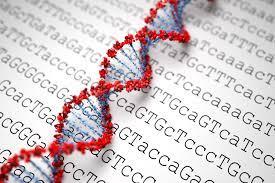
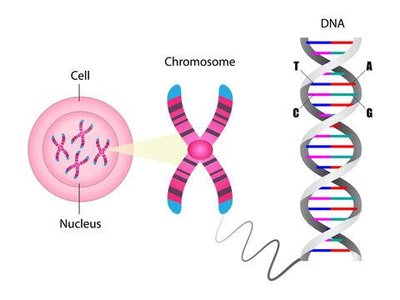
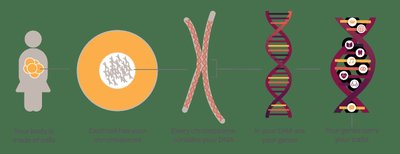
The genome is the complete set of genetic material in an organism, encoded in DNA. DNA molecules are packaged into chromosomes, which carry genetic information in genes.
Chromosome: Structure of nucleic acids and protein found in the nucleus, consisting of one long linear DNA molecule associated with proteins.
Gene: Unit of information specifying inherited traits.
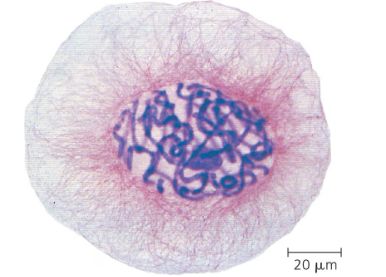
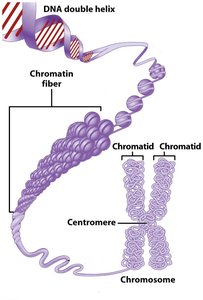
Chromatin: The complex of DNA and proteins that forms chromosomes, making DNA more compact.
Chromosome Number and Types
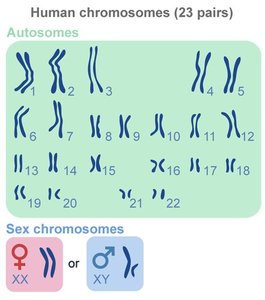
Each eukaryotic species has a characteristic number of chromosomes. Human somatic cells contain 46 chromosomes (two sets of 23, one from each parent), while gametes (egg/sperm) have 23 chromosomes.
Somatic cells: All body cells except reproductive cells.
Gametes: Reproductive cells with half the chromosome number of somatic cells.
Distribution of Chromosomes During Eukaryotic Cell Division
Chromatin, Chromosomes, and Sister Chromatids
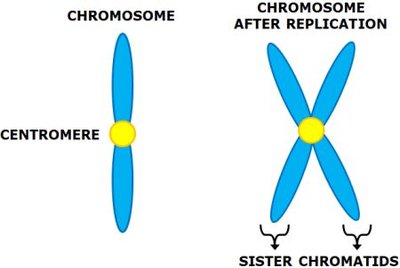
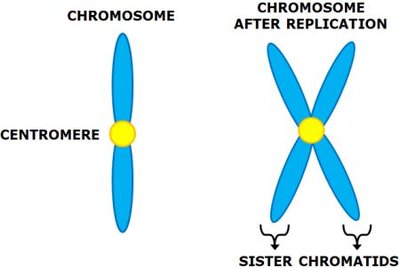
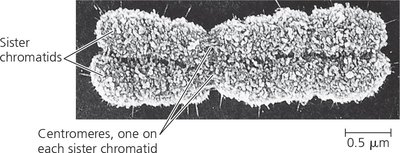
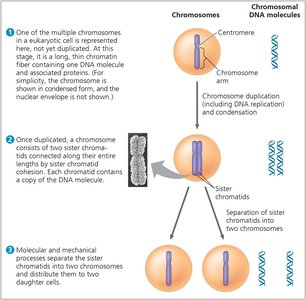
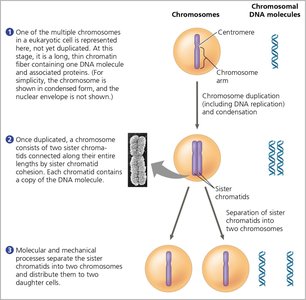
When a cell is not dividing, chromosomes exist as chromatin fibers. After DNA replication, chromosomes condense, and each duplicated chromosome consists of two sister chromatids attached at the centromere.
Sister chromatids: Two identical copies of a duplicated chromosome attached at the centromere.
Centromere: Region where chromatids are most closely attached.
Separation of Sister Chromatids
During cell division, sister chromatids separate and move into two new nuclei, becoming individual chromosomes. This step doubles the chromosome number during cell division.
Mitosis: Nuclear division that conserves chromosome number.
Cytokinesis: Division of cytoplasm, producing two genetically identical cells.
Phases of the Cell Cycle
Interphase
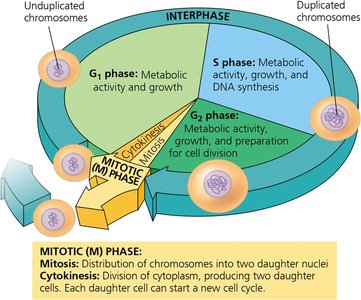
Interphase is the period when the cell is not dividing, accounting for about 90% of the cell cycle. It consists of three subphases: G₁ (growth), S (DNA synthesis), and G₂ (growth and preparation for division).
G₁ phase: Cell growth and metabolic activity.
S phase: DNA replication.
G₂ phase: Further growth and preparation for mitosis.
Mitotic Phase
The mitotic phase consists of mitosis (nuclear division) and cytokinesis (cytoplasmic division). Mitosis is conventionally broken down into five stages: prophase, prometaphase, metaphase, anaphase, and telophase.
Prophase: Chromatin condenses, spindle forms, nucleolus disappears, centrosomes move apart.
Prometaphase: Nuclear envelope fragments, kinetochores form, spindle microtubules attach.
Metaphase: Chromosomes align at metaphase plate, kinetochores attach to spindle.
Anaphase: Sister chromatids separate, move to opposite poles.
Telophase: Nuclear envelope reforms, chromosomes decondense, nucleoli reappear.
Cytokinesis: Division of cytoplasm, producing two daughter cells.
The Mitotic Spindle
Structure and Function
The mitotic spindle is essential for chromosome movement during mitosis. It consists of microtubules and proteins, assembled at the centrosome (microtubule organizing center).
Centrosome: Microtubule organizing center, contains centrioles (not essential for division).
Aster: Radial array of short microtubules extending from each centrosome.
Kinetochore: Protein structure at centromere, attaches chromatids to spindle.
Cytokinesis
Animal vs. Plant Cells
Cytokinesis differs between animal and plant cells. In animal cells, it occurs by cleavage, forming a cleavage furrow. In plant cells, a cell plate forms at the midline, eventually producing two daughter cells.
Cleavage furrow: Shallow groove in animal cell surface, deepens to split cell.
Cell plate: Membrane-bounded sac in plant cells, fuses with plasma membrane.
Binary Fission in Bacteria
Prokaryotic Cell Division
Prokaryotes reproduce by binary fission, a method of asexual reproduction where the cell grows, replicates its DNA, and divides into two cells.
Binary fission: Cell grows to double its size, then divides.
Regulation of the Eukaryotic Cell Cycle
Molecular Control System
The timing and rate of cell division are regulated by a molecular control system. The frequency of cell division varies with cell type and is controlled at the molecular level.
Cell cycle control system: Cyclically operating set of molecules that triggers and coordinates cell cycle events.
Checkpoints: G1, G2, and M phase checkpoints regulate progression.
Cyclins and Cyclin-Dependent Kinases (Cdks)
Fluctuations in cyclin and Cdk activity pace the cell cycle. Cdks are only active when bound to cyclins. MPF (Maturation Promoting Factor) is a cyclin-Cdk complex required for entry into mitosis.
Protein kinases: Enzymes that activate/inactivate proteins by phosphorylation.
Cyclins: Proteins with cyclically fluctuating concentrations.
MPF: Triggers passage to M phase, past G2 checkpoint.
Internal and External Signals at Checkpoints
Checkpoints are regulated by internal (kinases/cyclins) and external (chemical/physical) signals. Growth factors and cell-to-cell contact influence division.
G1 checkpoint: Most important; cells may enter G0 phase if not passed.
M checkpoint: Ensures proper chromosome attachment before separation.
S phase checkpoint: Prevents progression with DNA damage.
Density-dependent inhibition: Crowded cells stop dividing.
Anchorage dependence: Cells must be attached to ECM to divide.
Loss of Cell Cycle Controls in Cancer Cells
Cancer Cell Characteristics
Cancer cells do not respond to normal cell cycle controls. They may divide indefinitely, evade apoptosis, and form tumors. Mutations in cell cycle control genes are the underlying cause.
Benign tumor: Abnormal cells remain at original site.
Malignant tumor: Cells spread to new tissues, impairing organ function.
Summary Table: Cell Cycle Phases and Key Events
Phase | Main Events |
|---|---|
G₁ | Cell growth, metabolic activity |
S | DNA replication |
G₂ | Further growth, preparation for mitosis |
Mitosis | Nuclear division (prophase, prometaphase, metaphase, anaphase, telophase) |
Cytokinesis | Division of cytoplasm, formation of two daughter cells |
Key Equations
Chromosome number in gametes:
DNA replication:
Additional info: Academic context was added to clarify the molecular control system, checkpoint regulation, and cancer cell characteristics. Examples and diagrams were used to reinforce understanding of chromosome structure, cell cycle phases, and cell division mechanisms.
