 Back
The Cell Cycle: Structure, Regulation, and Implications for Cell Division
Study Guide - Smart Notes
 Tailored notes based on your materials, expanded with key definitions, examples, and context.
The Cell Cycle
Introduction to the Cell Cycle
The cell cycle is a fundamental process by which cells grow, replicate their DNA, and divide to produce new cells. This process is essential for growth, development, and maintenance in multicellular organisms. Cell division occurs through two main mechanisms: mitosis and meiosis.
Mitosis: Produces somatic cells, resulting in daughter cells genetically identical to the parent cell.
Meiosis: Produces gametes (reproductive cells), resulting in daughter cells with half the hereditary material of the parent cell.
Cytokinesis: Division of the cytoplasm, usually following mitosis or meiosis, to form two distinct daughter cells.
Basic Steps in Cellular Replication
Cellular replication involves three main steps:
Copying DNA: The genetic material is duplicated.
Separating Copies: The duplicated chromosomes are separated.
Dividing Cytoplasm: The cell splits into two complete cells.
Chromosome Structure and Replication
What Is a Chromosome?
A chromosome is a single, long double helix of DNA wrapped around proteins called histones. Chromosomes carry genes, which are regions of DNA that code for specific RNA and proteins.
Gene: A segment of DNA that codes for a specific protein via RNA.
Chromatid: Each double-stranded DNA copy after replication; chromatids are attached by proteins called cohesions.
Sister Chromatids: Chromatid copies that remain attached at the centromere; considered a single chromosome until separated during mitosis.
Phases of the Cell Cycle
Cell Cycle Phases
The cell cycle consists of four main phases:
M phase: Mitotic or meiotic division phase.
Interphase: Non-dividing phase, includes three subphases:
G1 phase: Cell grows and prepares for DNA replication.
S phase: DNA synthesis and chromosome replication.
G2 phase: Cell prepares for mitosis.
Mitosis: Events and Subphases
Mitosis is a continuous process divided into five subphases:
Prophase: Chromosomes condense and spindle apparatus forms.
Prometaphase: Nuclear envelope breaks down; microtubules attach to chromosomes at kinetochores.
Metaphase: Chromosomes align at the metaphase plate; spindle formation is complete.
Anaphase: Sister chromatids are separated and pulled to opposite poles.
Telophase: Nuclear envelope reforms; chromosomes decondense.
Cytokinesis
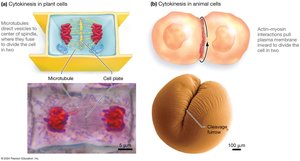
Cytokinesis is the process by which the cytoplasm divides, resulting in two daughter cells. The mechanism varies between plant and animal cells.
Plant cells: Vesicles from the Golgi apparatus form a cell plate at the center.
Animal cells: A ring of actin and myosin filaments contracts to form a cleavage furrow.
Chromosome Movement during Mitosis
Mechanism of Chromosome Movement
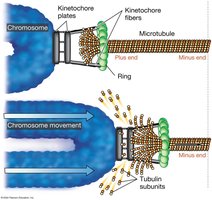
During anaphase, chromosomes are moved by the shortening of kinetochore microtubules. Proteins at the kinetochore attach to a ring surrounding the microtubule, and as the plus end disassembles, the ring moves toward the minus end, pulling the chromosome.
Regulation of the Cell Cycle
Cell-Cycle Control and Checkpoints
The cell cycle is tightly regulated by checkpoints that ensure proper division and prevent errors. Key checkpoints include:
G1 checkpoint: Determines if the cell will proceed with division based on size, nutrients, signals, and DNA integrity.
G2 checkpoint: Ensures DNA replication is complete and undamaged before mitosis.
M-phase checkpoints: Ensure proper chromosome attachment and separation during mitosis.
M Phase-Promoting Factor (MPF)
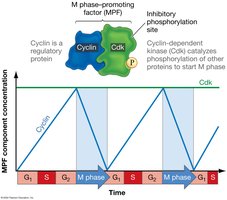
MPF is a key regulatory complex composed of cyclin and cyclin-dependent kinase (Cdk). MPF activity is regulated by cyclin concentration and phosphorylation.
Cyclin: Regulatory protein whose concentration fluctuates during the cell cycle.
Cdk: Protein kinase active only when bound to cyclin; catalyzes phosphorylation of proteins to start M phase.
Cancer and Cell Cycle Control
Cancer: Out-of-Control Cell Division
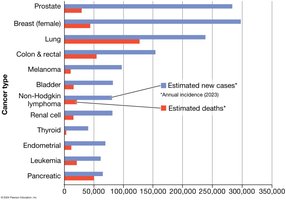
Cancer arises from defects in cell-cycle regulation, leading to uncontrolled cell division, invasion of tissues, and metastasis. Tumors can be:
Malignant: Cancerous, invasive, and capable of spreading.
Benign: Noncancerous and noninvasive.
Loss of Cell-Cycle Control in Cancer
Cancer cells often have defects in checkpoint proteins, such as p53 and Rb, leading to loss of social control and unregulated division. Overproduction of cyclin or defective Rb can result in continuous activation of cell division genes.
Summary Table: Structures Involved in Mitosis
Structure | Function |
|---|---|
Chromosome | Genetic material; condenses during mitosis |
Chromatid | Replicated DNA; attached as sister chromatids |
Centromere | Attachment site for sister chromatids |
Spindle apparatus | Moves chromosomes during mitosis |
Kinetochore | Protein complex for microtubule attachment |
Microtubules | Form spindle fibers; move chromosomes |
Actin/Myosin ring | Contracts for cytokinesis in animal cells |
Cell plate | Forms new cell wall in plant cells |
Key Equations and Concepts
MPF Activation
MPF is activated by removal of inhibitory phosphate:
Negative Feedback in Cell Cycle
MPF is deactivated by destruction of cyclin:
Conclusion
The cell cycle is a highly regulated process essential for life. Understanding its phases, regulation, and implications for diseases like cancer is fundamental for biology students.
