 Back
The Cell Cycle: Structure, Regulation, and Implications for Cancer
Study Guide - Smart Notes
 Tailored notes based on your materials, expanded with key definitions, examples, and context.
The Cell Cycle
Overview of the Cell Cycle
The cell cycle is the series of events that cells undergo to grow and divide. It is fundamental to the development, maintenance, and reproduction of all living organisms. The cycle consists of four main phases: G1, S, G2, and M phase, with checkpoints that regulate progression and ensure fidelity.
G1 phase: Cell grows and prepares for DNA replication.
S phase: DNA synthesis and chromosome replication occur.
G2 phase: Cell prepares for mitosis.
M phase: Includes mitosis (nuclear division) and cytokinesis (cytoplasmic division).
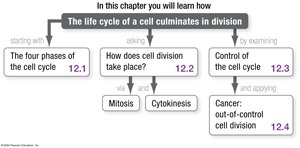
Additional info: The cell cycle is tightly regulated to prevent errors in DNA replication and division, which can lead to diseases such as cancer.
Cell Division: Mitosis and Cytokinesis
Mitosis: Steps and Significance
Mitosis is the process by which a cell divides its replicated chromosomes into two identical daughter nuclei. It ensures genetic continuity across generations of cells.
Prophase: Chromosomes condense and spindle apparatus forms.
Prometaphase: Nuclear envelope breaks down; microtubules attach to kinetochores.
Metaphase: Chromosomes align at the metaphase plate.
Anaphase: Sister chromatids separate and move to opposite poles.
Telophase: Nuclear envelopes reform; chromosomes decondense.
Example: Skin cells undergo mitosis to replace damaged tissue.
Cytokinesis: Mechanisms in Plants and Animals
Cytokinesis is the division of the cytoplasm, resulting in two daughter cells. The mechanism differs between plant and animal cells.
Plants: Vesicles from the Golgi apparatus form a cell plate at the center, which develops into a new cell wall.
Animals: A contractile ring of actin and myosin filaments pinches the cell membrane inward, forming a cleavage furrow.
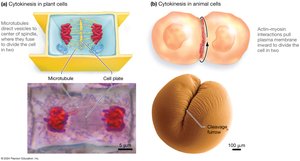
Additional info: Cytokinesis ensures that each daughter cell receives sufficient cytoplasmic contents and organelles.
Chromosome Structure and Replication
Chromosomes and Chromatids
Chromosomes are long DNA molecules wrapped around histone proteins, containing genetic information. Before mitosis, each chromosome is replicated, forming two sister chromatids joined at the centromere.
Gene: A region of DNA coding for a specific RNA and protein.
Sister chromatids: Identical copies of a chromosome, attached at the centromere.
Example: During S phase, each chromosome is duplicated to ensure both daughter cells receive identical genetic material.
Regulation of the Cell Cycle
Cell-Cycle Checkpoints
Checkpoints are regulatory mechanisms that ensure the cell cycle progresses only when conditions are favorable and DNA is undamaged.
G1 checkpoint: Checks cell size, nutrients, growth signals, and DNA integrity.
G2 checkpoint: Ensures DNA replication is complete and undamaged.
M-phase checkpoints: Confirm proper chromosome attachment and separation.
Example: The p53 protein can halt the cell cycle or trigger apoptosis if DNA is damaged.
Regulatory Molecules: Cyclins and Cdks
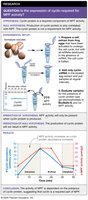
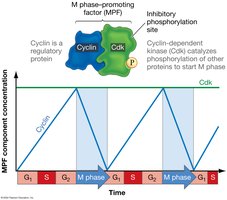
Cyclins and cyclin-dependent kinases (Cdks) are key proteins that regulate cell cycle transitions. Their concentrations and activity fluctuate throughout the cycle.
Cyclin: Regulatory protein whose levels rise and fall with the cell cycle.
Cdk: Protein kinase activated by binding cyclin; phosphorylates target proteins to drive cell cycle progression.
Equation:
Additional info: MPF (M-phase-promoting factor) is active only when cyclin is bound to Cdk and specific phosphorylation events occur.
Chromosome Movement during Mitosis
Anaphase: Microtubule Dynamics
During anaphase, chromosomes are separated by the shortening of kinetochore microtubules. Proteins at the kinetochore facilitate movement by disassembling tubulin subunits at the microtubule's plus end.
Kinetochore: Protein complex at the centromere, attaches chromosomes to spindle fibers.
Microtubule dynamics: Tubulin subunits are lost from the plus end, moving the chromosome toward the pole.
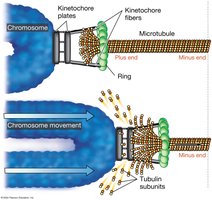
Additional info: This mechanism ensures accurate chromosome segregation.
Cancer and Cell Cycle Control
Cancer: Loss of Cell Cycle Regulation
Cancer arises when cell cycle checkpoints fail, leading to uncontrolled cell division. Tumor suppressor genes and growth factor signaling are often defective in cancer cells.
Malignant tumors: Invasive, can metastasize to other tissues.
Benign tumors: Non-invasive, do not spread.
Metastasis: Spread of cancer cells via blood or lymph.
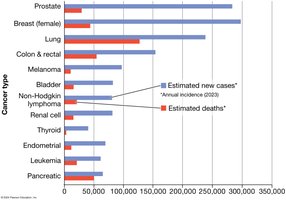
Example: Mutations in the p53 gene or overproduction of cyclin can lead to cancer.
Additional info: Social control mechanisms, such as growth factors, normally restrict cell division to benefit the organism. Cancer cells often ignore these signals.
Summary Table: Cell Cycle Phases and Key Features
Phase | Main Events | Key Regulatory Proteins |
|---|---|---|
G1 | Cell growth, preparation for DNA replication | Cyclin D, Cdk4/6 |
S | DNA synthesis, chromosome replication | Cyclin E/A, Cdk2 |
G2 | Preparation for mitosis | Cyclin A/B, Cdk1 |
M | Mitosis and cytokinesis | MPF (Cyclin B + Cdk1) |
Additional info: Checkpoints at G1, G2, and M phases ensure proper cell cycle progression and prevent propagation of damaged DNA.
