Back
BackThe Cell Theory and Basic Components of Cells
Study Guide - Smart Notes
 Tailored notes based on your materials, expanded with key definitions, examples, and context.
The Cell Theory
Foundational Principles of Cell Biology
The cell theory is a fundamental concept in biology that describes the properties of cells, the basic unit of life. It provides the framework for understanding the structure and function of all living organisms.
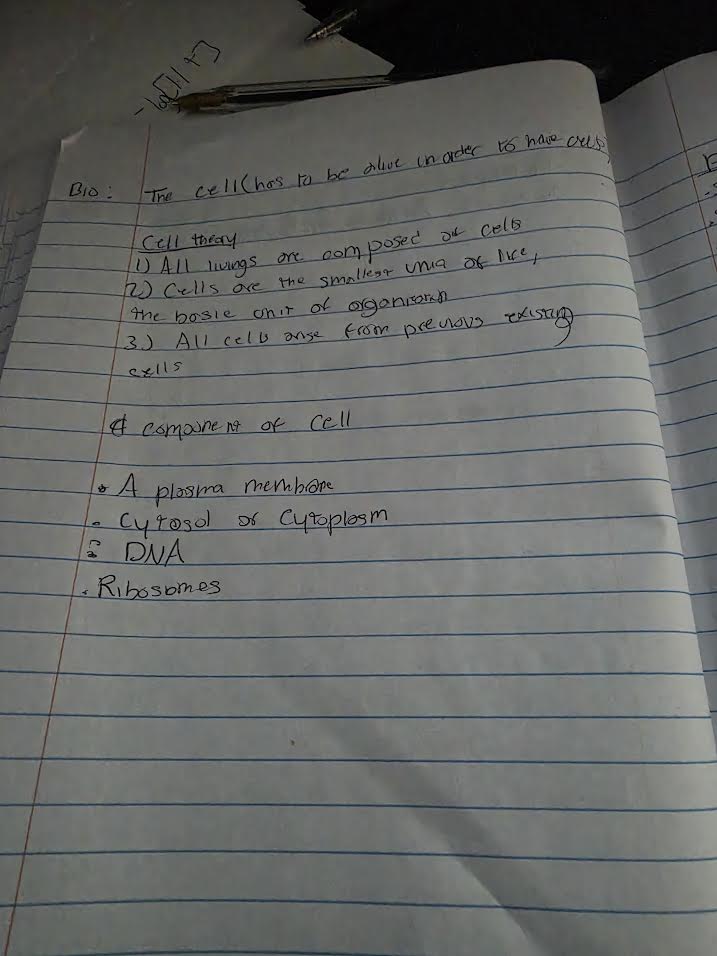
All living things are composed of cells: Every organism, from the simplest bacteria to complex multicellular organisms like plants and animals, is made up of one or more cells.
Cells are the smallest unit of life: The cell is the basic structural and functional unit of all living organisms. It is the smallest entity that can carry out all life processes.
All cells arise from pre-existing cells: New cells are produced by the division of existing cells, ensuring the continuity of life.
Example: When a human body heals a wound, new skin cells are produced by the division of existing skin cells, illustrating the principle that all cells come from pre-existing cells.
Basic Components of All Cells
Universal Structures Found in Cells
Despite the diversity of cell types, all cells share certain fundamental structures that are essential for their function and survival.
Plasma Membrane: A selectively permeable barrier that surrounds the cell, controlling the movement of substances in and out of the cell.
Cytosol (Cytoplasm): The semi-fluid, jelly-like substance inside the cell where cellular processes occur. The cytoplasm includes the cytosol and the organelles suspended within it.
DNA: The genetic material that contains instructions for the cell's structure, function, and regulation. In eukaryotic cells, DNA is found in the nucleus; in prokaryotic cells, it is located in the nucleoid region.
Ribosomes: Molecular machines responsible for protein synthesis. Ribosomes can be free in the cytoplasm or attached to cellular membranes.
Additional info: These components are present in both prokaryotic and eukaryotic cells, although their organization and complexity may differ. For example, eukaryotic cells have membrane-bound organelles, while prokaryotic cells do not.