 Back
The Chemical Basis for Life: Essential Concepts for General Biology
Study Guide - Smart Notes
 Tailored notes based on your materials, expanded with key definitions, examples, and context.
Chapter 2: The Chemical Basis for Life
What is Matter, Elements, and Compounds?
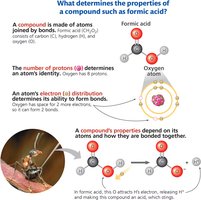
Matter is anything that occupies space and has mass. It is composed of elements, which are pure substances consisting of only one type of atom. Compounds are substances formed when two or more elements are chemically combined in fixed ratios.
Element: A substance that cannot be broken down into simpler substances by chemical means.
Compound: A substance made of atoms joined by bonds, such as formic acid (HCOOH).
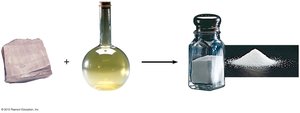
Example: Sodium (Na) and Chlorine (Cl) combine to form sodium chloride (NaCl), a compound.
Elements of Life and Trace Elements
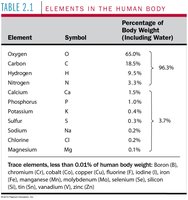
Living organisms are primarily composed of a few major elements, with trace elements required in small amounts for proper physiological function.
Major elements: Oxygen, Carbon, Hydrogen, Nitrogen
Trace elements: Iron, Iodine, Fluorine, Zinc, etc.
Deficiency effects:
Iron: Anemia
Iodine: Goiter, mental retardation
Fluorine: Tooth decay
Zinc: Acne, diarrhea, wasting of body tissue

Atomic Structure
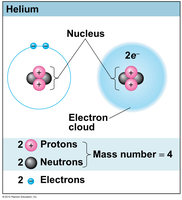
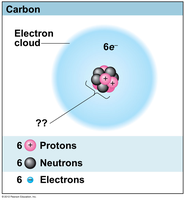
Atoms are the basic units of matter, consisting of subatomic particles: protons, neutrons, and electrons. The number of protons determines the element's identity, while the atomic mass is the sum of protons and neutrons.
Protons: Positively charged particles in the nucleus
Neutrons: Neutral particles in the nucleus
Electrons: Negatively charged particles orbiting the nucleus
Atomic number: Number of protons
Atomic mass: Number of protons + number of neutrons
Isotopes and Radioactivity
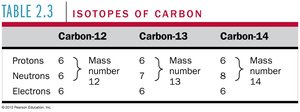
Isotopes are atoms of the same element with different numbers of neutrons. Some isotopes are radioactive, meaning their nuclei decay spontaneously, emitting radiation.
Stable isotope: Does not emit radiation
Radioactive isotope: Unstable, emits radiation
Applications:
Phosphorus-32: Labels DNA and RNA
Carbon-14: Carbon dating, labeling biological molecules
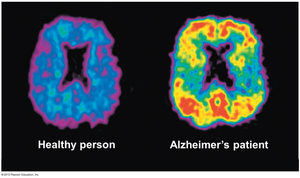
Fluorine-18: PET scans
Isotope | Protons | Neutrons | Electrons | Mass Number |
|---|---|---|---|---|
Carbon-12 | 6 | 6 | 6 | 12 |
Carbon-13 | 6 | 7 | 6 | 13 |
Carbon-14 | 6 | 8 | 6 | 14 |
Electron Shells and Energy Levels
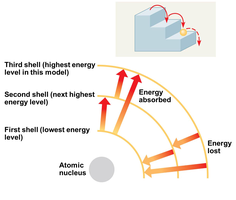
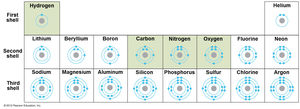
Electrons occupy energy levels called shells. The potential energy of electrons depends on their shell, and electrons absorb or release energy when moving between shells.
Valence shell: Outermost shell, determines chemical properties
Electron orbitals: Regions where electrons are likely found
Shell capacity:
1st shell: 2 electrons
2nd shell: 8 electrons
3rd shell: 8 electrons
Chemical Bonds
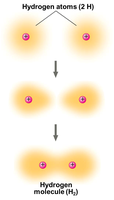
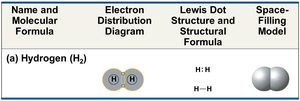
Atoms form chemical bonds to fill their valence shells. The main types of bonds are covalent, ionic, and weak bonds (hydrogen bonds, van der Waals interactions).
Covalent bond: Pair of electrons shared between atoms; forms molecules
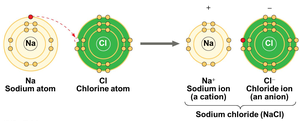
Ionic bond: Electrons transferred, forming charged ions that attract each other
Hydrogen bond: Weak attraction between a hydrogen atom and another electronegative atom
Van der Waals interaction: Weak, temporary attractions between molecules
Polar and Nonpolar Covalent Bonds
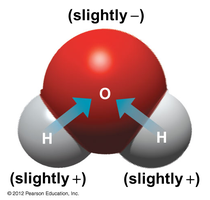
Polar covalent bonds occur when electrons are shared unequally due to differences in electronegativity, resulting in partial charges. Nonpolar covalent bonds involve equal sharing of electrons.
Electronegativity: Atom's ability to attract electrons
Example: Water (H2O) is a polar molecule
Ionic Bonds and Salts
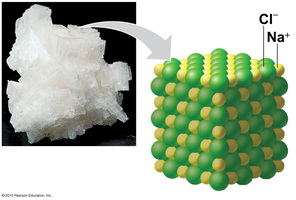
Ionic bonds form when atoms transfer electrons, resulting in oppositely charged ions that attract each other. Ionic compounds, such as salts, are formed from these bonds.
Cation: Positively charged ion
Anion: Negatively charged ion
Example: Sodium chloride (NaCl) is formed from Na+ and Cl-
Chemical Reactions
Chemical reactions involve the making or breaking of chemical bonds, resulting in the rearrangement of atoms. These reactions can release or store energy.
Reactants: Starting substances
Products: Substances formed
Example: Photosynthesis captures energy from sunlight to form glucose.
Balanced equation:
Reversible reactions: Some reactions can proceed in both directions, indicated by double arrows.
