 Back
BackThe Chemical Basis of Life: Atoms, Bonds, and Water
Study Guide - Smart Notes
 Tailored notes based on your materials, expanded with key definitions, examples, and context.
The Chemical Basis of Life
Holistic vs. Reductionist Approaches
Biology can be studied from a holistic perspective, which considers the complexity of entire systems, or a reductionist perspective, which breaks down systems into their component parts for detailed study. Both approaches are valuable for understanding biological phenomena.
Matter, Atoms, and Elements
Definitions and Key Concepts
Matter: Anything that has mass and occupies space.
Element: A substance that cannot be broken down into other substances by chemical means.
Atom: The smallest unit of an element that retains its properties.
Molecule: Two or more atoms held together by chemical bonds.
Compound: A substance consisting of two or more different elements combined in a fixed ratio.
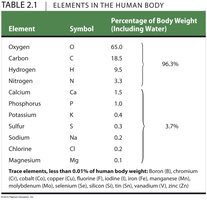
Elements in the Human Body
Living organisms are composed primarily of a few key elements. The most abundant elements in the human body are oxygen, carbon, hydrogen, and nitrogen.
Element | Symbol | Percentage of Body Weight |
|---|---|---|
Oxygen | O | 65.0 |
Carbon | C | 18.5 |
Hydrogen | H | 9.5 |
Nitrogen | N | 3.3 |
Calcium | Ca | 1.5 |
Phosphorus | P | 1.0 |
Potassium | K | 0.4 |
Sulfur | S | 0.3 |
Sodium | Na | 0.2 |
Chlorine | Cl | 0.2 |
Magnesium | Mg | 0.1 |
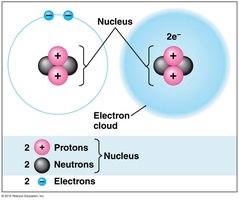
Parts of an Atom
Atomic Structure
Protons: Positively charged particles found in the nucleus.
Neutrons: Neutral particles found in the nucleus.
Electrons: Negatively charged particles orbiting the nucleus in electron shells.
Atomic Properties
Atomic Number: Number of protons in an atom, determines the element.
Atomic Mass (Mass Number): Sum of protons and neutrons in the nucleus.
Isotope: Atoms of the same element with different numbers of neutrons.
Radioisotope: An isotope with an unstable nucleus that emits radiation.
Ion: An atom or molecule with a net electric charge due to loss or gain of electrons.
Cation: Positively charged ion (loss of electrons).
Anion: Negatively charged ion (gain of electrons).
Electron Shells: Energy levels where electrons are found; the outermost is the valence shell.
Electrons and Chemical Bonds
Valence Shells and Stability
The outermost shell of an atom, called the valence shell, determines its chemical reactivity. Atoms tend to share, gain, or lose electrons to achieve a full valence shell, leading to the formation of chemical bonds.
Covalent Bonds
Covalent bonds form when two atoms share one or more pairs of electrons. These bonds can be single, double, or triple, depending on the number of shared electron pairs. Covalent bonds are strong and common in biological molecules.
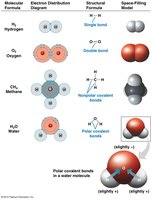
Electronegativity
Electronegativity is the tendency of an atom to attract electrons in a covalent bond. Differences in electronegativity between atoms can lead to polar covalent bonds, where electrons are shared unequally, creating partial charges within the molecule.
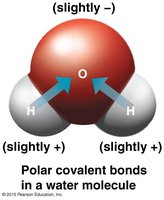
Ionic Bonds
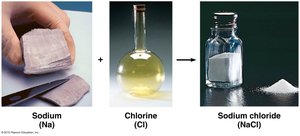
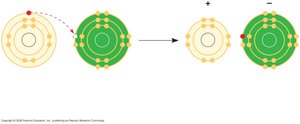
Ionic bonds form when one atom transfers electrons to another, resulting in the formation of oppositely charged ions that attract each other. For example, sodium (Na) donates an electron to chlorine (Cl), forming sodium chloride (NaCl).
Hydrogen Bonds
Hydrogen bonds are weak attractions between a hydrogen atom covalently bonded to a highly electronegative atom (such as oxygen or nitrogen) and another electronegative atom. These bonds are crucial for the structure and properties of water and biological macromolecules.
Van der Waals Interactions
Van der Waals interactions are weak, transient attractions between molecules or parts of molecules that result from transient local partial charges. These interactions are important in the three-dimensional structure of proteins and other macromolecules.

Chemical Reactions and Bonds
Chemical Reactions
A chemical reaction involves the making and breaking of chemical bonds, converting reactants into products.
Some reactions are reversible, meaning they can proceed in both directions.
Chemical equilibrium is reached when the forward and reverse reactions occur at the same rate.
Example: The reaction of hydrogen and oxygen to form water:
Water and Hydrogen Bonding
Cohesion and Adhesion
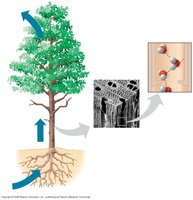
Water molecules are held together by hydrogen bonds, resulting in cohesion (attraction between water molecules) and adhesion (attraction between water and other substances). These properties are essential for processes like water transport in plants.
Temperature Moderation
Water has a high specific heat capacity due to hydrogen bonding, allowing it to absorb and release large amounts of heat with minimal temperature change. This property helps stabilize temperatures in organisms and environments.
Density of Water
Water is less dense as a solid (ice) than as a liquid because hydrogen bonds form a crystalline structure in ice, spacing molecules farther apart. This allows ice to float on water, insulating aquatic life in cold climates.
The Universal Solvent
Solvent: The dissolving agent in a solution (e.g., water).
Solute: The substance dissolved in the solvent.
Solution: A homogeneous mixture of solute and solvent.
Water and pH
pH and Ionization
Water molecules can dissociate into hydrogen ions (H+) and hydroxide ions (OH-). The pH scale measures the concentration of H+ ions in a solution:
pH < 7: Acidic (higher H+ concentration)
pH = 7: Neutral (equal H+ and OH-)
pH > 7: Basic (lower H+ concentration)
Acids and Bases
Acids: Substances that increase H+ concentration in solution (e.g., HCl).
Bases: Substances that decrease H+ concentration, either by absorbing H+ (e.g., NH3) or releasing OH- (e.g., NaOH).
The pH Scale
The pH scale ranges from 0 (most acidic) to 14 (most basic), with 7 being neutral. Each unit represents a tenfold difference in H+ concentration.
pH Buffers
Buffers are substances that minimize changes in pH by absorbing or releasing H+ or OH- ions. Biological systems rely on buffers to maintain stable internal pH for proper function.
Molecular Structure and Function
Structure Determines Function
The structure of molecules, determined by the types and arrangements of bonds, is critical to their function in living organisms. Understanding atomic interactions helps explain the behavior of biological molecules.
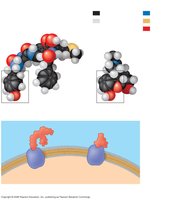
Example: Endorphin and Morphine
Both endorphin (a natural pain-relieving molecule) and morphine (a drug) have similar shapes, allowing them to bind to the same receptors in the brain and produce similar effects.
Key Terms
Matter
Element
Atom
Molecule
Compound
Protons
Atomic number
Atomic mass
Electrons
Ions
Neutrons
Isotope
Chemical bonds
Ionic bonds
Covalent bonds
Hydrogen bonds
Chemical reaction
Reversible reaction
Chemical equilibrium
Solution
Solvent
Solute
pH
Acids
Bases
Buffers
