 Back
The Chemical Basis of Life: Carbon and Molecular Diversity
Study Guide - Smart Notes
 Tailored notes based on your materials, expanded with key definitions, examples, and context.
Organic Chemistry and the Origin of Life
Definition and Importance of Organic Chemistry
Organic chemistry is the study of compounds that contain carbon, regardless of their origin. This field is central to biology because carbon-based molecules form the foundation of all living organisms. Organic compounds range from simple molecules to complex macromolecules, and their diversity is essential for life's complexity.
Organic molecules are crucial for the structure and function of cells.
Experiments such as the Miller-Urey experiment support the hypothesis that organic molecules could form abiotically under early Earth conditions, possibly near volcanoes.
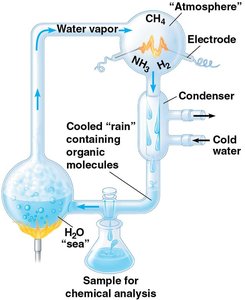
Example: The Miller-Urey experiment demonstrated that amino acids and other organic molecules could be synthesized from inorganic precursors under conditions simulating the early Earth's atmosphere.
Carbon: The Backbone of Life
Electron Configuration and Bonding
Carbon's unique electron configuration allows it to form four covalent bonds, enabling the construction of a vast array of molecular structures. This versatility is the basis for the diversity of organic molecules.
Valence electrons: Carbon has four valence electrons, allowing it to form four covalent bonds.
Electron configuration: Determines the types and numbers of bonds an atom can form.
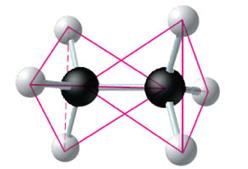
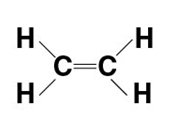
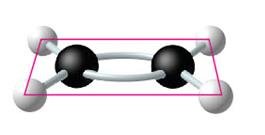
Molecular shape: When carbon forms four single bonds, the molecule adopts a tetrahedral geometry; double bonds result in planar structures.
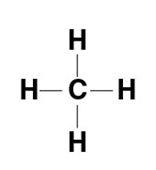
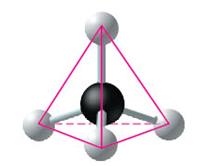
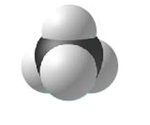
Example: Methane (CH4) is a simple organic molecule with a tetrahedral geometry.
Common Carbon Compounds and Their Structures
Methane (CH4): Tetrahedral shape.
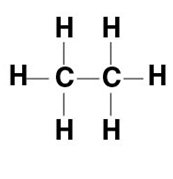
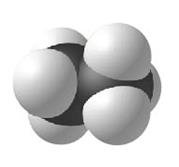
Ethane (C2H6): Two tetrahedral carbons bonded together.
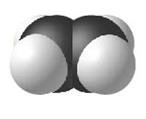
Ethene (C2H4): Planar molecule due to a double bond between carbons.
Valence and Bonding Capacity
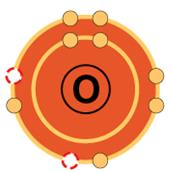
The number of unpaired electrons in the valence shell of an atom determines its bonding capacity (valence). For the main elements in organic molecules:
Element | Valence Electrons | Valence (Bonds Formed) |
|---|---|---|
Hydrogen | 1 | 1 |
Oxygen | 2 | 2 |
Nitrogen | 3 | 3 |
Carbon | 4 | 4 |



Carbon's Bonding Partners
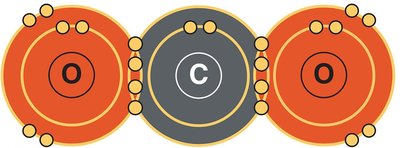
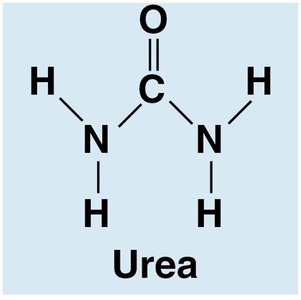
Carbon commonly forms covalent bonds with hydrogen, oxygen, and nitrogen, as well as with other carbon atoms. This allows for the formation of a wide variety of molecules, including carbon dioxide (CO2) and urea (CO(NH2)2).
Carbon Chains and Molecular Diversity
Carbon Skeletons
Carbon atoms can link together to form chains that serve as the backbone for organic molecules. These chains can vary in length, branching, double bond position, and the presence of rings, contributing to molecular diversity.
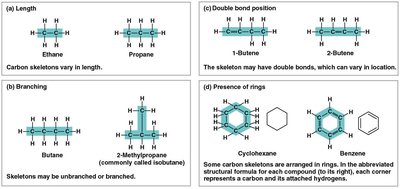
Length: Chains can be short or long.
Branching: Chains may be unbranched or branched.
Double bond position: Double bonds can vary in location.
Rings: Some carbon skeletons form rings.
Hydrocarbons
Hydrocarbons are organic molecules consisting entirely of carbon and hydrogen. They are hydrophobic and can store significant amounts of energy, making them important components of fats.
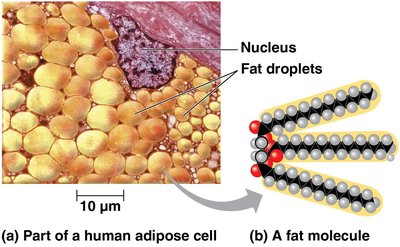
Example: Fat molecules contain long hydrocarbon chains that store energy for biological processes.
Isomers: Structural Diversity in Organic Molecules
Types of Isomers
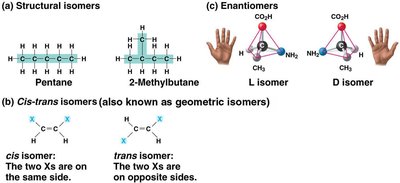
Isomers are compounds with the same molecular formula but different structures and properties. There are three main types:
Structural isomers: Differ in the covalent arrangement of atoms.
Cis-trans (geometric) isomers: Have the same covalent bonds but differ in spatial arrangement around a double bond.
Enantiomers: Are mirror images of each other and cannot be superimposed.
Biological Importance of Enantiomers
Enantiomers can have dramatically different biological effects. For example, only one enantiomer of a drug may be biologically active, while the other is inactive or even harmful.
Drug | Effective Enantiomer | Ineffective Enantiomer | Effect |
|---|---|---|---|
Ibuprofen | S-Ibuprofen | R-Ibuprofen | Reduces inflammation and pain |
Albuterol | R-Albuterol | S-Albuterol | Relaxes bronchial muscles |
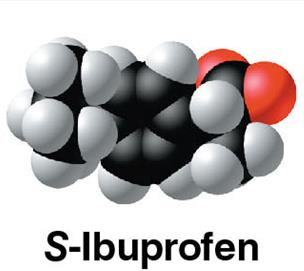
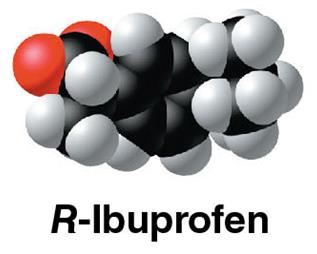
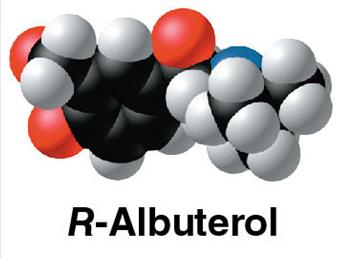
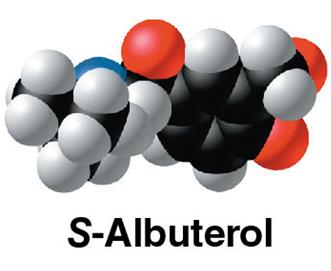
Example: The differing effects of enantiomers in drugs like ibuprofen and albuterol highlight the importance of molecular shape in biology.
Chemical Groups and Molecular Function
Functional Groups
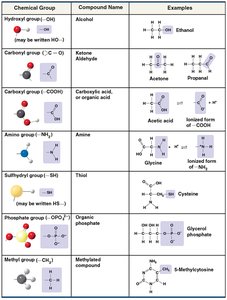
Functional groups are specific groups of atoms attached to carbon skeletons that are most commonly involved in chemical reactions. The number and arrangement of these groups give molecules their unique properties.
Hydroxyl group (-OH): Alcohols, e.g., ethanol
Carbonyl group (C=O): Ketones and aldehydes, e.g., acetone
Carboxyl group (-COOH): Carboxylic acids, e.g., acetic acid
Amino group (-NH2): Amines, e.g., glycine
Sulfhydryl group (-SH): Thiols, e.g., cysteine
Phosphate group (-OPO32-): Organic phosphates, e.g., ATP
Methyl group (-CH3): Methylated compounds, e.g., 5-methylcytosine
Case Study: Sex Hormones
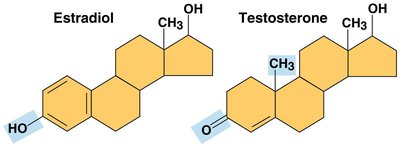
Estradiol and testosterone are both steroids with a common carbon skeleton but differ in the functional groups attached to the rings. These small differences result in distinct biological functions.
ATP: The Energy Currency of the Cell
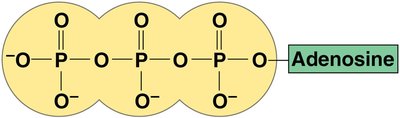
Adenosine triphosphate (ATP) is an organic phosphate molecule that stores and releases energy for cellular processes. The three phosphate groups are key to its energy-storing capability.

When ATP reacts with water, it releases energy by converting to adenosine diphosphate (ADP) and inorganic phosphate:
Summary Table: Key Concepts
Concept | Key Points |
|---|---|
Organic Chemistry | Study of carbon compounds; origin of life; abiotic synthesis |
Carbon Bonding | Four covalent bonds; molecular diversity; tetrahedral geometry |
Isomers | Structural, cis-trans, enantiomers; biological significance |
Functional Groups | Hydroxyl, carbonyl, carboxyl, amino, sulfhydryl, phosphate, methyl |
ATP | Energy storage and release; phosphate groups |
