 Back
BackThe Chemical Basis of Life: Elements, Atoms, and Water’s Properties
Study Guide - Smart Notes
 Tailored notes based on your materials, expanded with key definitions, examples, and context.
Chapter 2: The Chemical Basis of Life
Big Ideas: Elements, Atoms, and Compounds
This chapter explores the fundamental chemical principles that underlie biological processes, focusing on the structure of matter, the nature of atoms and elements, and the unique properties of water that support life.
Matter and Elements
Definition and States of Matter
Matter is any physical substance that occupies space and possesses mass.
Matter exists in three primary states: solid, liquid, and gas.
All matter is composed of atoms, the smallest units of elements.
Elements in Biology
An element is a substance consisting of only one type of atom, defined by its number of protons.
There are 118 known elements, with 94 occurring naturally.
Living organisms are primarily composed of a few key elements: oxygen (O), carbon (C), hydrogen (H), nitrogen (N), calcium (Ca), phosphorus (P), potassium (K), sulfur (S), and sodium (Na).
Atoms: Structure and Properties
Atomic Structure
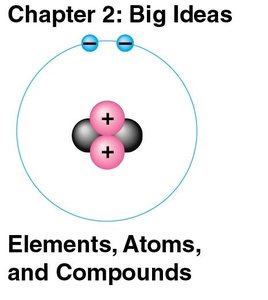
An atom consists of a central nucleus (containing protons and neutrons) and surrounding electron shells.
Protons: Positively charged particles in the nucleus.
Neutrons: Neutral particles in the nucleus.
Electrons: Negatively charged particles in shells around the nucleus.
Atomic Number, Mass Number, and Symbols
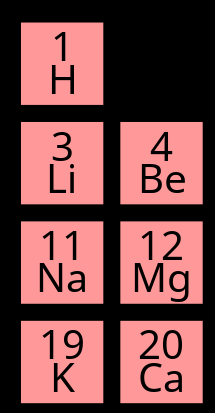
Atomic Number: Number of protons in an atom; defines the element.
Atomic Mass: Approximately the sum of protons and neutrons (measured in atomic mass units, AMU).
Atomic Symbol: One- or two-letter abbreviation for an element (e.g., H for hydrogen, Na for sodium).
Isotopes and Radioactivity
Isotopes: Atoms of the same element with different numbers of neutrons.
Some isotopes are radioactive, emitting particles as they decay to stability.
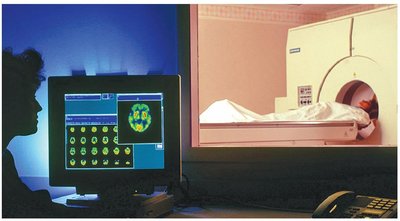
Radioactive isotopes are used as tracers in biological research and medicine, but can also be hazardous.
Electron Shells and Chemical Behavior
Electron Arrangement
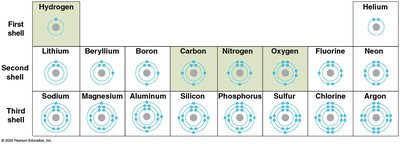
Electrons occupy shells around the nucleus, each with a maximum capacity (Shell 1: 2, Shell 2: 8, Shell 3: 8, Shell 4: 8 electrons).
The valence shell is the outermost shell; its occupancy determines chemical reactivity.
Atoms with incomplete valence shells tend to form chemical bonds to achieve stability.
Molecules, Compounds, and Chemical Reactions
Molecules and Compounds
A molecule is two or more atoms bonded together.
A compound is a molecule composed of two or more different elements (e.g., H2O, CO2).
Chemical formulas indicate the types and numbers of atoms in a molecule (e.g., C6H12O6).
Chemical Reactions
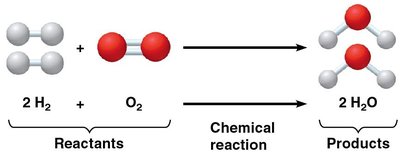
Chemical reactions involve breaking and forming chemical bonds, converting reactants into products.
Matter is neither created nor destroyed in chemical reactions; atoms are simply rearranged.
Example: The reaction of hydrogen and oxygen to form water:
Chemical Bonds
Types of Chemical Bonds
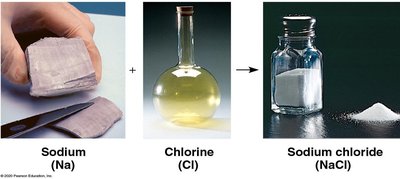
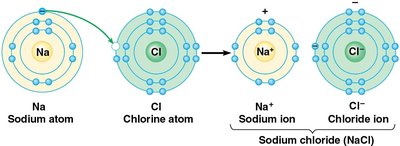
Ionic Bonds: Formed by the transfer of electrons from one atom to another, resulting in oppositely charged ions that attract each other (e.g., NaCl).
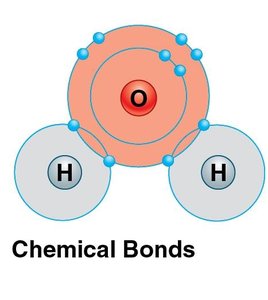
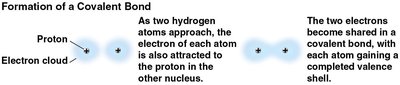
Covalent Bonds: Atoms share pairs of electrons to fill their valence shells. Can be nonpolar (equal sharing) or polar (unequal sharing).
Hydrogen Bonds: Weak attractions between partial positive and negative charges, often involving hydrogen and electronegative atoms like oxygen or nitrogen.
Ionic Bonds
Ions are atoms or molecules with a net electrical charge due to loss or gain of electrons.
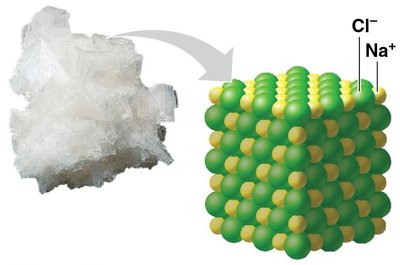
Oppositely charged ions attract, forming ionic compounds (e.g., table salt, NaCl).
Covalent Bonds
Atoms share valence electrons to achieve stable electron configurations.
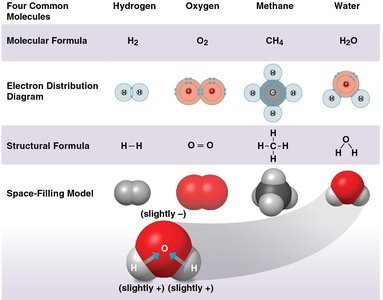
Nonpolar covalent bonds: Electrons are shared equally (e.g., H2, O2).
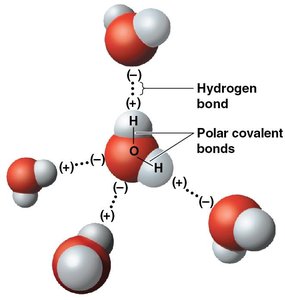
Polar covalent bonds: Electrons are shared unequally, creating partial charges (e.g., H2O).
Hydrogen Bonds
Form between the slightly positive hydrogen atom of one molecule and the slightly negative atom of another (often oxygen or nitrogen).
Individually weak, but collectively strong in large numbers (e.g., in water).
Properties of Water
Polarity and Hydrogen Bonding
Water is a polar molecule due to the unequal sharing of electrons between oxygen and hydrogen.
This polarity allows water molecules to form hydrogen bonds with each other.
Emergent Properties of Water
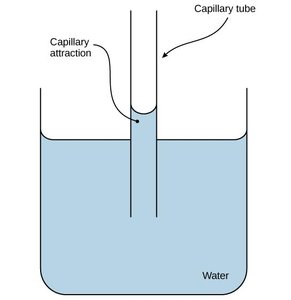
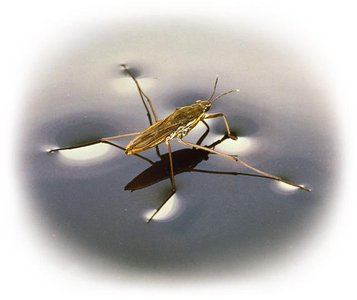
Cohesion: Water molecules stick to each other, creating surface tension.
Adhesion: Water molecules stick to other polar surfaces, aiding in capillary action.
High Specific Heat: Water can absorb or release large amounts of heat with little temperature change, stabilizing environments.
Evaporative Cooling: As water evaporates, it removes heat, cooling surfaces (e.g., sweating).
Ice Floats: Solid water (ice) is less dense than liquid water due to hydrogen bond-induced lattice structure.
Solvent Properties: Water dissolves many substances, making it the "solvent of life." Polar and ionic compounds dissolve readily in water.

Acids, Bases, and pH
Ionization of Water
Water can dissociate into hydrogen ions (H+) and hydroxide ions (OH-).
The balance of these ions determines the pH of a solution.
pH is a logarithmic scale:
pH 7 is neutral; lower values are acidic, higher values are basic.
Acids, Bases, and Buffers
Acids: Substances that increase H+ concentration (e.g., HCl).
Bases: Substances that decrease H+ concentration, often by releasing OH- or binding H+.
Buffers: Substances that minimize changes in pH by accepting or donating H+ as needed.
Summary Table: Types of Chemical Bonds
Bond Type | Mechanism | Strength | Example |
|---|---|---|---|
Ionic | Transfer of electrons; attraction between ions | Strong (in dry conditions) | NaCl (table salt) |
Covalent | Sharing of electron pairs | Very strong | H2O, O2 |
Hydrogen | Attraction between partial charges | Weak (individually) | Between water molecules |
Additional info: The chemical properties of water, including its polarity, hydrogen bonding, and ability to moderate temperature, are essential for life as we know it. These properties enable water to support complex biological processes, from cellular metabolism to climate regulation.
