 Back
Lecture 2 part 1
Study Guide - Smart Notes
 Tailored notes based on your materials, expanded with key definitions, examples, and context.
The Chemical Context of Life
Elements of Life
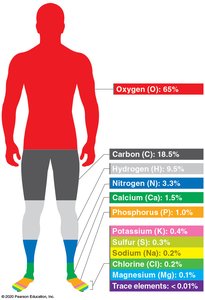
All living organisms are composed of matter, which is made up of elements. An element is a substance that cannot be broken down into other substances by ordinary chemical means. The human body is primarily composed of a few major elements, with several others present in trace amounts.
Major elements: Oxygen (O), Carbon (C), Hydrogen (H), Nitrogen (N), Calcium (Ca), Phosphorus (P)
Trace elements: Elements required by an organism in minute quantities, such as iron (Fe), iodine (I), and zinc (Zn).
Example: Iodine is a trace element essential for thyroid function.
Atoms: Structure and Subatomic Particles
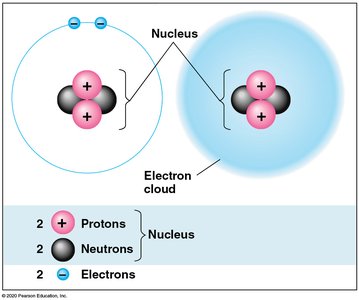
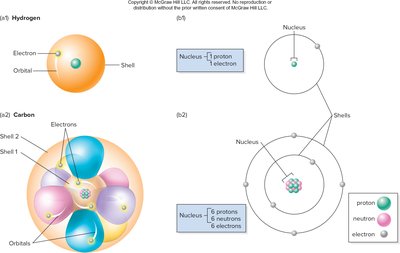
An atom is the smallest unit of matter that retains the properties of an element. Atoms are composed of three types of subatomic particles:
Proton: Positively charged particle found in the nucleus.
Neutron: Neutrally charged particle found in the nucleus.
Electron: Negatively charged particle that orbits the nucleus in electron shells.
The number of protons defines the element, while the number of neutrons and electrons can vary.
Atomic Number and Mass Number
Each element is characterized by its atomic number and mass number:
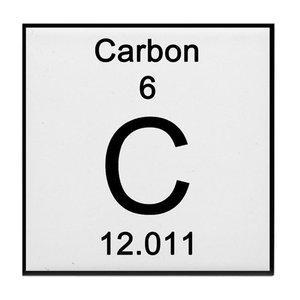
Atomic Number (Z): The number of protons in the nucleus. In a neutral atom, this also equals the number of electrons.
Mass Number (A): The sum of protons and neutrons in the nucleus.
Example: Carbon has an atomic number of 6 (6 protons) and a typical mass number of 12 (6 protons + 6 neutrons).
Isotopes
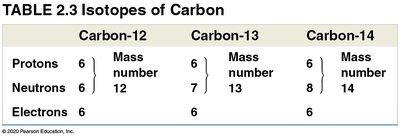
Isotopes are atoms of the same element that have the same number of protons but different numbers of neutrons, resulting in different mass numbers. Some isotopes are stable, while others are radioactive and decay over time.
Example: Carbon-12, Carbon-13, and Carbon-14 are isotopes of carbon.
Carbon-12 | Carbon-13 | Carbon-14 | |
|---|---|---|---|
Protons | 6 | 6 | 6 |
Neutrons | 6 | 7 | 8 |
Electrons | 6 | 6 | 6 |
Mass Number | 12 | 13 | 14 |
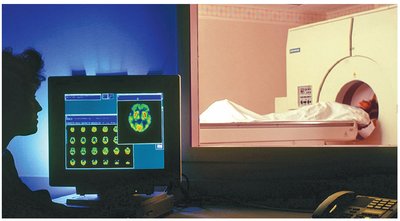
Applications: Radioactive isotopes are used in medical imaging and dating fossils.
Electron Shells and Valence Electrons
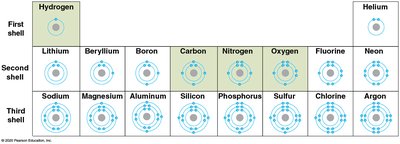
Electrons are arranged in electron shells around the nucleus. Each shell has a characteristic energy level and can hold a specific number of electrons:
First shell: up to 2 electrons
Second shell: up to 8 electrons
Third shell: up to 18 electrons (but is stable with 8 for many elements)
The valence shell is the outermost electron shell. The number of electrons in this shell determines the chemical properties and reactivity of the atom.
Example: Oxygen (atomic number 8) has 2 electrons in the first shell and 6 in the second shell; thus, it has 6 valence electrons.
Example: Carbon (atomic number 6) has 2 electrons in the first shell and 4 in the second shell; thus, it has 4 valence electrons.
Summary Table: Key Atomic Properties
Property | Definition | Example (Carbon) |
|---|---|---|
Atomic Number | Number of protons | 6 |
Mass Number | Protons + Neutrons | 12 (most common isotope) |
Isotope | Atoms with same protons, different neutrons | Carbon-12, Carbon-13, Carbon-14 |
Valence Electrons | Electrons in outermost shell | 4 |
Additional info: The arrangement of electrons in shells and the presence of valence electrons are fundamental to understanding chemical bonding and molecular interactions, which are covered in later chapters.
