 Back
The Chemical Basis of Life: Elements, Atoms, and Chemical Bonds
Study Guide - Smart Notes
 Tailored notes based on your materials, expanded with key definitions, examples, and context.
Chapter 2: The Chemical Basis of Life
Elements and Atoms
All matter is composed of chemical elements, which are substances that cannot be broken down into other substances by ordinary chemical means. Understanding the nature of elements and atoms is fundamental to biology, as living organisms are made up of these basic units.
Matter: Anything that occupies space and has mass. Exists in three physical states: solid, liquid, and gas.
Element: A pure substance consisting of only one type of atom. There are 92 naturally occurring elements, each with a unique symbol.
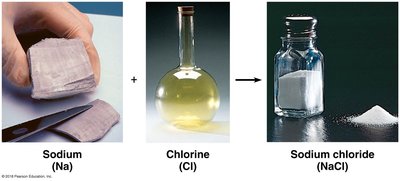
Compound: A substance formed from two or more elements combined in a fixed ratio. Compounds have characteristics different from their constituent elements.
Example: Table salt (sodium chloride, NaCl) is a compound formed from sodium (Na) and chlorine (Cl).
Components of Life
Living organisms are primarily composed of a small subset of elements. The number and type of elements required for life vary among organisms.
Most biological molecules contain at least three or four elements.
Sugar: Composed of carbon (C), oxygen (O), and hydrogen (H).
Proteins: Composed of C, O, H, nitrogen (N), and sulfur (S).
Humans require 25 elements; plants require 17 elements for life.
The Big Six Elements
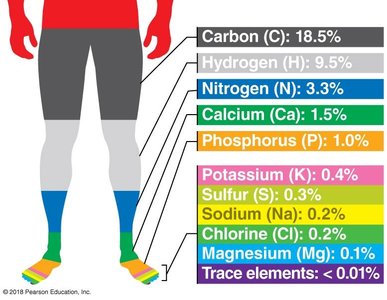
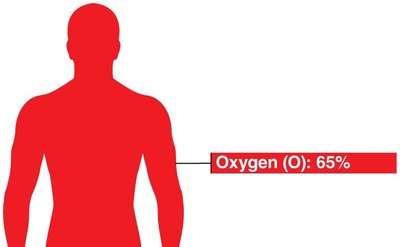
Six elements make up about 99% of the mass of the human body. These are essential for the structure and function of biomolecules.
Oxygen (O), Carbon (C), Hydrogen (H), Nitrogen (N): Building blocks of proteins, carbohydrates, and lipids.
Phosphorus (P) and Calcium (Ca): Major components of bones and teeth. Deficiency in either can lead to severe health issues.
Other Important Elements and Trace Elements
Other elements such as potassium (K), sulfur (S), sodium (Na), chlorine (Cl), and magnesium (Mg) are vital for nerve signaling and chemical reactions. Trace elements are required in minute amounts but are essential for life.
Trace elements: Boron, chromium, cobalt, copper, fluorine, iodine, iron, manganese, molybdenum, selenium, silicon, tin, vanadium, and zinc.
Some trace elements are required by all organisms (e.g., iron), while others are species-specific (e.g., iodine for humans).
Atoms and Subatomic Particles
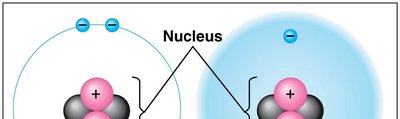
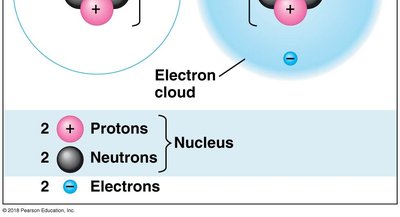
An atom is the smallest unit of matter that retains the properties of an element. Atoms are composed of subatomic particles: protons, neutrons, and electrons.
Proton: Positive charge (+1)
Neutron: No charge (neutral)
Electron: Negative charge (-1)
Nucleus: Central core containing protons and neutrons; electrons form a cloud around the nucleus.
Atomic Number, Mass Number, and Atomic Mass
Each element is defined by its atomic number, which is the number of protons in its nucleus. The mass number is the sum of protons and neutrons. Atomic mass is measured in Daltons (Da).
Atomic number: Number of protons in an atom.
Mass number: Number of protons plus neutrons.
Atomic mass: Approximately equal to the mass number (in Daltons).
Example: Helium has an atomic number of 2 and a mass number of 4.
Isotopes and Radioactivity
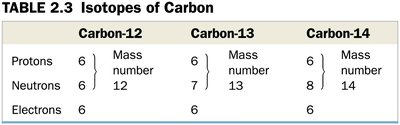
Isotopes are atoms of the same element with different numbers of neutrons. Some isotopes are stable, while others are radioactive and decay spontaneously, emitting radiation.
Stable isotopes: Do not change over time (e.g., Carbon-12, Carbon-13).
Radioactive isotopes: Unstable nuclei that decay, releasing particles and energy (e.g., Carbon-14).
Applications: Used in dating fossils, medical imaging, and research.
Carbon-12 | Carbon-13 | Carbon-14 | |
|---|---|---|---|
Protons | 6 | 6 | 6 |
Neutrons | 6 | 7 | 8 |
Electrons | 6 | 6 | 6 |
Mass number | 12 | 13 | 14 |
Electron Arrangement and Chemical Properties
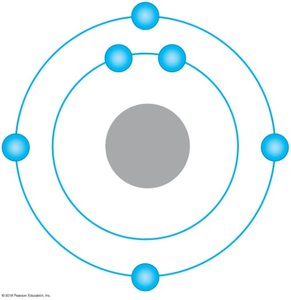
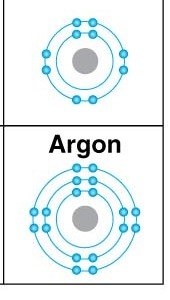
The arrangement of electrons in shells around the nucleus determines an atom's chemical properties. The outermost shell, called the valence shell, is most important for chemical bonding.
Electron shells: Each shell holds a specific number of electrons (1st: 2, 2nd: 8, 3rd: 8).
Valence electrons: Electrons in the outermost shell; determine reactivity.
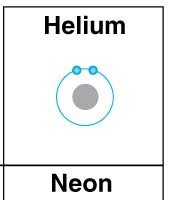
Inert elements: Atoms with full valence shells (e.g., helium, neon, argon) are chemically unreactive.
Chemical Bonds and Reactions
Chemical reactions occur when atoms interact to complete their valence shells by transferring or sharing electrons. The main types of chemical bonds are ionic and covalent bonds.
Ionic bond: Formed when one atom transfers electrons to another, resulting in oppositely charged ions that attract each other.
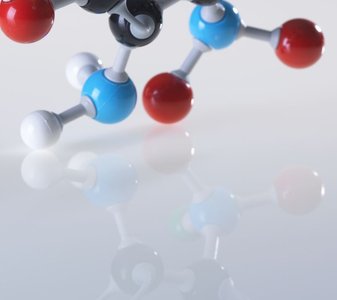
Covalent bond: Formed when two atoms share one or more pairs of electrons.
Bonding capacity (valence): The number of covalent bonds an atom can form, usually equal to the number of unpaired electrons in its valence shell.

Electronegativity and Types of Covalent Bonds
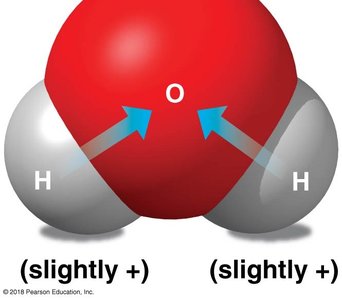
Electronegativity is an atom's ability to attract shared electrons. The difference in electronegativity between atoms determines whether a covalent bond is nonpolar or polar.
Nonpolar covalent bond: Electrons are shared equally between atoms of similar electronegativity.
Polar covalent bond: Electrons are shared unequally, resulting in partial charges on the atoms.
Example: In water (H2O), oxygen is more electronegative than hydrogen, creating a polar covalent bond.
Additional info: Understanding the chemical basis of life is essential for studying biological molecules, cellular processes, and the interactions that sustain life.
