 Back
The Chemical Basis of Life: Foundations for General Biology
Study Guide - Smart Notes
 Tailored notes based on your materials, expanded with key definitions, examples, and context.
Chapter 2: The Chemical Context of Life
Basic Concepts in Chemistry and Biology
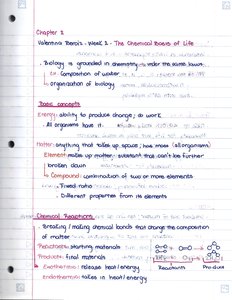
Understanding biology requires a foundation in chemistry, as life is composed of chemical substances and governed by chemical reactions. Key themes include the composition of water and the organization of biological molecules.
Energy: The capacity to produce change or do work. Energy is essential for all biological processes.
Elements: Substances that cannot be broken down into simpler substances by chemical means.
Compounds: Substances consisting of two or more elements combined in fixed ratios, with properties different from their constituent elements.
Chemical Reactions
Chemical reactions involve the breaking and forming of chemical bonds, resulting in changes to the composition of matter. These reactions are fundamental to metabolism and other biological processes.
Reactants: Starting materials in a chemical reaction.
Products: Materials resulting from a chemical reaction.
Exothermic reactions: Release heat energy.
Endothermic reactions: Absorb heat energy.
Elements in Biological Systems
Essential and Trace Elements
Living organisms are primarily composed of a small number of elements, with a few being essential for life and others required only in trace amounts.
Essential elements: Elements required for life in large amounts (e.g., O, C, H, N, Ca, P, K, S, Na, Cl, Mg).
Trace elements: Required in minute quantities but vital for proper physiological function (e.g., Fe for oxygen transport, I for thyroid hormones).
Iron (Fe): Necessary for hemoglobin and oxygen transport.
Iodine (I): Required for thyroid hormone production.
Atoms: Structure and Properties
An atom is the smallest unit of matter that retains the properties of an element. Atoms are composed of subatomic particles: protons, neutrons, and electrons.
Proton: Positively charged particle found in the nucleus.
Neutron: Electrically neutral particle found in the nucleus.
Electron: Negatively charged particle orbiting the nucleus in electron shells.
Atomic Structure
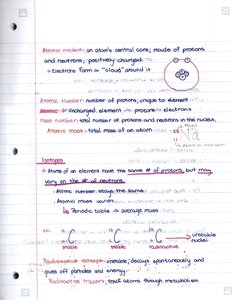
Atomic nucleus: Central core containing protons and neutrons; positively charged.
Electron cloud: Electrons move around the nucleus in defined energy levels (shells).
Atomic number (Z): Number of protons in the nucleus; defines the element.
Mass number: Total number of protons and neutrons in the nucleus.
Isotopes: Atoms of the same element with different numbers of neutrons; some are radioactive and decay spontaneously, emitting energy.
Chemical Bonds and Electron Configuration
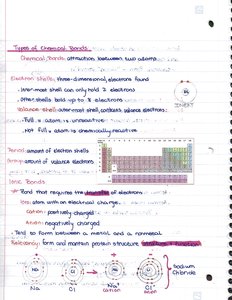
Chemical bonds are attractions between atoms that enable the formation of molecules and compounds. The arrangement of electrons in shells determines how atoms interact.
Electron shells: Energy levels where electrons are found; the outermost shell (valence shell) determines chemical reactivity.
Valence electrons: Electrons in the outermost shell; involved in forming bonds.
Octet rule: Atoms tend to form bonds to achieve eight electrons in their valence shell (except for hydrogen and helium).
Types of Chemical Bonds
Ionic bonds: Formed when electrons are transferred from one atom to another, resulting in oppositely charged ions that attract each other.
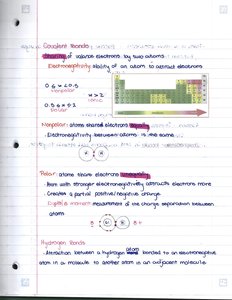
Covalent bonds: Formed when two atoms share one or more pairs of electrons.
Polar covalent bonds: Unequal sharing of electrons, leading to partial charges on atoms (e.g., in water molecules).
Nonpolar covalent bonds: Equal sharing of electrons between atoms.
Hydrogen bonds: Weak attractions between a hydrogen atom bonded to an electronegative atom (like O or N) and another electronegative atom in a different molecule.
Hydrogen Bonds and Their Biological Importance
Hydrogen bonds are weak attractions between partial positive and negative charges on different molecules or within a molecule. They are crucial for the structure and function of biological macromolecules.
Hydrogen bonds hold the two strands of DNA together (between adenine-thymine and guanine-cytosine pairs).
They are responsible for many of water's unique properties, such as cohesion and high specific heat.
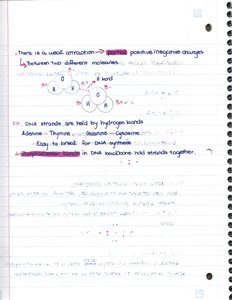
Additional info: Hydrogen bonds are much weaker than covalent or ionic bonds, but collectively they provide significant stability to biological structures.
