 Back
The Chemical Basis of Life: Structure, Properties, and Evolution
Study Guide - Smart Notes
 Tailored notes based on your materials, expanded with key definitions, examples, and context.
The Nature of Science and the Chemical Basis of Life
Scientific Process and Terminology
Understanding the scientific process is fundamental to biology. Science relies on systematic observation, hypothesis formation, and testing to explain natural phenomena.
Fact: An observation so well supported by evidence that it is accepted as true, though absolute certainty is unattainable.
Hypothesis: A proposed causal explanation for an observation or fact, not yet sufficiently tested.
Scientific Theory: A well-substantiated explanation of some aspect of the natural world, supported by a body of facts and laws confirmed through repeated observation and experiment.
Scientific Law: A description of a natural phenomenon, often expressed mathematically.
The Structure of Atoms, Ions, and Molecules
Atomic Structure
Atoms are the basic units of matter, composed of protons, neutrons, and electrons. The nucleus contains protons and neutrons, while electrons occupy shells around the nucleus.
Proton: Positively charged particle in the nucleus.
Neutron: Neutral particle in the nucleus.
Electron: Negatively charged particle in electron shells.
Valence Shell: The outermost electron shell; determines chemical reactivity.
Valence: The number of unpaired electrons in the valence shell.
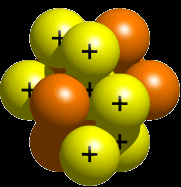
Electron Shells and Chemical Bonds
Atoms form bonds to achieve stable electron configurations. The type of bond depends on how electrons are shared or transferred.
Covalent Bond: Outer-shell electrons are shared between atoms to fill their respective orbitals.
Ionic Bond: Electrons are transferred from one atom to another, resulting in oppositely charged ions.
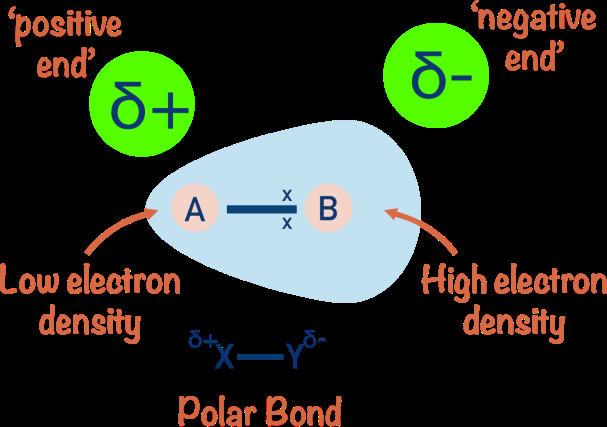
Polar Covalent Bond: Electrons are shared unequally, creating partial charges.
Nonpolar Covalent Bond: Electrons are shared equally between atoms.
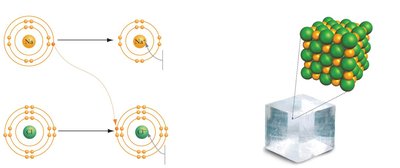
Electronegativity and Bond Formation
Electronegativity
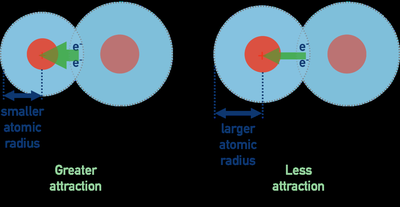
Electronegativity is the tendency of an atom to attract electrons in a chemical bond. It is influenced by atomic number and distance of valence electrons from the nucleus.
High Electronegativity: Atoms strongly attract electrons (e.g., oxygen, fluorine).
Low Electronegativity: Atoms weakly attract electrons (e.g., sodium, potassium).
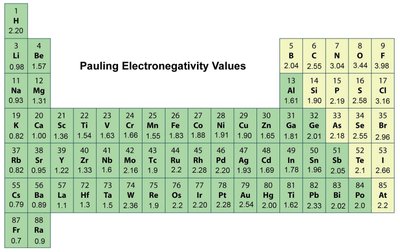
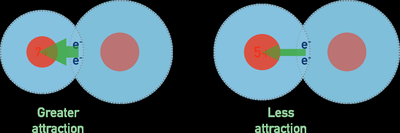
Bond Types and Polarity
The difference in electronegativity between atoms determines the bond type and polarity.
Nonpolar Covalent Bond: Electrons are shared equally; no charge separation.
Polar Covalent Bond: Electrons are shared unequally; partial positive and negative charges develop.
Ionic Bond: Electrons are transferred; full positive and negative charges result.
Chemical Bonds in Molecules
Single, Double, and Triple Bonds
Molecules can have single, double, or triple covalent bonds, affecting their stability and reactivity.
Single Bond: One pair of electrons shared (e.g., methane, ammonia, water).
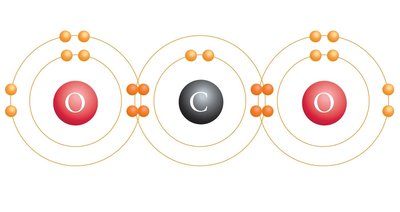
Double Bond: Two pairs of electrons shared (e.g., carbon dioxide).
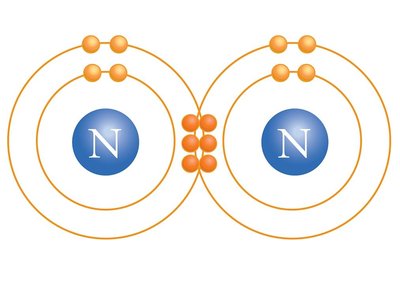
Triple Bond: Three pairs of electrons shared (e.g., molecular nitrogen).
Unique Properties of Water
Polarity and Hydrogen Bonding
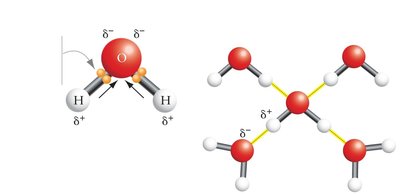
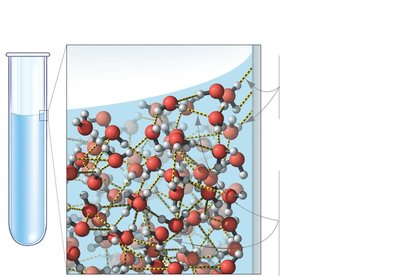
Water is a polar molecule, with oxygen being more electronegative than hydrogen. This leads to partial charges and the formation of hydrogen bonds between water molecules.
Hydrogen Bond: A weak intermolecular bond between hydrogen and electronegative atoms (O, N, F).
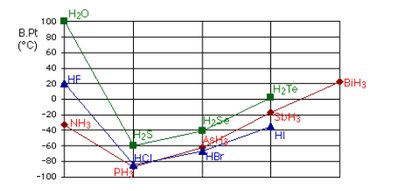
Intermolecular Forces: Hydrogen bonds increase boiling points and solubility of polar compounds.
Solubility and Water as a Solvent
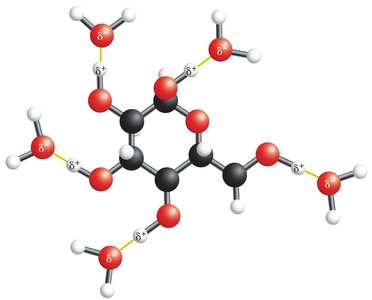
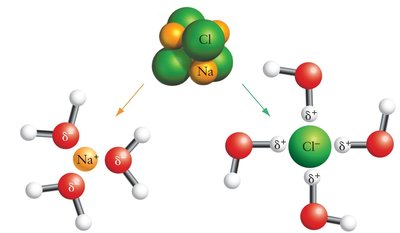
Water dissolves polar and ionic compounds due to its polarity and hydrogen bonding. Nonpolar molecules do not dissolve in water.
Hydrophilic: Polar or charged molecules that dissolve in water.
Hydrophobic: Nonpolar molecules that do not dissolve in water.
Cohesion, Adhesion, and Surface Tension
Water exhibits unique properties such as cohesion, adhesion, and high surface tension due to hydrogen bonding.
Cohesion: Water molecules stick to each other.
Adhesion: Water molecules stick to other surfaces.
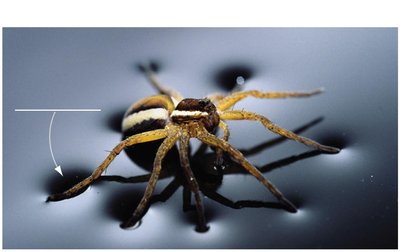
Surface Tension: The surface of water resists external force, allowing light objects to rest on it.
Density of Ice vs. Liquid Water
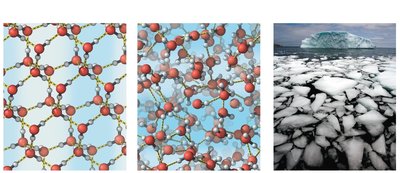
Solid water (ice) is less dense than liquid water because ice forms a crystal lattice, causing it to float.
Crystal Lattice: Hydrogen bonds hold water molecules in a rigid structure in ice.
Density: Liquid water is denser than ice.
pH and Acids/Bases in Biology
pH Scale and Calculations
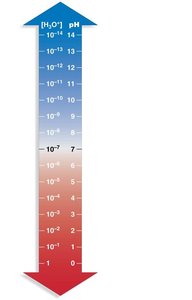
The pH scale measures the concentration of hydrogen ions in a solution. It is logarithmic, with lower pH indicating higher acidity.
pH Formula:
Acid: Substance that increases and lowers pH.
Base: Substance that decreases and raises pH.
Acids, Bases, and Buffering
Acids donate protons (), while bases accept protons. Buffers help maintain stable pH in biological systems.
Strong Acid: Dissociates completely in water (e.g., HCl).
Buffer: Substance that resists changes in pH.
Chemical Evolution and Early Life
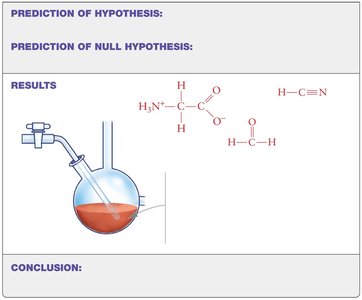
Stanley Miller's Experiment
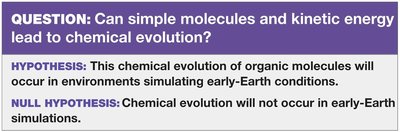
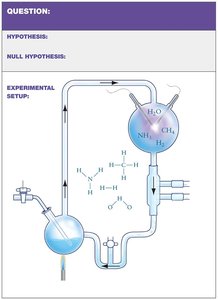
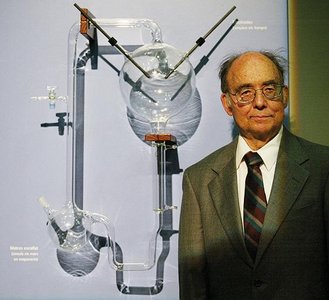
Stanley Miller's experiment demonstrated that simple molecules and kinetic energy could lead to the formation of complex organic compounds under early-Earth conditions.
Hypothesis: Chemical evolution of organic molecules will occur in environments simulating early-Earth conditions.
Null Hypothesis: Chemical evolution will not occur in early-Earth simulations.
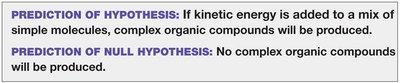
Prediction: If kinetic energy is added to a mix of simple molecules, complex organic compounds will be produced.
Result: Formation of amino acids and other organic molecules.
Atmospheric Evolution on Earth
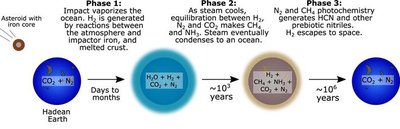
Recent studies suggest that asteroid impacts could transiently reduce the prebiotic atmosphere, leading to conditions favorable for chemical evolution.
Iron-rich Asteroid Impact: Can create a H2-, CH4-, and NH3-dominated atmosphere.
Persistence: Such an atmosphere could last millions of years, supporting chemical evolution.
Summary Table: Types of Chemical Bonds
Bond Type | Electron Sharing/Transfer | Charge Distribution | Example |
|---|---|---|---|
Nonpolar Covalent | Equal sharing | No charge | H2, CH4 |
Polar Covalent | Unequal sharing | Partial charges | H2O, NH3 |
Ionic | Electron transfer | Full charges | NaCl |
Conclusion
Chemistry is intimately linked to the evolution of life. The structure and properties of atoms, ions, and molecules, the unique characteristics of water, and the processes of chemical evolution all contribute to the molecular foundation of biology.
