 Back
The Chemical Context of Life & Water: Foundations for Biological Processes
Study Guide - Smart Notes
 Tailored notes based on your materials, expanded with key definitions, examples, and context.
Chapter 2: The Chemical Context of Life
Concept 2.1: Matter, Elements, and Compounds
All living organisms are composed of matter, which is anything that occupies space and has mass. Matter is made up of elements, substances that cannot be broken down by chemical reactions. Compounds are substances consisting of two or more elements in a fixed ratio, exhibiting emergent properties distinct from their constituent elements.
Element: A pure substance that cannot be decomposed into other substances by chemical means.
Compound: A substance formed from two or more elements combined in a fixed ratio.
Emergent Properties: New characteristics that arise when elements combine to form compounds.
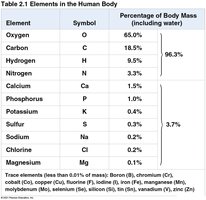
Essential Elements: About 20–25% of the 92 natural elements are essential for life. The four major elements—carbon, hydrogen, oxygen, and nitrogen—make up about 96% of living matter. The remaining 4% includes calcium, phosphorus, potassium, and sulfur, with trace elements required in minute quantities.
Concept 2.2: Atomic Structure and Properties
Each element consists of unique atoms, the smallest units retaining the properties of the element. Atoms are composed of subatomic particles: neutrons (no charge), protons (positive charge), and electrons (negative charge). Neutrons and protons form the atomic nucleus, while electrons occupy a cloud around the nucleus.
Atomic Number: Number of protons in the nucleus.
Mass Number: Sum of protons and neutrons.
Atomic Mass: Approximate total mass of an atom, measured in daltons.
Isotopes: Atoms of the same element with different numbers of neutrons.
Radioactive Isotopes: Unstable isotopes that decay, emitting particles and energy; used in dating fossils, tracing metabolic pathways, and medical diagnostics (e.g., PET scans).
Energy Levels and Electron Shells
Electrons possess potential energy based on their position relative to the nucleus. This energy is organized into discrete energy levels or shells. The chemical behavior of an atom is largely determined by the number of electrons in its outermost (valence) shell. Atoms with full valence shells are chemically inert.
Valence Electrons: Electrons in the outermost shell, crucial for chemical bonding.
Orbital: The three-dimensional space where an electron is found 90% of the time.
Concept 2.3: Chemical Bonds and Molecular Formation
Atoms with incomplete valence shells can share or transfer electrons, forming chemical bonds. The main types of bonds in biological molecules are covalent, ionic, hydrogen bonds, and van der Waals interactions.
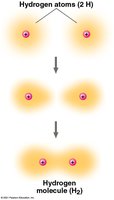
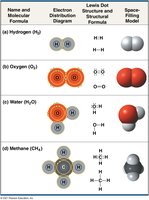
Covalent Bond: Sharing of a pair of valence electrons between two atoms. Can be single (one pair shared) or double (two pairs shared).
Electronegativity: The tendency of an atom to attract electrons in a covalent bond.
Nonpolar Covalent Bond: Electrons are shared equally.
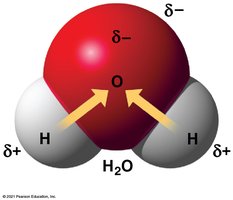
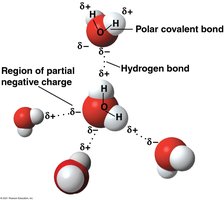
Polar Covalent Bond: Electrons are shared unequally, resulting in partial charges.
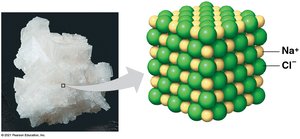
Ionic Bond: Formed when electrons are transferred from one atom to another, creating oppositely charged ions (cations and anions) that attract each other.
Hydrogen Bond: Weak attraction between a hydrogen atom covalently bonded to an electronegative atom (usually O or N) and another electronegative atom.
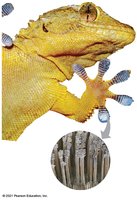
Van der Waals Interactions: Weak attractions between molecules or parts of molecules that result from transient local partial charges.
Molecular Shape and Function
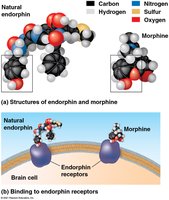
The shape of a molecule is determined by the positions of its atoms’ orbitals and is crucial for its function in biological systems. Molecules with similar shapes can have similar biological effects.
Concept 2.4: Chemical Reactions
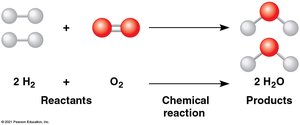
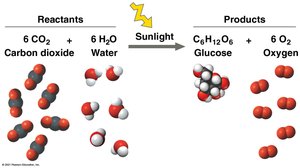
Chemical reactions involve the making and breaking of chemical bonds, transforming reactants into products. Chemical equilibrium is reached when the forward and reverse reaction rates are equal.
Reactants: Starting substances in a chemical reaction.
Products: Substances formed as a result of the reaction.
Example: Photosynthesis Sunlight powers the conversion of carbon dioxide and water into glucose and oxygen:
Chapter 3: Water and Life
Concept 3.1: Water’s Structure and Hydrogen Bonding
Water molecules are polar, with electrons spending more time near the oxygen atom, resulting in partial charges. This polarity allows water molecules to form hydrogen bonds with each other, which are critical for water’s unique properties.
Concept 3.2: Emergent Properties of Water
Water’s ability to form hydrogen bonds gives rise to four emergent properties essential for life:
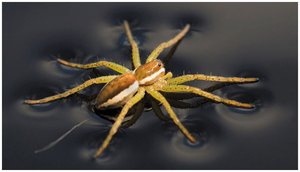
Cohesive Behavior: Hydrogen bonds hold water molecules together, resulting in high surface tension and aiding the transport of water in plants.
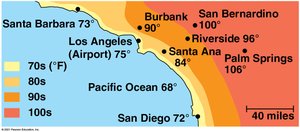
Ability to Moderate Temperature: Water absorbs and releases heat with minimal temperature change due to its high specific heat.
Expansion Upon Freezing: Water is less dense as a solid than as a liquid, allowing ice to float and insulate aquatic environments.
Versatility as a Solvent: Water’s polarity enables it to dissolve a wide range of substances, facilitating biochemical reactions.
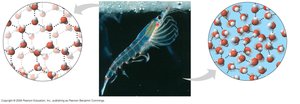
Hydrophilic and Hydrophobic Substances
Hydrophilic: Substances with an affinity for water (e.g., salts, sugars).
Hydrophobic: Substances that repel water (e.g., oils, fats).
Solution: Homogeneous mixture of two or more substances.
Solvent: The dissolving agent (water in aqueous solutions).
Solute: The substance dissolved.
Solute Concentration
Molecular Mass: Sum of all atomic masses in a molecule.
Mole (mol): 6.02 × 10²³ molecules (Avogadro’s number).
Molarity (M): Moles of solute per liter of solution.
Concept 3.3: Acids, Bases, and pH
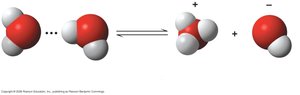
Water can dissociate into hydrogen ions (H+) and hydroxide ions (OH–). The concentrations of these ions determine the acidity or basicity of a solution, measured by the pH scale.
Acid: Increases H+ concentration in solution.
Base: Reduces H+ concentration, often by donating OH– or accepting H+.
pH Scale: Ranges from 0 (most acidic) to 14 (most basic); pH = –log[H+].
Neutral Solution: [H+] = [OH–], pH = 7.
Buffers
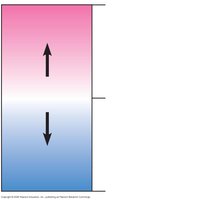
Buffers are substances that minimize changes in pH by reversibly binding H+ ions. Most biological fluids are buffered to maintain a stable internal environment.
Acidification and Environmental Impact
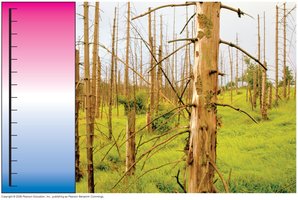
Acid precipitation (rain, snow, or fog with pH < 5.6) results from pollutants mixing with atmospheric water, harming aquatic life and forests.
Summary Table: Types of Chemical Bonds
Bond Type | Description | Relative Strength | Biological Importance |
|---|---|---|---|
Covalent | Sharing of electron pairs between atoms | Strongest | Forms stable molecules (e.g., DNA, proteins) |
Ionic | Transfer of electrons, attraction between oppositely charged ions | Strong (in dry conditions) | Formation of salts, nerve function |
Hydrogen | Attraction between H and electronegative atom (O or N) | Weak (individually) | Stabilizes DNA, protein structure, water properties |
Van der Waals | Transient attractions due to local partial charges | Weakest | Helps molecules adhere, gecko climbing |
Key Concepts to Know
Identify the four major elements in living organisms.
Distinguish between neutrons and protons, atomic number and mass number, atomic weight and mass number.
Explain the biological importance of nonpolar covalent, polar covalent, ionic, hydrogen, and van der Waals bonds.
List and explain the four emergent properties of water.
Distinguish between hydrophobic and hydrophilic substances; solute, solvent, and solution.
Define acid, base, and pH; explain buffer function.
