 Back
The Chemical Context of Life & Water: Foundations for Biological Processes
Study Guide - Smart Notes
 Tailored notes based on your materials, expanded with key definitions, examples, and context.
The Chemical Context of Life
Van der Waals Interactions
Van der Waals interactions are weak attractions that occur between molecules when electrons are distributed asymmetrically, creating temporary regions of partial positive and negative charges. These interactions are significant when many such contacts occur simultaneously, as seen in biological systems.
Definition: Weak attractions between molecules or parts of molecules that result from transient local partial charges.
Example: The ability of a gecko to climb walls is due to the collective strength of Van der Waals interactions between the gecko’s toe hairs and the wall surface.
Weak Chemical Interactions
Besides covalent and ionic bonds, weak chemical interactions such as hydrogen bonds and Van der Waals forces play crucial roles in the structure and function of biological molecules. These interactions are essential for the dynamic nature of biological processes.
Key Point: Weak interactions are reversible and allow for the flexibility and specificity required in biological systems.
Molecular Shape and Function
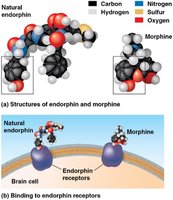
The shape of a molecule is determined by the arrangement of its atoms and the hybridization of atomic orbitals. This three-dimensional shape is critical for the molecule’s biological function, especially in molecular recognition and binding events.
Key Point: Molecular shape determines how biological molecules recognize and respond to each other, such as hormones binding to receptors.
Example: Opiates like morphine and natural endorphins have similar shapes, allowing them to bind to the same receptors in the brain and produce similar effects.
Chemical Reactions
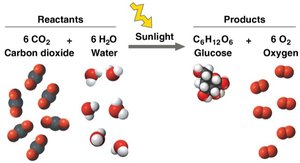
Chemical reactions involve the making and breaking of chemical bonds, transforming reactants into products. All chemical reactions are, in principle, reversible.
Reactants: Starting molecules in a chemical reaction.
Products: Resulting molecules after the reaction.
Reversibility: Many reactions can proceed in both directions under biological conditions.
Water and Life
Polar Covalent Bonds and Hydrogen Bonding
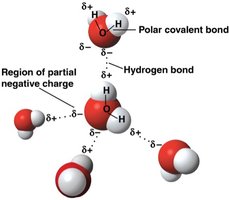
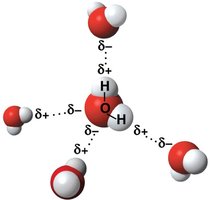
Water molecules are polar, with electrons spending more time near the oxygen atom than the hydrogen atoms. This polarity allows water molecules to form hydrogen bonds with each other, which are critical for water’s unique properties.
Polar Covalent Bond: A bond where electrons are shared unequally between atoms, resulting in partial charges.
Hydrogen Bond: A weak bond between a hydrogen atom and an electronegative atom (like oxygen).
Emergent Properties of Water
Water’s structure gives rise to several emergent properties that are essential for life on Earth:
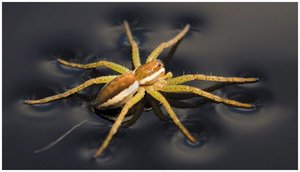
Cohesive Behavior: Water molecules stick together due to hydrogen bonding, resulting in high surface tension.
Ability to Moderate Temperature: Water can absorb or release large amounts of heat with little change in its own temperature.
Expansion Upon Freezing: Water is less dense as a solid than as a liquid, allowing ice to float.
Versatility as a Solvent: Water’s polarity allows it to dissolve many substances, making it the solvent of life.
Cohesion and Adhesion
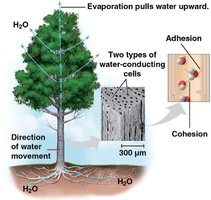
Cohesion refers to the attraction between water molecules, while adhesion is the attraction between water molecules and other substances. These properties are vital for the transport of water in plants.
Cohesion: Responsible for surface tension and the upward movement of water in plants.
Adhesion: Helps water stick to plant cell walls, aiding in water transport against gravity.
Moderation of Temperature by Water
Water’s high specific heat allows it to buffer temperature changes, stabilizing environments and organisms. The specific heat of water is 1 cal/(g·ºC).
Heat Absorption and Release: Water absorbs heat when hydrogen bonds break and releases heat when they form.
Evaporative Cooling: As water evaporates, it cools the surface, helping regulate temperature in organisms and ecosystems.
Expansion Upon Freezing
When water freezes, its molecules form a crystalline lattice that is less dense than liquid water, causing ice to float. This property insulates bodies of water, protecting aquatic life in cold climates.
Water: The Solvent of Life
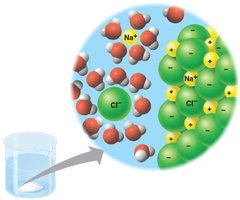
Water’s polarity makes it an excellent solvent, especially for ionic and polar substances. When an ionic compound dissolves, water molecules surround each ion, forming a hydration shell.
Hydrophilic Substances: Substances that have an affinity for water (e.g., salts, sugars).
Hydrophobic Substances: Substances that do not mix well with water (e.g., oils), important in cell membrane structure.
Solute Concentration in Aqueous Solutions
Chemical reactions in organisms often occur in aqueous solutions. The concentration of solutes is measured in moles per liter (molarity, M).
Molecular Mass: The sum of the masses of all atoms in a molecule.
Avogadro’s Number: molecules per mole.
Molarity (M): Number of moles of solute per liter of solution.
Acidic and Basic Conditions Affect Living Organisms
The concentration of hydrogen ions (H+) and hydroxide ions (OH–) in a solution determines its acidity or basicity. The pH scale is used to quantify this, with most biological fluids having a pH between 6 and 8.
Acid: Increases H+ concentration in a solution.
Base: Reduces H+ concentration in a solution.
pH Scale:
Neutral Solution: [H+] = M, so pH = 7.
Acidification: A Threat to Our Oceans
Burning fossil fuels increases atmospheric CO2, which dissolves in oceans and forms carbonic acid, lowering ocean pH. This process, known as ocean acidification, reduces carbonate ion concentration, threatening marine organisms that rely on carbonate for calcification, such as corals.
Key Reaction: CO2 + H2O → H2CO3 (carbonic acid)
Impact: Reduced carbonate availability impairs the formation of calcium carbonate (CaCO3) structures in marine life.
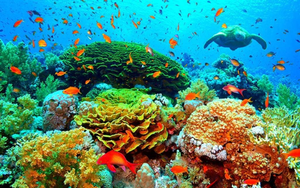
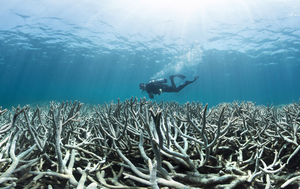
Additional info: Ocean acidification is expected to cause widespread changes in marine ecosystems, particularly affecting reef-building corals and organisms that depend on them.
