 Back
The Chemical Context of Life & Water: Foundations for Biological Structure and Function
Study Guide - Smart Notes
 Tailored notes based on your materials, expanded with key definitions, examples, and context.
Chapter 2: The Chemical Context of Life
Chemistry and Matter
Chemistry is the study of matter, which is anything that takes up space and has mass. All living and nonliving things are composed of matter, and the laws of chemistry apply universally. Understanding the interactions of matter's building blocks is essential for grasping the properties and functions of biological structures.
Elements and Compounds
Element: A substance that cannot be broken down into other substances by chemical reactions.
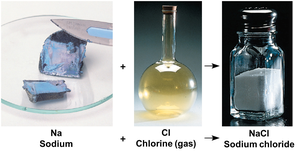
Compound: A substance consisting of two or more elements in a fixed ratio, with characteristics different from its constituent elements.
The Elements of Life
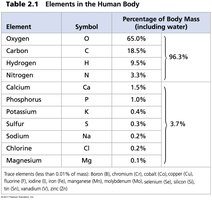
Of the 92 naturally occurring elements, about 20–25% are essential for life. Four elements—carbon, hydrogen, oxygen, and nitrogen (CHON)—make up about 96% of living matter. The remaining 4% consists mainly of calcium, phosphorus, potassium, sulfur, sodium, chlorine, and magnesium. Trace elements are required in minute quantities.
Atoms: The Building Blocks of Matter
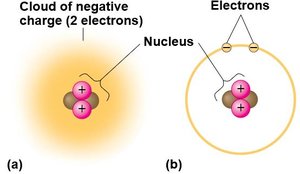
An atom is the smallest unit of matter that retains the properties of an element. Atoms are composed of subatomic particles: neutrons (neutral), protons (positive), and electrons (negative). Neutrons and protons form the atomic nucleus, while electrons form a cloud around the nucleus.
Atomic Number, Mass Number, and Isotopes
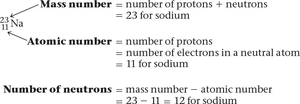
Atomic number: Number of protons in the nucleus (defines the element).
Mass number: Sum of protons and neutrons in the nucleus.
Atomic mass: Total mass of an atom.
Isotopes: Atoms of the same element with different numbers of neutrons.
Radioactive isotopes: Unstable isotopes that decay spontaneously, emitting particles and energy.
Applications of Radioactive Isotopes
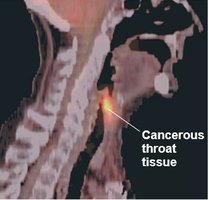
Radioactive isotopes are used as tracers in medicine to track atoms through metabolic processes and for diagnostic imaging.
Electrons and Energy Levels
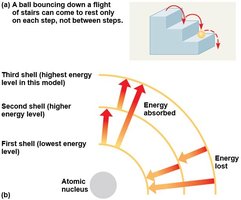
Electrons have potential energy due to their position relative to the nucleus. They occupy electron shells, with each shell having a specific energy level. Electrons can move between shells by absorbing or releasing energy.
Electron Orbitals
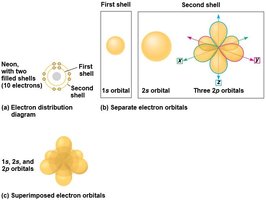
Each electron shell contains a specific number of orbitals, which are three-dimensional spaces where electrons are likely to be found. The arrangement of electrons in these orbitals determines the chemical behavior of an atom.
Valence Electrons and Chemical Reactivity
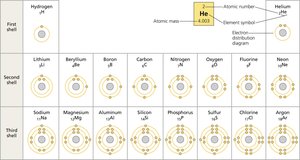
Valence electrons are those in the outermost shell. Atoms with full valence shells are chemically inert, while those with incomplete shells tend to react to achieve stability.
Chemical Bonds
Atoms with incomplete valence shells can share or transfer electrons, resulting in chemical bonds that hold atoms together in molecules or compounds.
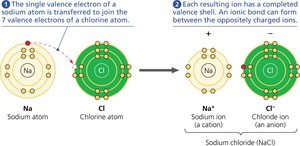
Ionic Bonds
Formed when electrons are transferred from one atom to another, creating charged ions.
Cation: Positively charged ion.
Anion: Negatively charged ion.
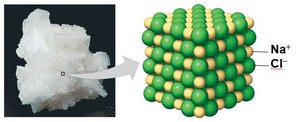
The attraction between cations and anions forms ionic bonds, resulting in ionic compounds (salts).
Covalent Bonds
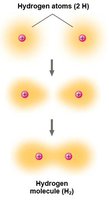
Formed when two atoms share pairs of valence electrons.
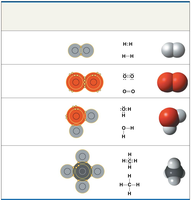
Single, double, or triple covalent bonds involve sharing one, two, or three pairs of electrons, respectively.
Molecules are groups of atoms held together by covalent bonds.
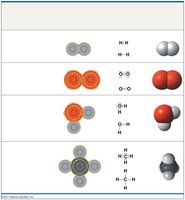
Electronegativity and Bond Polarity
Electronegativity: An atom's attraction for electrons in a covalent bond.
Nonpolar covalent bond: Electrons are shared equally (similar electronegativity).
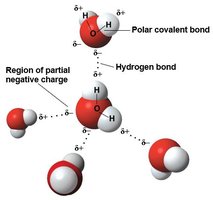
Polar covalent bond: Electrons are shared unequally (different electronegativity), resulting in partial charges.
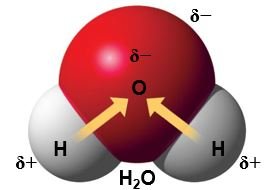
Weak Molecular Interactions
Large biological molecules are often stabilized by weak interactions, which are reversible and allow for dynamic biological processes.
Dipole-dipole interactions: Attractions between polar molecules.
Hydrogen bonds: Form between a hydrogen atom covalently bonded to a highly electronegative atom (O or N) and another electronegative atom.
Van der Waals forces: Weak attractions due to transient local partial charges.
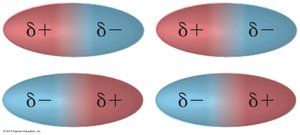
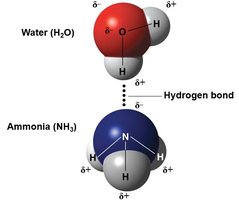
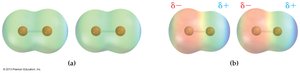
Molecular Shape and Function
The shape of a molecule is determined by the positions of its atoms' orbitals and is crucial for its biological function. Molecular shape and charge dictate how molecules interact in biological systems.
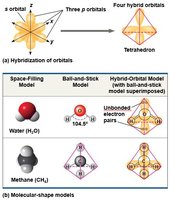
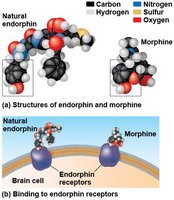
Chemical Reactions
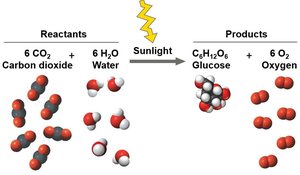
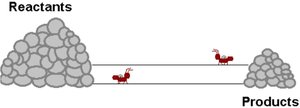
Chemical reactions involve the making and breaking of chemical bonds. Reactants are the starting materials, and products are the resulting substances. All chemical reactions are reversible, and equilibrium is reached when the forward and reverse reactions occur at the same rate.
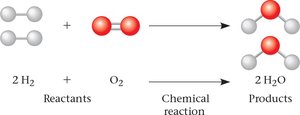
Photosynthesis and Cellular Respiration
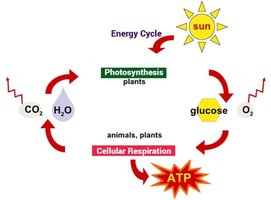
Photosynthesis is a key chemical reaction in biology, converting carbon dioxide and water into glucose and oxygen using sunlight. The reverse process, cellular respiration, releases energy for cellular activities.
Chapter 3: Water and Life
Importance of Water
Water is essential for life, covering about 70% of Earth's surface and making up 70–95% of cell mass. It is unique in existing naturally in all three physical states: solid, liquid, and gas. The shape and charge of the water molecule are critical to its biological roles.
Hydrogen Bonding in Water
Water molecules are polar, with oxygen being highly electronegative and hydrogen less so. This polarity allows water molecules to form hydrogen bonds, which require significant energy to break and release energy when formed.
Four Emergent Properties of Water
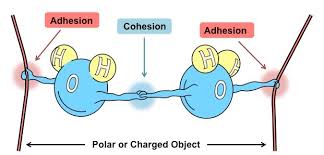
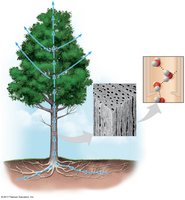
Cohesive and Adhesive Behavior: Cohesion is the attraction between water molecules, while adhesion is the attraction between water and other substances. These properties are vital for processes like water transport in plants.
Ability to Moderate Temperature: Water absorbs and releases heat with minimal temperature change due to its high specific heat.
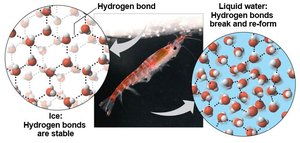
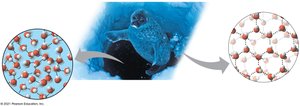
Expansion upon Freezing: Ice is less dense than liquid water, allowing it to float and insulate aquatic life.
Versatility as a Solvent: Water dissolves many substances, making it an excellent medium for biological reactions.

Temperature Moderation and Specific Heat
Water's high specific heat (1 cal/g·°C) allows it to buffer temperature changes, supporting life by minimizing temperature fluctuations. Evaporative cooling occurs as liquid water evaporates, cooling the surface left behind.

Expansion upon Freezing
As water freezes, hydrogen bonds become more ordered, making ice less dense than liquid water. This property prevents bodies of water from freezing solid, preserving aquatic ecosystems.
Water as a Solvent
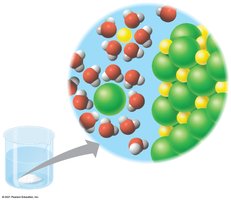
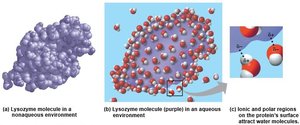
Water's polarity allows it to dissolve ionic and polar substances, forming aqueous solutions. When ionic compounds dissolve, each ion is surrounded by a hydration shell of water molecules.
Hydrophilic and Hydrophobic Substances
Hydrophilic: Substances with an affinity for water (ionic or polar).
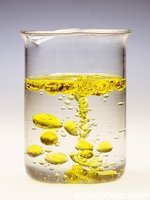
Hydrophobic: Substances that repel water (non-polar, e.g., oils and lipids).
Solute Concentration and Molarity
Mole (mol): 6.022 × 10²³ molecules.
Molar mass: Mass (g) of 1 mol of a molecule.
Molarity (M): Number of moles of solute per liter of solution.
Acidity, Basicity, and the pH Scale
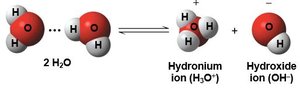
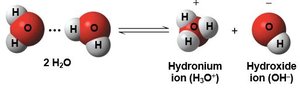
Water can dissociate into hydronium (H3O+) and hyd
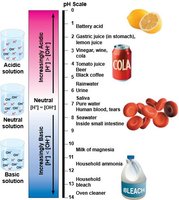
roxide (OH–) ions. Acids increase H+ concentrat ion, while bases decrease it. The pH scale measures H+ concentration:
Buffers
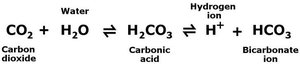
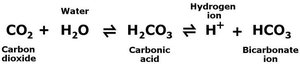
Buffers are substances that minimize changes in pH by accepting or donating H+ ions. The bicarbonate buffer system is crucial for maintaining blood pH in humans.
Acidification and Ocean Chemistry
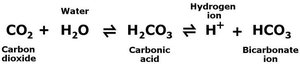
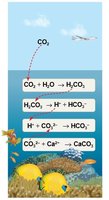
Human activities, such as burning fossil fuels, increase atmospheric CO2, which dissolves in oceans to form carbonic acid. This process, called ocean acidification, reduces carbonate ion availability, threatening marine organisms that rely on calcium carbonate for their skeletons and shells.
Summary Table: Key Terms and Concepts
Term | Definition |
|---|---|
Matter | Anything that takes up space and has mass |
Element | Substance that cannot be broken down by chemical reactions |
Compound | Substance of two or more elements in a fixed ratio |
Atom | Smallest unit of an element retaining its properties |
Isotope | Atoms of the same element with different numbers of neutrons |
Energy | Capacity to cause change |
Chemical equilibrium | State where forward and reverse reactions occur at the same rate |
Cohesion | Attraction between molecules of the same substance |
Adhesion | Attraction between different substances |
pH | Negative logarithm of H+ concentration |
