 Back
The Chemical Context of Life and the Structure and Function of Large Biological Molecules
Study Guide - Smart Notes
 Tailored notes based on your materials, expanded with key definitions, examples, and context.
The Chemical Context of Life
Emergent Properties of Water
Water exhibits unique emergent properties due to its molecular structure and hydrogen bonding. These properties are critical for supporting life on Earth.
Cohesion and Adhesion: Water molecules stick to each other (cohesion) and to other substances (adhesion) due to hydrogen bonding.
High Specific Heat: Water can absorb or release large amounts of heat with only a slight change in its own temperature.
Expansion Upon Freezing: Ice is less dense than liquid water, allowing it to float and insulate aquatic environments.
Versatile Solvent: Water dissolves a wide range of substances, facilitating chemical reactions in cells.
Hydrogen Bonding: Each water molecule can form up to four hydrogen bonds, creating a dynamic network.
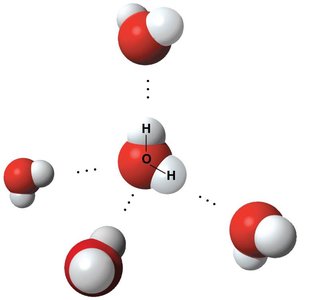
Additional info: These properties arise from the polar nature of water molecules and their ability to form hydrogen bonds.
Subatomic Particles and Atomic Structure
Atoms are composed of three types of subatomic particles:
Protons: Positively charged particles found in the nucleus.
Neutrons: Neutral particles also located in the nucleus.
Electrons: Negatively charged particles orbiting the nucleus in electron shells.
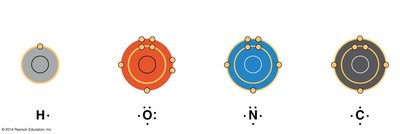
The arrangement of electrons determines an atom's chemical behavior, especially the electrons in the outermost shell (valence electrons).
Chemical Bonds
Atoms interact through chemical bonds to achieve stable electron configurations:
Covalent Bonds: Atoms share pairs of electrons. Can be nonpolar (equal sharing) or polar (unequal sharing).
Ionic Bonds: Electrons are transferred from one atom to another, creating charged ions that attract each other.
Hydrogen Bonds: Weak attractions between a hydrogen atom covalently bonded to an electronegative atom (like O or N) and another electronegative atom.
Carbon and the Molecular Diversity of Life
The Importance of Carbon
Carbon is the backbone of biological molecules due to its ability to form four covalent bonds, allowing for a diversity of stable structures such as chains, rings, and branches.
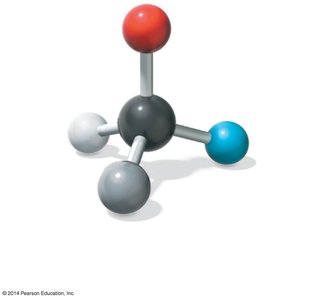
Additional info: The valence of carbon and its common partners (H, O, N) determines the architecture of organic molecules.
Functional Groups
Functional groups are specific groups of atoms attached to carbon skeletons that confer distinct chemical properties and reactivity to organic molecules.
Functional Group | Structure | Compound Name | Example |
|---|---|---|---|
Hydroxyl | –OH | Alcohol | Ethanol |
Carbonyl | –C=O | Aldehyde/Ketone | Propanal/Acetone |
Carboxyl | –COOH | Carboxylic acid | Acetic acid |
Amino | –NH2 | Amine | Glycine |
Sulfhydryl | –SH | Thiol | Cysteine |
Phosphate | –OPO32– | Organic phosphate | Glycerol phosphate |
Methyl | –CH3 | Methylated compound | 5-Methyl cytosine |
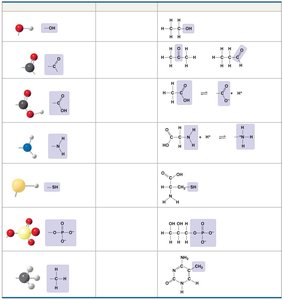
These groups are key to the function of biomolecules, influencing solubility, reactivity, and molecular recognition.
Isomers
Isomers are compounds with the same molecular formula but different structures and properties:
Structural Isomers: Differ in the covalent arrangement of atoms.
Cis-Trans Isomers: Differ in spatial arrangement around a double bond.
Enantiomers: Mirror images of each other, important in pharmaceuticals due to different biological activities.
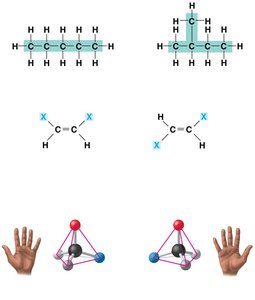
Example: Thalidomide enantiomers have drastically different effects in the body.
The Structure and Function of Large Biological Molecules
Macromolecules: Overview
Macromolecules are large, complex molecules essential for life, including carbohydrates, lipids, proteins, and nucleic acids. They are typically formed by polymerization of smaller subunits (monomers).
Dehydration Synthesis: Monomers are joined by covalent bonds with the removal of a water molecule.
Hydrolysis: Polymers are broken down into monomers by the addition of water.
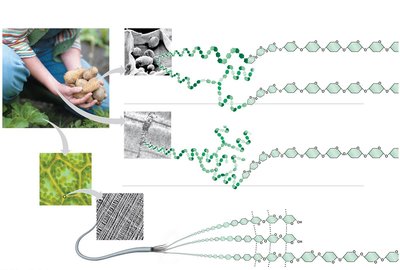
Carbohydrates
Carbohydrates serve as fuel and building material. They include sugars and their polymers.
Monosaccharides: Simple sugars (e.g., glucose).
Disaccharides: Two monosaccharides joined by a glycosidic linkage (e.g., sucrose).
Polysaccharides: Polymers of sugars (e.g., starch, glycogen, cellulose).
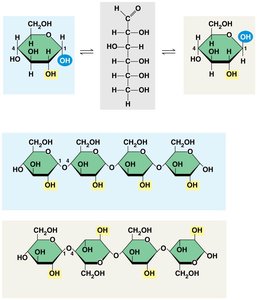
Additional info: The orientation of glycosidic bonds determines the structure and digestibility of polysaccharides.
Lipids
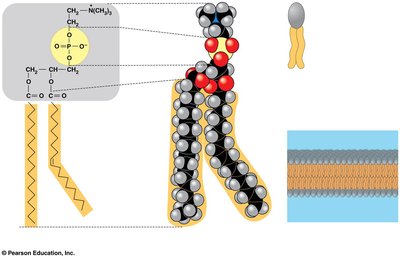
Lipids are hydrophobic molecules, including fats, phospholipids, and steroids. They are not true polymers.
Fats: Composed of glycerol and fatty acids; used for energy storage.
Phospholipids: Major component of cell membranes; amphipathic with hydrophilic heads and hydrophobic tails.
Steroids: Characterized by four fused rings; include hormones like cholesterol.
Proteins
Proteins are polymers of amino acids and perform a vast array of functions, including catalysis, transport, support, and signaling.
Primary Structure: Sequence of amino acids.
Secondary Structure: Local folding (α-helix, β-sheet) stabilized by hydrogen bonds.
Tertiary Structure: Overall 3D shape due to R-group interactions.
Quaternary Structure: Association of multiple polypeptide chains.
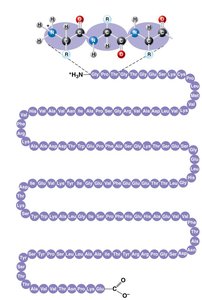
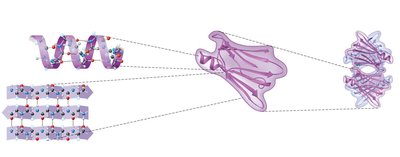
Additional info: Protein function depends on correct folding, which can be disrupted by changes in temperature, pH, or mutations.
Nucleic Acids
Nucleic acids (DNA and RNA) store and transmit genetic information. They are polymers of nucleotides, each consisting of a phosphate group, a pentose sugar, and a nitrogenous base.
DNA: Double-stranded helix; stores genetic information.
RNA: Single-stranded; involved in protein synthesis and gene regulation.
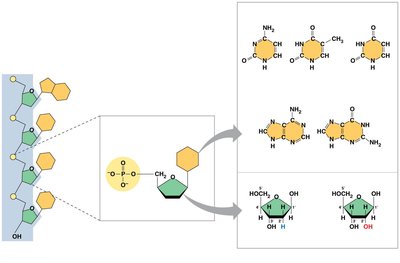
Additional info: The sequence of bases encodes genetic instructions, and complementary base pairing enables replication and transcription.
