 Back
Chapter 2: The Chemical Context of Life: Atomic Structure, Chemical Bonds, and Reactions
Study Guide - Smart Notes
 Tailored notes based on your materials, expanded with key definitions, examples, and context.
The Chemical Context of Life
Describing Matter: Mass and Elements
Matter is anything that occupies space and has mass. In biology, understanding the chemical context of life begins with recognizing how matter is described and classified.
Mass: The quantity of matter in an object, measured in units such as grams or kilograms.
Elements: Pure substances consisting of only one type of atom, each with unique properties.
Compounds: Substances formed when two or more different elements combine in fixed ratios.
Molecules: Two or more atoms held together by chemical bonds.
Example: Water (H2O) is a compound made of hydrogen and oxygen.
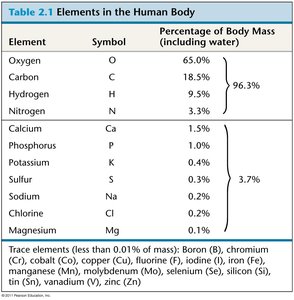
Table Purpose: Classification of elements by their abundance in the human body.
Element | Symbol | Percentage of Body Mass |
|---|---|---|
Oxygen | O | 65.0% |
Carbon | C | 18.5% |
Hydrogen | H | 9.5% |
Nitrogen | N | 3.3% |
Calcium | Ca | 1.5% |
Phosphorus | P | 1.0% |
Potassium | K | 0.4% |
Sulfur | S | 0.3% |
Sodium | Na | 0.2% |
Chlorine | Cl | 0.2% |
Magnesium | Mg | 0.1% |
Atomic Structure
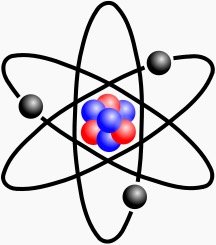
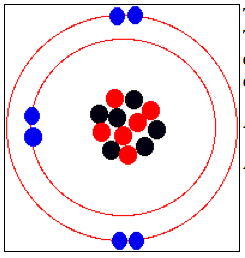
The properties of an element are determined by its atomic structure. Atoms consist of a nucleus containing protons and neutrons, surrounded by electrons in orbitals.
Proton: Positively charged particle in the nucleus.
Neutron: Neutral particle in the nucleus.
Electron: Negatively charged particle orbiting the nucleus.
Atomic Number: Number of protons in the nucleus; defines the element.
Mass Number: Sum of protons and neutrons.
Atomic Mass: Measured in Daltons (Da).
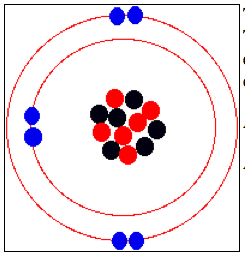
Example: Helium atom has 2 protons, 2 neutrons, and 2 electrons.
Periodic Table and Element Properties
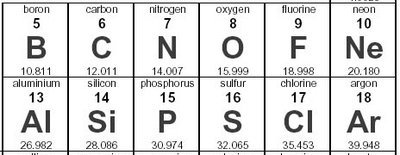
The periodic table organizes elements by atomic number and groups them by similar chemical properties.
Example: Carbon (C), Nitrogen (N), Oxygen (O), and others are essential for life.
Electron Configuration and Chemical Behavior
Electron Shells and Energy Levels
Electrons occupy specific energy levels called shells. The outermost shell, known as the valence shell, determines an atom's chemical reactivity.
Electron Shell: Energy level where electrons reside.
Valence Electrons: Electrons in the outermost shell; involved in chemical bonding.
Orbitals: Regions within shells where electrons are likely to be found.
Electrons can move between shells as they gain or lose energy.
Chemical Bonds
Types of Chemical Bonds
Atoms are held together by various types of chemical bonds, which involve the sharing or transfer of electrons.
Covalent Bonds: Atoms share pairs of valence electrons.
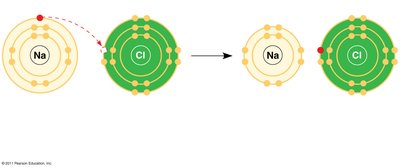
Ionic Bonds: Electrons are transferred from one atom to another, creating charged ions.
Hydrogen Bonds: Weak attractions between partially charged regions of molecules.
Van der Waals Interactions: Weak attractions due to temporary changes in electron distribution.
Covalent Bonding
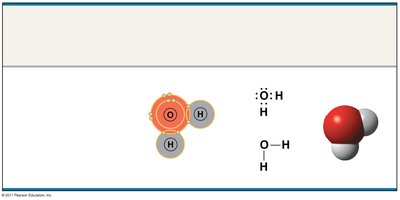
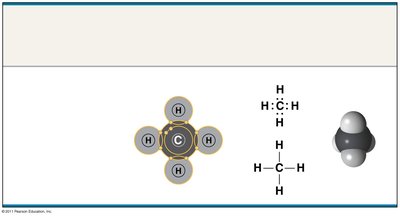
Covalent bonds involve the sharing of electron pairs between atoms, allowing them to complete their valence shells.
Single, double, or triple bonds can form depending on the number of shared electron pairs.
Example: Water (H2O) and methane (CH4).
Polar vs Nonpolar Covalent Bonds
Not all covalent bonds share electrons equally. The degree of sharing depends on electronegativity, which is an atom's ability to attract electrons.
Nonpolar Covalent Bond: Equal sharing of electrons.
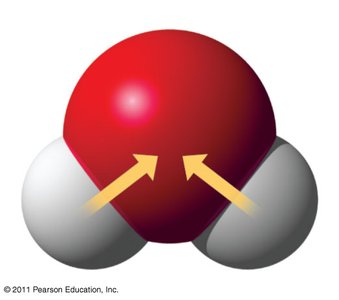
Polar Covalent Bond: Unequal sharing, resulting in partial charges (δ+ and δ–).
Electronegativity: The tendency of an atom to attract electrons.
Example: Water is a polar molecule due to the higher electronegativity of oxygen.
Ionic Bonding
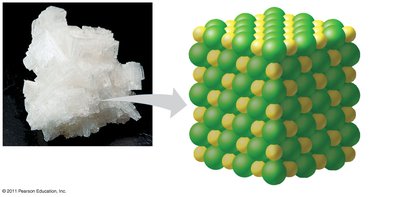
Ionic bonds form when electrons are transferred from one atom to another, resulting in oppositely charged ions that attract each other.
Cation: Positively charged ion (e.g., Na+).
Anion: Negatively charged ion (e.g., Cl–).
Example: Sodium chloride (NaCl) is formed by the transfer of an electron from sodium to chlorine.
Hydrogen Bonding
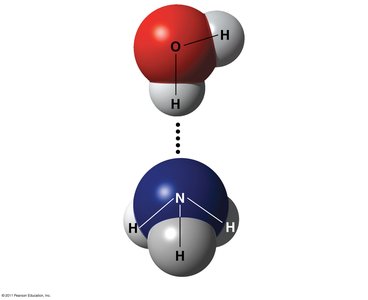
Hydrogen bonds are weak interactions that occur between a hydrogen atom covalently bonded to an electronegative atom and another electronegative atom.
Hydrogen bonds are important for the structure of water and biological molecules like DNA.
Example: Hydrogen bonding between water and ammonia molecules.
Van der Waals Interactions
Van der Waals interactions are weak attractions that occur due to temporary changes in electron distribution within molecules.
These interactions are significant in large molecules, such as proteins and lipids.

Chemical Reactions
Making and Breaking Chemical Bonds
Chemical reactions involve the rearrangement of atoms by making or breaking chemical bonds. Reactants are transformed into products.
Reactants: Starting substances in a chemical reaction.
Products: Substances formed as a result of the reaction.
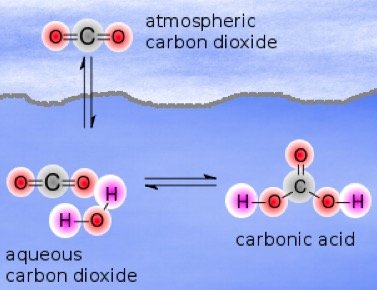
Chemical Equilibrium: The state where the rate of the forward reaction equals the rate of the reverse reaction.
Example: Formation of carbonic acid from carbon dioxide and water.
Equation Example:
