 Back
BackThe Chemical Context of Life: Atoms, Elements, and Chemical Bonds
Study Guide - Smart Notes
 Tailored notes based on your materials, expanded with key definitions, examples, and context.
Chapter 2: The Chemical Context of Life
Overview: A Chemical Connection to Biology
Biology is deeply rooted in the principles of chemistry and physics. Living organisms are composed of matter, which is organized into a hierarchy of structural levels, from atoms to molecules to cells. At each level, new emergent properties arise, and the transition from molecules to cells marks the boundary between nonlife and life.
Concept 2.1: Matter, Elements, and Compounds
Definitions and Properties
Matter: Anything that takes up space and has mass.
Element: A substance that cannot be broken down to other substances by chemical reactions.
Compound: A substance consisting of two or more elements in a fixed ratio, with properties different from its constituent elements (emergent properties).
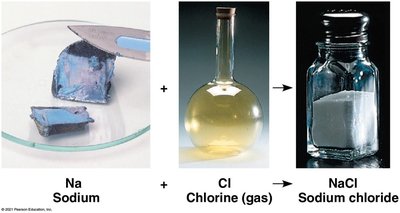
Example: Table salt (sodium chloride, NaCl) is a compound formed from sodium (a reactive metal) and chlorine (a poisonous gas), resulting in an edible substance with new properties.
The Elements of Life
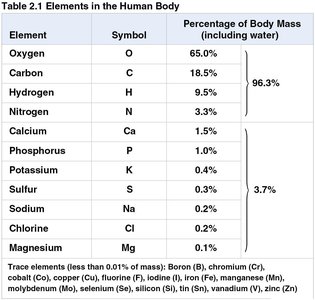
About 20–25% of the 92 natural elements are essential for life.
Four elements—carbon, hydrogen, oxygen, and nitrogen—make up about 96% of living matter.
Other important elements include calcium, phosphorus, potassium, and sulfur.
Trace elements are required in minute quantities (e.g., iron, iodine).
Element | Symbol | Percentage of Body Mass (including water) |
|---|---|---|
Oxygen | O | 65.0% |
Carbon | C | 18.5% |
Hydrogen | H | 9.5% |
Nitrogen | N | 3.3% |
Calcium | Ca | 1.5% |
Phosphorus | P | 1.0% |
Potassium | K | 0.4% |
Sulfur | S | 0.3% |
Sodium | Na | 0.2% |
Chlorine | Cl | 0.2% |
Magnesium | Mg | 0.1% |
Concept 2.2: Atomic Structure and Properties
Subatomic Particles
Atoms are the smallest units of elements that retain their properties.
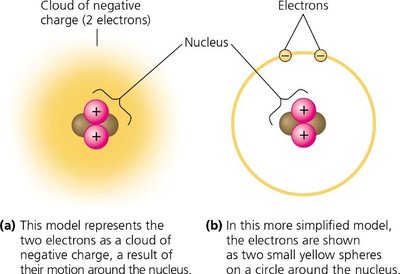
Composed of protons (positive charge), neutrons (no charge), and electrons (negative charge).
Protons and neutrons form the atomic nucleus; electrons form a cloud around the nucleus.
Proton and neutron mass ≈ 1 dalton; electron mass is negligible.
Atomic Number, Mass Number, and Isotopes
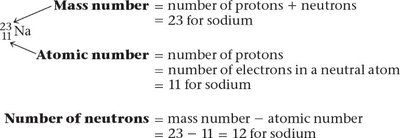
Atomic number: Number of protons in the nucleus (also equals number of electrons in a neutral atom).
Mass number: Sum of protons and neutrons.
Atomic mass: Approximate total mass of an atom (in daltons).
Isotopes: Atoms of the same element with different numbers of neutrons.
Radioactive isotopes: Unstable isotopes that decay, emitting particles and energy.
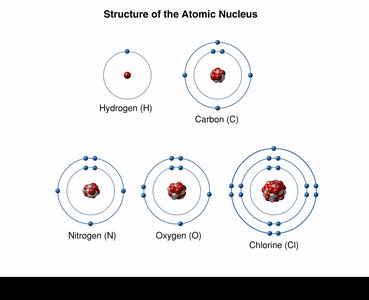
Structure of the Atomic Nucleus and Electron Arrangement
Atoms differ in the number of subatomic particles, affecting their chemical properties.
Electron arrangement determines reactivity and bonding behavior.
Energy Levels and Electron Shells
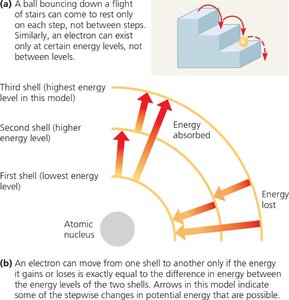
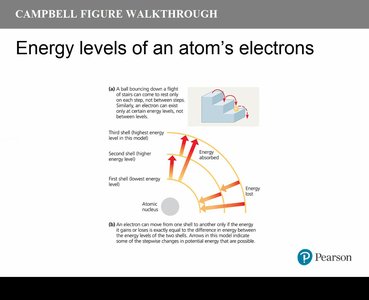
Potential energy: Energy due to position or structure; electrons have more potential energy the farther they are from the nucleus.
Electrons occupy electron shells with discrete energy levels.
Electrons can move between shells by absorbing or releasing energy equal to the difference between shells.
Electron Distribution and the Periodic Table
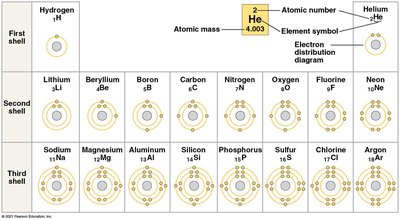
The periodic table arranges elements by increasing atomic number and electron configuration.
Electron distribution in shells determines chemical properties and reactivity.
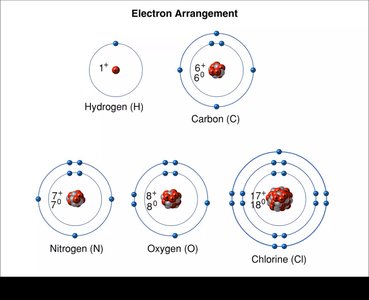
Valence Electrons and Chemical Behavior
Valence electrons: Electrons in the outermost shell; determine chemical reactivity.
Elements with full valence shells are chemically inert (e.g., noble gases).
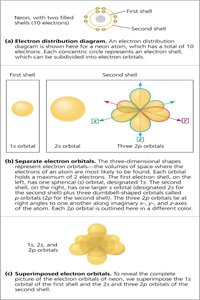
Electron Orbitals
Orbitals: Three-dimensional spaces where electrons are likely to be found (maximum 2 electrons per orbital).
Electron shells contain specific numbers and types of orbitals (e.g., s, p).
Concept 2.3: Chemical Bonds and Molecular Formation
Covalent Bonds
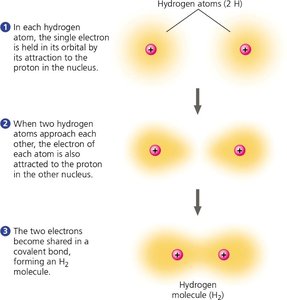
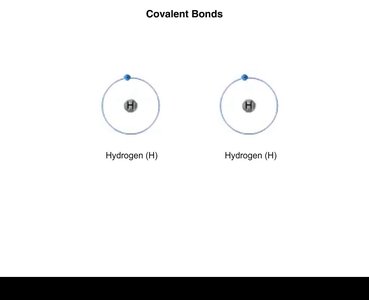
Covalent bond: Sharing of a pair of valence electrons between two atoms.
Each atom contributes one electron to the shared pair, achieving a full valence shell.
Can occur between atoms of the same or different elements.
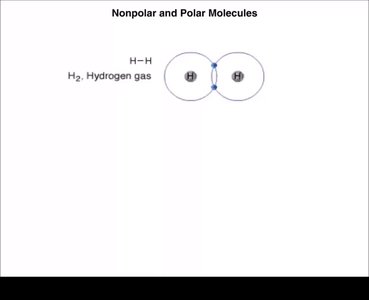
Single bond: Sharing one pair of electrons (e.g., H—H).
Double bond: Sharing two pairs of electrons (e.g., O═O).
Valence: Number of covalent bonds an atom can form (H: 1, O: 2, N: 3, C: 4).
Electronegativity and Types of Covalent Bonds
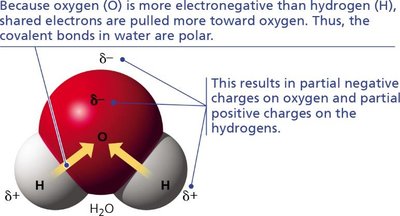
Electronegativity: Atom's attraction for electrons in a covalent bond.
Nonpolar covalent bond: Electrons shared equally (e.g., H2).
Polar covalent bond: Electrons shared unequally, creating partial charges (e.g., H2O).
Ionic Bonds and Ionic Compounds
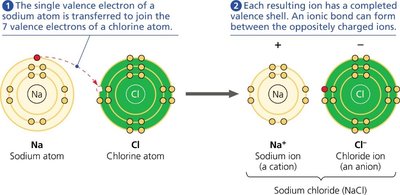
Ionic bond: Attraction between oppositely charged ions (cation and anion).
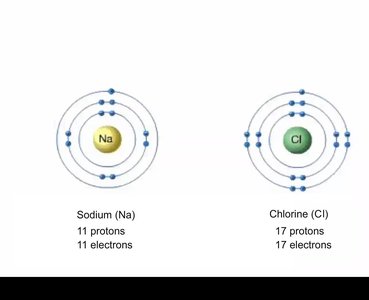
Formed when one atom transfers electrons to another, resulting in charged ions (e.g., Na+ and Cl–).
Ionic compounds (salts): Compounds formed by ionic bonds, often found as crystals (e.g., NaCl).
Weak Chemical Interactions
Weak bonds (hydrogen bonds, van der Waals interactions) are crucial for the structure and function of large biological molecules.
Hydrogen Bonds
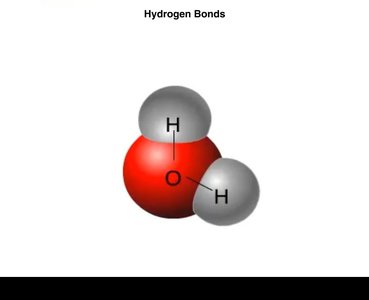
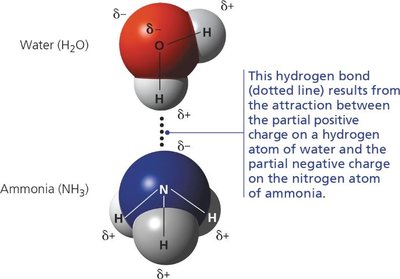
Form when a hydrogen atom covalently bonded to an electronegative atom (O or N) is attracted to another electronegative atom.
Important in stabilizing DNA, protein structure, and water properties.
Van der Waals Interactions
Weak attractions due to temporary partial charges from uneven electron distribution.
Individually weak, but collectively significant in molecular stability and biological adhesion (e.g., gecko feet).
Molecular Shape and Function
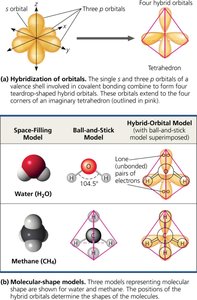
Molecular shape is determined by the positions of atoms’ orbitals and is critical for biological function.
Hybridization of orbitals leads to specific molecular geometries (e.g., tetrahedral in methane, bent in water).
Molecular shape determines how molecules interact and recognize each other (e.g., hormone-receptor binding).
Summary Table: Types of Chemical Bonds
Bond Type | Strength | Example | Biological Importance |
|---|---|---|---|
Covalent | Strong | H2O, CH4 | Stabilizes molecules |
Ionic | Strong (dry), weak (in water) | NaCl | Formation of salts, nerve function |
Hydrogen | Weak (individually) | H2O, DNA base pairs | Stabilizes structures, water properties |
Van der Waals | Very weak (individually) | Gecko adhesion | Molecular stability, adhesion |
Additional info: This guide expands on the original notes with definitions, examples, and tables for clarity and exam preparation.
