 Back
BackThe Chemical Context of Life: Atoms, Molecules, and Bonds
Study Guide - Smart Notes
 Tailored notes based on your materials, expanded with key definitions, examples, and context.
The Chemical Context of Life
Introduction to Biological Chemistry
All living organisms are composed of matter, which is made up of elements organized into atoms and molecules. Understanding the chemical basis of life is essential for studying biology, as the structure and function of biomolecules are determined by atomic interactions and chemical bonds.
Atoms, Elements, and Molecules
Basic Structure of Atoms
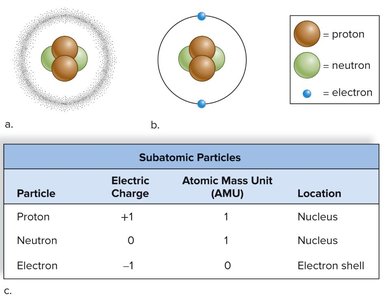
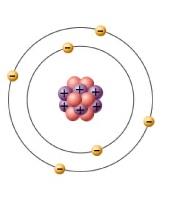
Atoms are the fundamental units of matter, consisting of a nucleus (containing protons and neutrons) and electrons that orbit the nucleus in shells. The number of protons defines the atomic number and the element.
Proton: Positively charged particle in the nucleus.
Neutron: Neutral particle in the nucleus.
Electron: Negatively charged particle in electron shells.
Elements Essential for Life
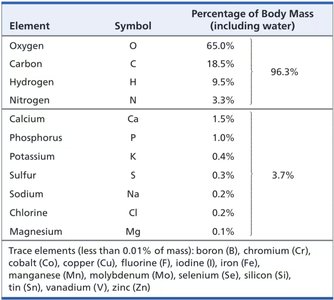
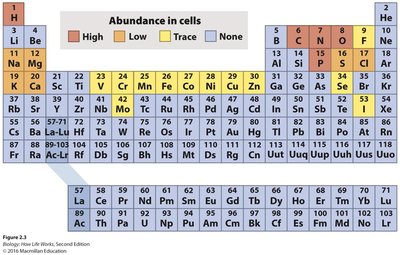
Living organisms are primarily composed of a few key elements: oxygen, carbon, hydrogen, and nitrogen. These elements make up over 96% of the human body mass, with other elements present in smaller amounts.
Atomic Number, Mass Number, and Isotopes
The atomic number is the number of protons in an atom, while the mass number is the sum of protons and neutrons. Isotopes are atoms of the same element with different numbers of neutrons.
Atomic number (Z): Number of protons
Mass number (A): Number of protons + neutrons

Electron Shells and Energy Levels
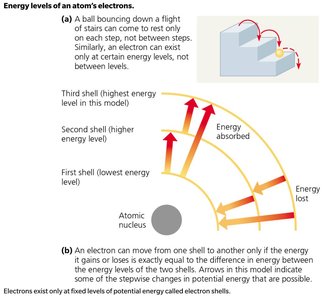
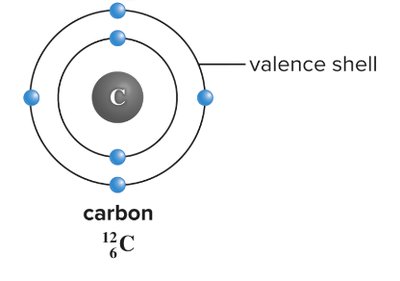
Electrons occupy specific energy levels or shells around the nucleus. The arrangement of electrons determines the chemical reactivity of an atom. The outermost shell is called the valence shell, and electrons in this shell are called valence electrons.
First shell: up to 2 electrons
Second shell: up to 8 electrons
Third shell: up to 8 electrons
Chemical Bonds and Interactions
Types of Chemical Bonds
Atoms form chemical bonds to achieve stable electron configurations. The main types of bonds in biology are ionic, covalent, and hydrogen bonds.
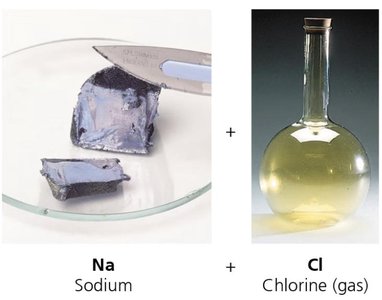
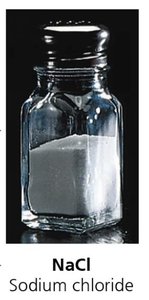
Ionic Bonds: Formed by the transfer of electrons from one atom to another, resulting in oppositely charged ions that attract each other.
Covalent Bonds: Formed by the sharing of electron pairs between atoms. Can be single, double, or triple bonds.
Hydrogen Bonds: Weak attractions between a hydrogen atom covalently bonded to an electronegative atom and another electronegative atom.
Valence Electrons and Bonding Capacity
The number of valence electrons determines how many bonds an atom can form. For example, carbon has 4 valence electrons and can form 4 covalent bonds, while oxygen has 6 valence electrons and typically forms 2 bonds.
Electronegativity and Bond Polarity
Electronegativity is the ability of an atom to attract shared electrons. When two atoms with different electronegativities form a covalent bond, the electrons are shared unequally, resulting in a polar covalent bond. If the electronegativities are similar, the bond is nonpolar covalent.
Polar covalent bond: Unequal sharing of electrons (e.g., H2O)
Nonpolar covalent bond: Equal sharing of electrons (e.g., O2)
Ionic Bonds and Redox Reactions
Ionic bonds result from the transfer of electrons, creating ions. Redox reactions involve the transfer of electrons between atoms, with one atom being oxidized (losing electrons) and another reduced (gaining electrons).
Oxidation: Loss of electrons
Reduction: Gain of electrons
Biological Molecules and Their Chemical Properties
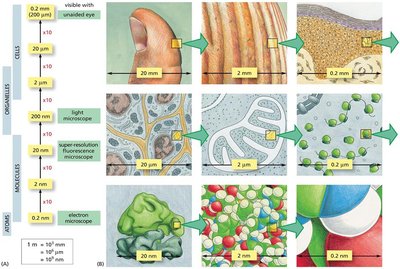
Atoms to Molecules to Organelles
Atoms combine to form molecules, which in turn make up organelles and cells. The structure and function of biological molecules depend on the types of atoms involved and the bonds they form.
Major Classes of Biomolecules
Biomolecules such as proteins, lipids, carbohydrates, and nucleic acids are composed of specific arrangements of atoms and functional groups. Their properties are determined by the types of bonds and the polarity of the molecules.
Proteins: Polymers of amino acids, involved in structure and function
Lipids: Hydrophobic molecules, important for membranes and energy storage
Carbohydrates: Sugars and polysaccharides, energy sources and structural components
Nucleic acids: DNA and RNA, store and transmit genetic information
Summary Table: Elements Essential for Life
Element | Symbol | Percentage of Body Mass (including water) |
|---|---|---|
Oxygen | O | 65.0% |
Carbon | C | 18.5% |
Hydrogen | H | 9.5% |
Nitrogen | N | 3.3% |
Calcium | Ca | 1.5% |
Phosphorus | P | 1.0% |
Potassium | K | 0.4% |
Sulfur | S | 0.3% |
Sodium | Na | 0.2% |
Chlorine | Cl | 0.2% |
Magnesium | Mg | 0.1% |
Key Equations
Atomic number:
Mass number:
Electron configuration (first three shells):
Conclusion
Understanding the chemical context of life provides the foundation for studying biological molecules and cellular processes. The properties of atoms, the types of chemical bonds they form, and the resulting molecular structures are central to the function of all living systems.
