 Back
BackThe Chemical Context of Life: Atoms, Elements, and Chemical Bonds
Study Guide - Smart Notes
 Tailored notes based on your materials, expanded with key definitions, examples, and context.
Chapter 2: The Chemical Context of Life
Concept 2.1: Matter, Elements, and Compounds
All living organisms are composed of matter, which is anything that occupies space and has mass. Matter is made up of elements, and elements can combine to form compounds with unique properties.
Matter: Anything that takes up space and has mass.
Element: A substance that cannot be broken down into other substances by chemical reactions.
Compound: A substance consisting of two or more elements in a fixed ratio. Compounds have characteristics different from their constituent elements.
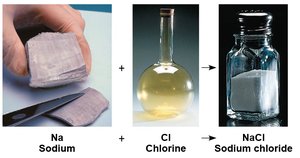
Example: Table salt (NaCl) is a compound of sodium and chlorine, both of which have very different properties in their elemental forms.
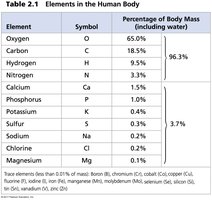
Elements in the Human Body
Only a few elements are essential for life, and these make up the majority of the human body’s mass.
Element | Symbol | Percentage of Body Mass (including water) |
|---|---|---|
Oxygen | O | 65.0% |
Carbon | C | 18.5% |
Hydrogen | H | 9.5% |
Nitrogen | N | 3.3% |
Calcium | Ca | 1.5% |
Phosphorus | P | 1.0% |
Potassium | K | 0.4% |
Sulfur | S | 0.3% |
Sodium | Na | 0.2% |
Chlorine | Cl | 0.2% |
Magnesium | Mg | 0.1% |
Concept 2.2: Atomic Structure and Properties
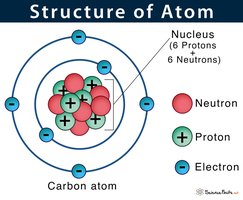
Each element consists of unique atoms, which are the smallest units of matter that retain the properties of an element. Atoms are composed of subatomic particles: protons, neutrons, and electrons.
Proton: Positively charged particle found in the nucleus.
Neutron: Electrically neutral particle found in the nucleus.
Electron: Negatively charged particle found in electron shells around the nucleus.
Atomic Number: Number of protons in the nucleus; defines the element.
Mass Number: Sum of protons and neutrons in the nucleus.
Atomic Mass: Approximate total mass of an atom, measured in daltons.
Isotopes
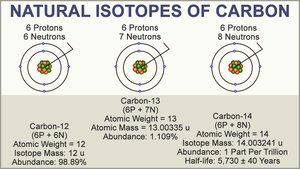
Isotopes are atoms of the same element that differ in the number of neutrons. Some isotopes are stable, while others are radioactive and decay over time, releasing energy.
Example: Carbon-12, Carbon-13, and Carbon-14 are isotopes of carbon, differing in neutron number.
Electron Distribution and the Periodic Table
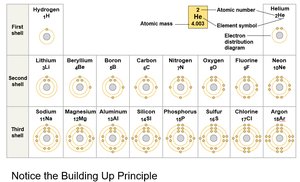
The chemical behavior of an atom is determined by the arrangement of electrons in electron shells. The periodic table organizes elements by their atomic number and electron configuration.
Valence Electrons: Electrons in the outermost shell; determine chemical reactivity.
Chemically Inert: Elements with full valence shells (e.g., noble gases) are unreactive.
Concept 2.3: Chemical Bonds and Molecular Interactions
Atoms with incomplete valence shells can share or transfer electrons, forming chemical bonds. These bonds hold atoms together in molecules and compounds.
Covalent Bonds
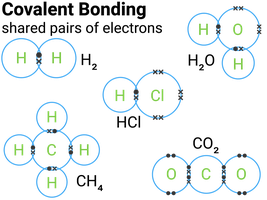
A covalent bond involves the sharing of a pair of valence electrons between two atoms. Covalent bonds can be single, double, or triple, depending on the number of shared electron pairs.
Single Bond: Sharing of one pair of electrons (e.g., H—H).
Double Bond: Sharing of two pairs of electrons (e.g., O=O).
Molecule: Two or more atoms held together by covalent bonds.
Electronegativity: The tendency of an atom to attract electrons in a covalent bond.
Nonpolar Covalent Bond: Electrons are shared equally.
Polar Covalent Bond: Electrons are shared unequally, resulting in partial charges.
Ionic Bonds
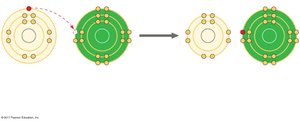
Ionic bonds form when one atom transfers electrons to another, resulting in oppositely charged ions that attract each other. Compounds formed by ionic bonds are called salts.
Cation: Positively charged ion (e.g., Na+).
Anion: Negatively charged ion (e.g., Cl−).
Example: Sodium chloride (NaCl) forms from the transfer of an electron from sodium to chlorine.
Hydrogen Bonds
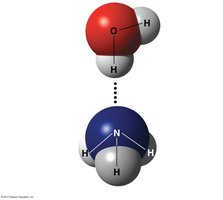
A hydrogen bond forms when a hydrogen atom covalently bonded to one electronegative atom is attracted to another electronegative atom. Hydrogen bonds are important in the structure of water and biological molecules like DNA and proteins.
Example: Hydrogen bonding between water molecules and between water and ammonia.
Additional info: This summary covers the foundational chemical principles necessary for understanding biological molecules and processes, including atomic structure, types of chemical bonds, and the relevance of these concepts to living organisms.
