 Back
The Chemical Context of Life: Atoms, Elements, and Bonds
Study Guide - Smart Notes
 Tailored notes based on your materials, expanded with key definitions, examples, and context.
The Chemical Context of Life
Atoms and Subatomic Particles
Understanding the structure of atoms is fundamental to biology, as it underpins the chemical properties of elements and molecules found in living organisms.
Atom: The smallest unit of matter that retains the properties of an element.
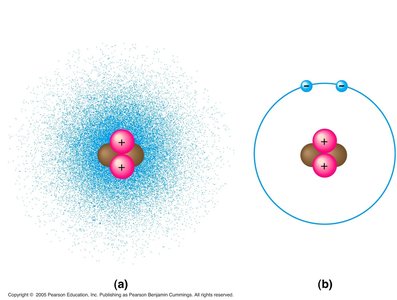
Subatomic particles: Atoms are composed of protons (positive charge, mass = 1 Dalton), neutrons (neutral, mass = 1 Dalton), and electrons (negative charge, mass ≈ 0 Dalton).
Atomic number: The number of protons in an atom, which determines the element.
Mass number: The sum of protons and neutrons in the nucleus.
Electrons: Occupy energy shells around the nucleus; the arrangement of electrons determines chemical reactivity.
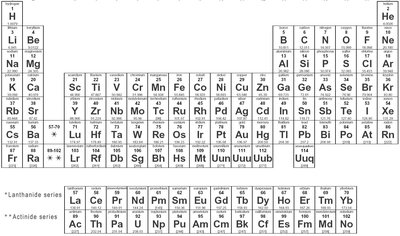
The Periodic Table of Elements
The periodic table organizes elements by increasing atomic number and groups them by similar chemical properties. It is a foundational tool for understanding biological chemistry.
Element: A substance that cannot be broken down by chemical reactions.
Compound: A substance consisting of two or more elements in a fixed ratio, often with emergent properties.
Elements essential for life include hydrogen, carbon, nitrogen, oxygen, phosphorus, and sulfur.
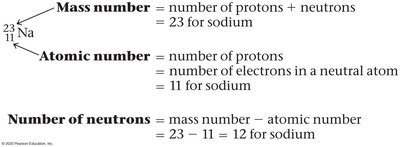
Atomic Number, Mass Number, and Isotopes
Atoms of the same element can have different numbers of neutrons, resulting in isotopes. Calculating atomic and mass numbers is essential for understanding atomic structure.
Atomic number (Z): Number of protons.
Mass number (A): Number of protons plus neutrons.
Number of neutrons:
Example: Sodium (Na) has 11 protons and a mass number of 23, so it has 12 neutrons.
Electron Shells and Chemical Reactivity
Electrons are arranged in shells around the nucleus. The distribution of electrons determines how atoms interact and form bonds.
The first shell holds 2 electrons, the second and third shells hold up to 8 electrons each.
Atoms with incomplete outer shells are reactive and tend to form bonds to achieve stability.
Example: Neon (Ne) has a full outer shell and is chemically inert, while lithium (Li) has one electron in its second shell and is highly reactive.
Types of Chemical Bonds
Atoms form bonds by sharing or transferring electrons to achieve stable electron configurations. The main types of bonds relevant to biology are ionic, covalent, and hydrogen bonds.
Ionic bonds: Formed when electrons are transferred from one atom to another, resulting in oppositely charged ions that attract each other.
Covalent bonds: Formed when atoms share pairs of electrons.
Hydrogen bonds: Weak attractions between a hydrogen atom and an electronegative atom (such as oxygen or nitrogen).
Ionic Bonds: Formation and Properties
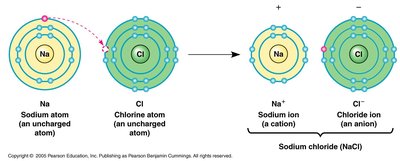
Ionic bonds are formed when one atom donates an electron to another, creating charged ions. These ions are held together by electrostatic attraction.
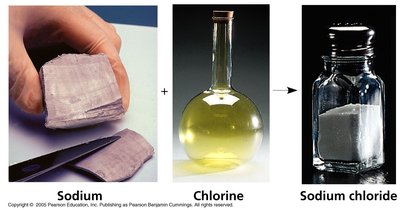
Example: Sodium (Na) donates an electron to chlorine (Cl), forming sodium chloride (NaCl).
Sodium becomes a positively charged cation (Na+), and chlorine becomes a negatively charged anion (Cl-).
Covalent Bonds: Electron Sharing
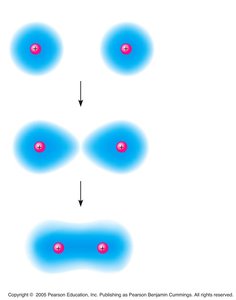
Covalent bonds involve the sharing of electron pairs between atoms. This type of bond is common in biological molecules.
Single covalent bond: One pair of electrons is shared.
Double covalent bond: Two pairs of electrons are shared.
Example: Two hydrogen atoms share electrons to form a hydrogen molecule (H2).
Hybridization of Orbitals and Molecular Shapes
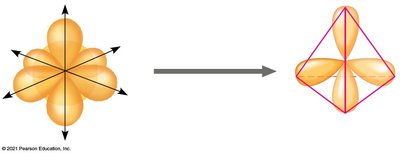
The shape of molecules is determined by the arrangement of electron orbitals. Hybridization leads to specific molecular geometries, which are important for biological function.
Hybrid orbitals: Orbitals mix to form new shapes, such as tetrahedral geometry in methane (CH4).
Molecular shape: Determines how molecules interact and react in biological systems.
Molecular Models: Water and Methane
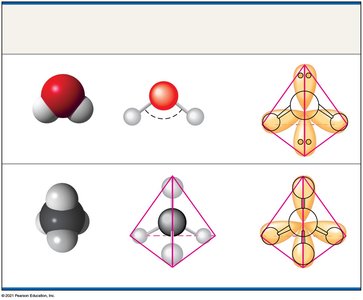
Molecular models help visualize the three-dimensional structure of molecules, which is crucial for understanding their function in biology.
Water (H2O): Bent shape due to lone pairs on oxygen; bond angle is 104.5°.
Methane (CH4): Tetrahedral shape with bond angles of 109.5°.
Different models include space-filling, ball-and-stick, and hybrid-orbital representations.
Emergent Properties of Compounds
Compounds often have properties distinct from their constituent elements. This concept is important in biology, where molecules such as water and salts exhibit unique behaviors.
Example: Sodium is a reactive metal, chlorine is a poisonous gas, but together they form table salt (NaCl), which is essential for life.
Summary Table: Subatomic Particles
Particle | Charge | Mass (Daltons) |
|---|---|---|
Proton | +1 | 1 |
Neutron | 0 | 1 |
Electron | -1 | ~0 |
Summary Table: Electron Shells
Shell | Maximum Electrons |
|---|---|
1st | 2 |
2nd | 8 |
3rd | 8 |
Summary Table: Types of Bonds
Bond Type | Mechanism | Example |
|---|---|---|
Ionic | Electron transfer | NaCl |
Covalent | Electron sharing | H2O, CH4 |
Hydrogen | Weak attraction | Between water molecules |
Additional info: Expanded explanations and context were added to ensure completeness and clarity for General Biology students.
