 Back
The Chemical Context of Life: Atoms, Elements, and Chemical Bonds
Study Guide - Smart Notes
 Tailored notes based on your materials, expanded with key definitions, examples, and context.
The Chemical Context of Life
Introduction to the Chemical Basis of Biology
All living organisms are composed of matter, which is anything that takes up space and has mass. The study of the chemical context of life focuses on the elements and atoms that form the foundation of biological molecules and processes.
Essential Elements: About 25% of the 92 naturally occurring elements are essential to life. Four elements—carbon (C), hydrogen (H), oxygen (O), and nitrogen (N)—make up approximately 96% of living matter.
Elements: Substances that cannot be broken down into other substances by chemical reactions.
Atoms: The smallest unit of matter that retains the properties of an element.
Atomic Structure
Subatomic Particles
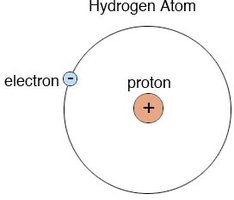
Atoms are composed of three main subatomic particles:
Protons (p+): Positively charged particles found in the nucleus.
Neutrons (n0): Electrically neutral particles also located in the nucleus.
Electrons (e-): Negatively charged particles that orbit the nucleus in electron shells.
Atomic Number and Mass Number
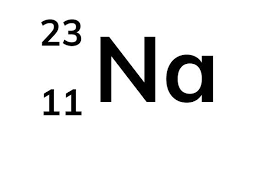
Atomic Number: The number of protons in an atom, which determines the element.
Mass Number: The sum of protons and neutrons in the nucleus.
Number of Neutrons: Calculated as mass number minus atomic number.
Number of Electrons: In a neutral atom, equals the number of protons.
Isotopes and Ions
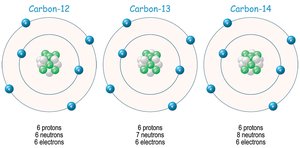
Isotopes: Atoms of the same element with different numbers of neutrons. Some isotopes are stable, while others are radioactive and decay spontaneously.
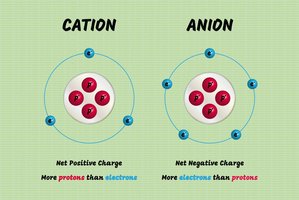
Ions: Atoms that have gained or lost electrons, resulting in a net charge. Cations are positively charged (loss of electrons), and anions are negatively charged (gain of electrons).
The Periodic Table
Organization and Significance
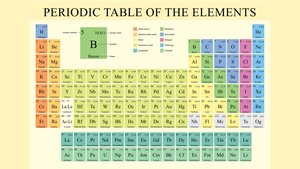
The periodic table arranges elements by increasing atomic number and groups elements with similar chemical properties in vertical columns. The table provides information about atomic structure and electron configuration.
Electron Configuration and Chemical Properties
Electron Shells and Energy Levels
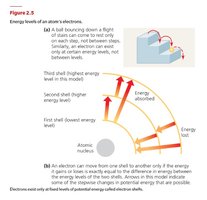
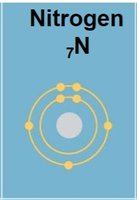
Electrons occupy specific energy levels or shells around the nucleus. The chemical behavior of an atom is largely determined by the number of electrons in its outermost shell, known as the valence shell.
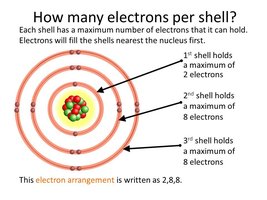
First shell: Holds up to 2 electrons
Second shell: Holds up to 8 electrons
Third shell: Holds up to 8 electrons
Valence Electrons and Reactivity
Atoms with incomplete valence shells are reactive and tend to form chemical bonds to achieve stability. Atoms interact by sharing or transferring electrons to complete their valence shells.
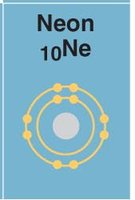
Inert elements: Atoms with full valence shells (e.g., neon) are chemically unreactive.
Reactive elements: Atoms with incomplete valence shells (e.g., carbon, nitrogen) readily form bonds.
Chemical Bonds
Covalent Bonds
Covalent bonds involve the sharing of pairs of valence electrons between atoms, resulting in the formation of molecules. The strength and type of covalent bond depend on the electronegativity of the atoms involved.
Nonpolar Covalent Bonds: Electrons are shared equally between atoms with similar electronegativity (e.g., H2, O2).
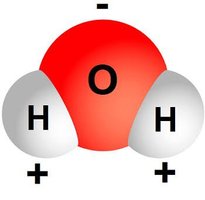
Polar Covalent Bonds: Electrons are shared unequally due to differences in electronegativity, resulting in partial charges (e.g., H2O).
Ionic Bonds
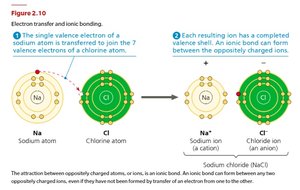
Ionic bonds form when electrons are transferred from one atom to another, creating oppositely charged ions that are attracted to each other. This typically occurs between atoms with large differences in electronegativity.
Cation: Atom that loses electrons and becomes positively charged.
Anion: Atom that gains electrons and becomes negatively charged.
Hydrogen Bonds
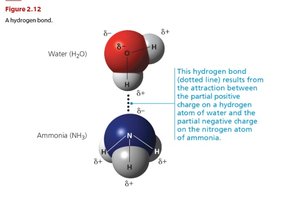
Hydrogen bonds are weak interactions that occur when a hydrogen atom covalently bonded to an electronegative atom (such as oxygen or nitrogen) is attracted to another electronegative atom. These bonds are crucial in stabilizing the structures of proteins and nucleic acids, and in the unique properties of water.
Electron Density and Molecular Polarity
Electron Density Distribution
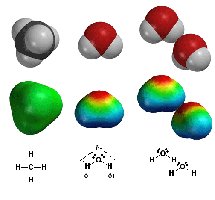
Electron density maps show regions of high and low electron concentration in molecules. Polar molecules have uneven electron density, leading to partial positive and negative charges, while nonpolar molecules have even electron distribution.
Molecular Shape and Function
Importance of Molecular Shape
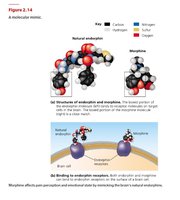
The three-dimensional shape of a molecule is determined by the arrangement of its atoms and the types of bonds present. Molecular shape is critical for biological function, such as the binding of hormones to receptors or the specificity of enzyme-substrate interactions.
Chemical Reactions
Reactants, Products, and Conservation of Matter
Chemical reactions involve the making and breaking of chemical bonds, transforming reactants into products. Matter is neither created nor destroyed in a chemical reaction; atoms are simply rearranged.
Reversible Reactions: Many reactions are reversible, reaching chemical equilibrium when the forward and reverse reactions occur at the same rate.
Comparison of Ionic and Covalent Bonds
Similarities and Differences
Aspect | Ionic Bonds | Covalent Bonds |
|---|---|---|
Electron Involvement | Electrons are transferred | Electrons are shared |
Resulting Structure | Compound or salt made of ions | Molecule (polar or non-polar) |
Bond Strength | Generally weaker in water | Generally stronger |
Hydrogen Bonding | Does not occur | Occurs between polar covalent molecules |
Key Equations
Number of neutrons:
Atomic mass:
