 Back
The Chemical Context of Life: Atoms, Water, and Carbon
Study Guide - Smart Notes
 Tailored notes based on your materials, expanded with key definitions, examples, and context.
Chemical Context of Life
Introduction to Matter and Elements
Matter is composed of elements, which can exist in pure form or as compounds. Understanding the properties of atoms and compounds is foundational for grasping biological phenomena, such as the structure of cell membranes and the behavior of biomolecules.
Atoms: The smallest units of matter that retain the properties of an element.
Elements: Substances that cannot be broken down by chemical means; each has a unique type of atom.
Compounds: Substances formed from two or more elements in fixed ratios.
Molecules: Two or more atoms held together by covalent bonds.
The Elements of Life
CHON (Carbon, Hydrogen, Oxygen, Nitrogen) make up about 96% of human body mass.
The remaining 4% includes elements like Calcium (Ca), Potassium (K), Phosphorus (P), and trace elements such as Iron (Fe).
Properties of Elements
Subatomic particles: Protons (positive), neutrons (neutral), electrons (negative).
Mass Number vs. Atomic Mass: Mass number is the sum of protons and neutrons; atomic mass is the weighted average of all isotopes.
Valence electrons: Electrons in the outermost shell determine chemical properties and bonding potential.
Electron distribution influences chemical reactivity; atoms seek to fill their valence shells, often by gaining, losing, or sharing electrons (the 'octet rule').
Orbitals: Regions where electrons are likely to be found; unpaired electrons drive chemical interactions.
Isotopes and Radioisotopes
Isotopes: Atoms of the same element with different numbers of neutrons.
Radioisotopes: Unstable isotopes that decay at a constant rate, measured by half-life (time for 50% to decay).
Applications:
Radiometric dating of rocks and fossils
Medical imaging (e.g., PET scans)
Treatment of medical conditions (e.g., hyperthyroidism)
Chemical Bonds
Ionic Bonds: Formed when electrons are transferred from one atom to another, creating cations (+) and anions (−). Example: Na+ and Cl− in nerve cell function.
Covalent Bonds: Atoms share electrons; can be single, double, or triple bonds. Most biological molecules are held together by covalent bonds.
Polar Covalent Bonds: Electrons are shared unequally, creating partial charges (e.g., in water).
Nonpolar Covalent Bonds: Electrons are shared equally (e.g., in lipids).
Water and Life
Structure and Properties of Water
Water's unique properties arise from its polar covalent bonds and ability to form hydrogen bonds. These features are critical for life on Earth.
Polar molecule: Oxygen is more electronegative, pulling electrons closer and creating partial charges.
Hydrogen bonding: Weak attractions between the partial positive hydrogen of one water molecule and the partial negative oxygen of another.
V-shaped molecule: Bond angle of 104.45°.
Emergent Properties of Water
Cohesion: Water molecules stick together via hydrogen bonds, leading to surface tension and capillary action.
Moderation of Temperature: Water absorbs and releases heat slowly, stabilizing environments.
Floating of Ice: Solid water is less dense than liquid water, allowing ice to float and insulate aquatic life.
Water as a Solvent: Water dissolves many substances, facilitating chemical reactions in cells.
Hydrophilic: Substances that dissolve in water.
Hydrophobic: Substances that do not dissolve in water.
Water Potential
Water potential () determines the direction of water movement.
Formula:
Solute potential:
i: Ionization constant (e.g., 1 for sucrose, 2 for NaCl)
C: Molar concentration
R: Pressure constant
T: Temperature in Kelvin
Acids, Bases, and pH
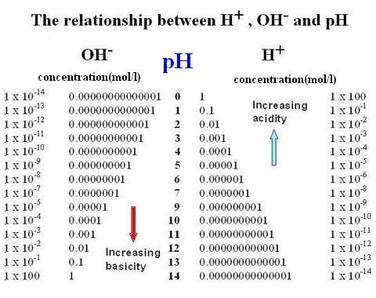
Acids increase the concentration of H+ ions, while bases increase OH− ions. Water is neutral, with equal concentrations of H+ and OH−. The pH scale measures the concentration of H+ ions, with lower pH indicating higher acidity.
Acids: More H+ than OH−
Bases: More OH− than H+
pH:
Carbon and the Molecular Diversity of Life
Organic Chemistry and the Importance of Carbon
Organic chemistry is the study of carbon compounds. Carbon's ability to form four covalent bonds allows for a vast diversity of molecular structures, which is the basis for the complexity of life.
Miller-Urey Experiment: Demonstrated that organic molecules could be synthesized from inorganic precursors under conditions thought to resemble early Earth.
Biodiversity: Arises from carbon's versatility in forming molecules with different shapes and properties (e.g., glucose vs. fructose, steroids).
Carbon Bonding and Molecular Diversity
Valence of 4: Carbon can form four bonds with other atoms, including itself, creating chains and rings (carbon skeletons).
Hydrocarbons: Chains of carbon and hydrogen; nonpolar and hydrophobic.
Isomers: Compounds with the same chemical formula but different structures and properties.
Structural isomers: Differ in covalent arrangements.
Cis-trans isomers: Differ in spatial arrangement around double bonds.
Enantiomers: Mirror images of each other.
Chemical Groups and Molecular Function
Certain chemical groups attached to carbon skeletons are key to the function of organic molecules. These groups participate in chemical reactions and influence molecular behavior.
Hydroxyl (-OH): Turns hydrocarbons and sugars into alcohols.
Carbonyl (>CO): Found in sugars, giving rise to aldoses and ketoses.
Carboxyl (-COOH): Acts as an acid, donating H+.
Amino (-NH2): Acts as a base, picking up H+.
Sulfhydryl (-SH): Important in protein structure (disulfide bridges).
Example: Estradiol and testosterone are steroids with the same carbon skeleton but different functional groups, resulting in distinct biological activities.
