 Back
The Chemical Context of Life: Lecture Notes #3
Study Guide - Smart Notes
 Tailored notes based on your materials, expanded with key definitions, examples, and context.
The Chemical Context of Life
Atoms, Elements, and Molecules
All living organisms are composed of matter, which consists of elements organized into atoms and molecules. Understanding the structure and behavior of atoms is fundamental to biology, as it underpins the chemical properties of life.
Atom: The smallest unit of an element that retains its chemical properties. Atoms are composed of protons, neutrons, and electrons.
Element: A substance that cannot be broken down into other substances by chemical means. Examples include carbon (C), hydrogen (H), oxygen (O), and nitrogen (N).
Molecule: Two or more atoms held together by chemical bonds. For example, water (H2O) is a molecule composed of two hydrogen atoms and one oxygen atom.
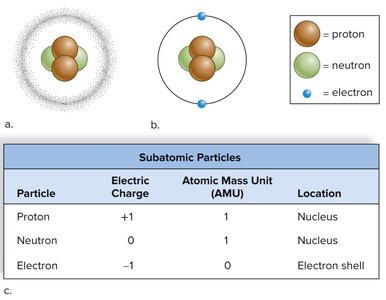
Table: Major elements in the human body and their relative abundance.
Structure of the Atom
Atoms consist of a central nucleus (containing protons and neutrons) surrounded by electrons in shells. The arrangement of electrons determines the atom's chemical behavior.
Proton: Positively charged particle in the nucleus.
Neutron: Electrically neutral particle in the nucleus.
Electron: Negatively charged particle orbiting the nucleus in electron shells.

Table: Properties of subatomic particles.
Atomic Number, Mass Number, and Isotopes
The atomic number is the number of protons in an atom and defines the element. The mass number is the sum of protons and neutrons. Isotopes are atoms of the same element with different numbers of neutrons.
Atomic Number (Z): Number of protons in the nucleus.
Mass Number (A): Number of protons plus neutrons.
Isotope: Atoms of the same element with different neutron numbers.
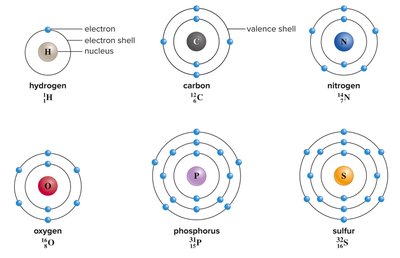
Electron Shells and Energy Levels
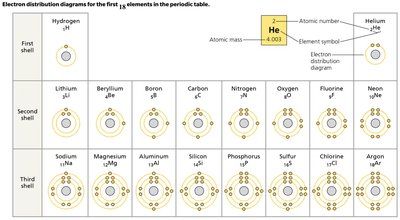
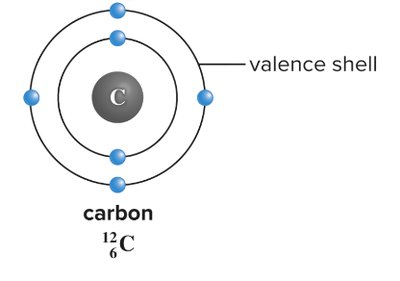
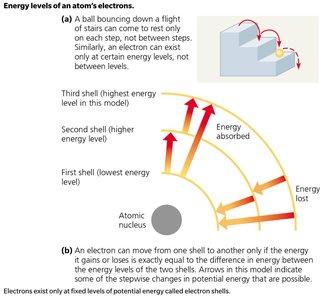
Electrons occupy energy levels or shells around the nucleus. The chemical reactivity of an atom is determined by the electrons in its outermost (valence) shell. Atoms are most stable when their valence shell is full (the "octet rule").
First shell: up to 2 electrons
Second shell: up to 8 electrons
Third shell: up to 8 electrons
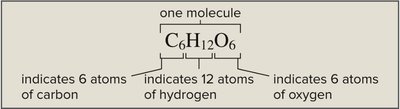
Diagram: Electrons occupy discrete energy levels (shells).
Chemical Bonds and Interactions
Atoms interact to achieve stable electron configurations, forming chemical bonds. The main types of bonds in biology are ionic, covalent, and hydrogen bonds.
Ionic Bond: Formed when electrons are transferred from one atom to another, resulting in oppositely charged ions that attract each other.
Covalent Bond: Formed when two atoms share one or more pairs of electrons. Can be single, double, or triple bonds.
Polar Covalent Bond: Unequal sharing of electrons, resulting in partial charges (δ+ and δ-).
Nonpolar Covalent Bond: Equal sharing of electrons, no charge difference across the molecule.
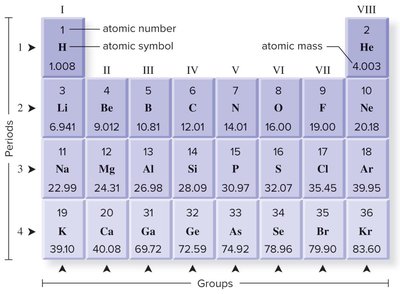
Diagram: Types of chemical bonds and how atoms achieve stability.
Electronegativity and Polarity
Electronegativity is an atom's ability to attract shared electrons. Differences in electronegativity between atoms determine bond polarity.
High electronegativity: Atoms like oxygen and nitrogen pull electrons more strongly.
Polarity: Molecules with polar covalent bonds have regions of partial positive and negative charge, leading to unique chemical properties (e.g., water's polarity).
Redox Reactions
Redox (reduction-oxidation) reactions involve the transfer of electrons between atoms or molecules.
Oxidation: Loss of electrons.
Reduction: Gain of electrons.
Mnemonic: O.I.L. R.I.G. (Oxidation Is Loss, Reduction Is Gain).
Biological Molecules and Their Chemical Basis
Biomolecules such as proteins, lipids, carbohydrates, and nucleic acids are composed of atoms bonded together in specific arrangements. Their structure and function are determined by the types of bonds and the polarity of the molecules.
Proteins: Polymers of amino acids, contain C, H, O, N, and sometimes S.
Lipids: Hydrophobic molecules, rich in C and H, with some O.
Carbohydrates: Sugars and polymers of sugars, contain C, H, and O.
Nucleic Acids: DNA and RNA, contain C, H, O, N, and P.
Summary Table: Major Chemical Bonds in Biology
Bond Type | How Formed | Relative Strength | Example |
|---|---|---|---|
Ionic | Electron transfer | Strong (in dry conditions) | NaCl (table salt) |
Covalent | Electron sharing | Very strong | H2O, O2, CH4 |
Hydrogen | Attraction between partial charges | Weak (individually) | Between water molecules |
Example: Formation of Sodium Chloride (NaCl)
Sodium (Na) donates an electron to chlorine (Cl), forming Na+ and Cl- ions, which are held together by ionic bonds to form table salt.
Scale of Biological Organization
Biology studies life at multiple scales, from atoms and molecules to cells and organisms. Understanding the chemical context is foundational for all higher levels of biological organization.
Key Takeaways
Atoms interact via chemical bonds to form molecules essential for life.
The structure and function of biomolecules depend on the types of atoms, bonds, and molecular polarity.
Understanding atomic structure and bonding is crucial for studying biological processes.
