 Back
The Chemical Context of Life: Atoms, Elements, and Chemical Bonds
Study Guide - Smart Notes
 Tailored notes based on your materials, expanded with key definitions, examples, and context.
The Chemical Context of Life
Atoms, Elements, and the Periodic Table
All matter is composed of elements, which are substances that cannot be broken down into simpler substances by chemical means. Elements are made up of atoms, the smallest units that retain the properties of an element. The atomic number of an element is the number of protons in its nucleus and is unique to each element. The arrangement of elements in the periodic table provides important information about their atomic structure and chemical properties.
Rows (Periods): Indicate the number of electron shells. For example, elements in the first row have one shell, the second row has two shells, and so on.
Columns (Groups): Indicate the number of valence electrons. Elements in the same column have the same number of electrons in their outermost shell, which determines their chemical reactivity.
Noble Gases: The last column contains elements with full valence shells, making them stable and unreactive.
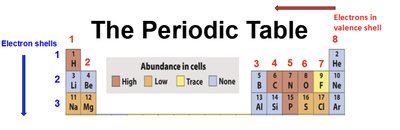
Electron Shells and Chemical Stability
Atoms are most stable when their outermost electron shell (valence shell) is full. Atoms with incomplete valence shells tend to interact with other atoms to achieve stability, often by sharing, donating, or receiving electrons. These interactions result in the formation of chemical bonds.
Chemical Bonds
Ionic Bonds
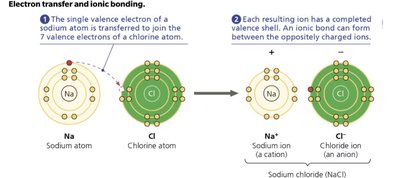
Ionic bonds form when one atom donates an electron to another atom, resulting in the formation of ions—charged atoms or molecules. This typically occurs between metals and non-metals. The atom that loses an electron becomes a positively charged cation, while the atom that gains an electron becomes a negatively charged anion. The electrostatic attraction between oppositely charged ions holds them together.
Example: Sodium (Na) donates one electron to chlorine (Cl), forming Na+ and Cl-, which combine to make sodium chloride (NaCl).
Ionic bonds are generally easy to break, especially in water.
Covalent Bonds
Covalent bonds form when two atoms share one or more pairs of electrons. These bonds are common in organic molecules and are generally stronger than ionic bonds. Covalent bonds can be single, double, or triple, depending on the number of shared electron pairs.
Single bond: Sharing one pair of electrons (e.g., H–H in H2).
Double bond: Sharing two pairs of electrons (e.g., O=O in O2).
Triple bond: Sharing three pairs of electrons (e.g., N≡N in N2).
The major elements in biological molecules—hydrogen, oxygen, nitrogen, and carbon (HONC)—form a predictable number of covalent bonds based on their valence electrons.
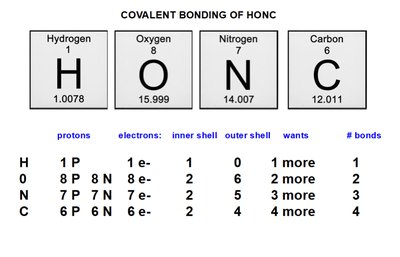
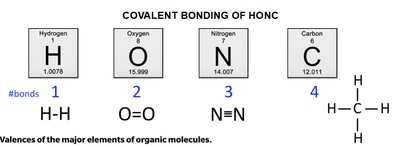
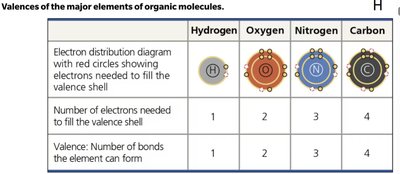
Element | Number of Bonds | Example |
|---|---|---|
Hydrogen (H) | 1 | H–H |
Oxygen (O) | 2 | O=O |
Nitrogen (N) | 3 | N≡N |
Carbon (C) | 4 | CH4 |
Types of Covalent Bonds: Nonpolar vs. Polar
Nonpolar Covalent Bonds
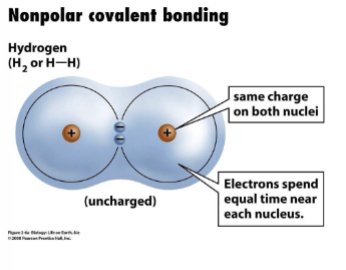
In nonpolar covalent bonds, electrons are shared equally between the two atoms, resulting in no charge difference across the molecule. These bonds typically occur between atoms of the same element or between atoms with similar electronegativities.
Examples: H–H, C–H, O=O, N≡N, CH4, CO2 (due to symmetry).
Nonpolar molecules are often symmetrical.
Polar Covalent Bonds
In polar covalent bonds, electrons are shared unequally, resulting in partial positive (δ+) and partial negative (δ-) charges on different parts of the molecule. This occurs when atoms with different electronegativities form a bond.
Examples: H–O (in H2O), H–N, H–F, C–O, C–N.
Polar molecules often have bent or asymmetrical shapes (e.g., H2O).
Polarity is the state of having two opposite or contradictory tendencies, such as partial charges in a molecule.
Electronegativity
Electronegativity is the ability of an atom to attract shared electrons in a covalent bond. Atoms with higher electronegativity (such as oxygen and nitrogen) pull electrons more strongly. The difference in electronegativity between two atoms can be used to predict the type of bond:
If the difference is large, the bond is ionic.
If the difference is moderate, the bond is polar covalent.
If the difference is small or zero, the bond is nonpolar covalent.
Electronegativity increases across a period (left to right) and decreases down a group (top to bottom) in the periodic table.
Hydrogen Bonds
Hydrogen bonds are weak attractions between a slightly positive hydrogen atom (usually bonded to O or N) and a slightly negative atom (O or N) in another molecule or a different part of the same molecule. Hydrogen bonds are responsible for many of water's unique properties and play a crucial role in the structure of biological molecules like DNA and proteins.
Hydrogen bonds are weaker than covalent bonds.
They are represented by dashed lines in diagrams.
Hydrogen bonds form due to the polarity of molecules.
Redox Reactions: Electron Transfers
In biological systems, redox reactions involve the transfer of electrons from one atom or molecule to another. These reactions are essential for processes like cellular respiration and photosynthesis.
Oxidation: Loss of electrons (e.g., Na → Na+ + e-).
Reduction: Gain of electrons (e.g., Cl + e- → Cl-).
Oxidation and reduction always occur together (one atom is oxidized, another is reduced).
Example: In the formation of NaCl, sodium is oxidized and chlorine is reduced.
Summary Table: Types of Chemical Bonds
Bond Type | How Formed | Strength | Example |
|---|---|---|---|
Ionic | Electron transfer between atoms | Moderate (weak in water) | NaCl |
Covalent (Nonpolar) | Equal sharing of electrons | Strong | H2, CH4 |
Covalent (Polar) | Unequal sharing of electrons | Strong | H2O, NH3 |
Hydrogen Bond | Attraction between δ+ H and δ- O or N | Weak | Between water molecules |
Additional info: Phosphorus (P) is also biologically relevant and can form up to 5 covalent bonds, as seen in molecules like ATP and nucleic acids.
