 Back
The Chemical Context of Life: Atoms, Elements, and Chemical Bonds
Study Guide - Smart Notes
 Tailored notes based on your materials, expanded with key definitions, examples, and context.
The Chemical Context of Life
Atoms, Molecules, and Biological Organization
All living organisms are composed of matter, which is made up of elements organized into atoms and molecules. Understanding the structure and behavior of atoms is fundamental to biology, as it underpins the chemical properties of life.
Atoms are the smallest units of elements that retain the properties of the element.
Molecules are combinations of two or more atoms held together by chemical bonds.
Biological organization proceeds from atoms to molecules, organelles, cells, tissues, organs, and organisms.
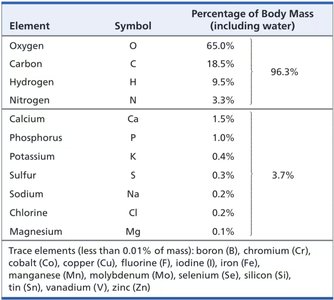
Elements Essential to Life
Life depends on a relatively small number of chemical elements. Four elements—oxygen, carbon, hydrogen, and nitrogen—make up about 96% of living matter. Other elements are required in smaller amounts but are still essential for life.
Major elements: O, C, H, N
Minor elements: Ca, P, K, S, Na, Cl, Mg
Trace elements: Required in minute quantities (e.g., Fe, Zn, I)
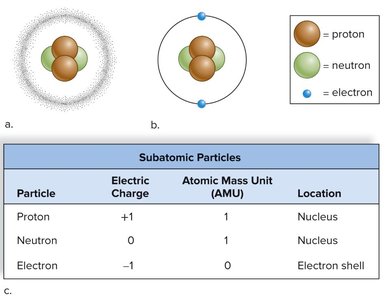
Atomic Structure
Subatomic Particles
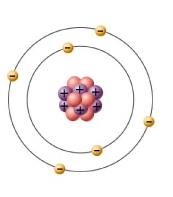
Atoms are composed of three types of subatomic particles: protons, neutrons, and electrons. The arrangement of these particles determines the atom's properties and behavior in chemical reactions.
Protons: Positively charged, found in the nucleus
Neutrons: No charge, found in the nucleus
Electrons: Negatively charged, orbit the nucleus in electron shells
Atomic Number, Mass Number, and Isotopes
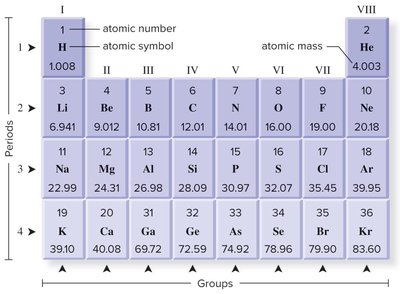
The atomic number is the number of protons in an atom and defines the element. The mass number is the sum of protons and neutrons. Isotopes are atoms of the same element with different numbers of neutrons.
Atomic number (Z): Number of protons
Mass number (A): Number of protons + neutrons
Isotopes: Atoms with the same atomic number but different mass numbers
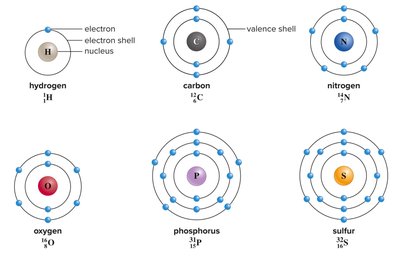
Electron Shells and Energy Levels
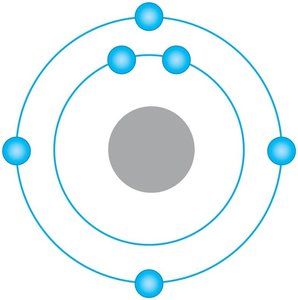
Electrons occupy specific energy levels or shells around the nucleus. The arrangement of electrons in these shells determines the atom's chemical reactivity.
The first shell holds up to 2 electrons.
The second shell holds up to 8 electrons.
The third shell also holds up to 8 electrons (for main group elements).
Valence electrons are those in the outermost shell and are involved in chemical bonding.
Chemical Bonds and Interactions
Stability and the Octet Rule
Atoms are most stable when their valence shell is full. The tendency to achieve a full outer shell drives chemical bonding. The 'octet rule' states that atoms tend to gain, lose, or share electrons to have eight electrons in their valence shell (except for hydrogen and helium, which are stable with two).
Stable configuration: Full valence shell (2 or 8 electrons)
Unstable configuration: Incomplete valence shell
Types of Chemical Bonds
Atoms interact to achieve stability through chemical bonds. The main types of bonds in biology are ionic, covalent, and hydrogen bonds.
Ionic bonds: Formed when electrons are transferred from one atom to another, resulting in oppositely charged ions that attract each other.
Covalent bonds: Formed when two atoms share one or more pairs of electrons. Can be polar (unequal sharing) or nonpolar (equal sharing).
Hydrogen bonds: Weak attractions between a hydrogen atom in a polar molecule and an electronegative atom (e.g., oxygen or nitrogen) in another molecule. (To be covered in detail in the next class.)
Covalent Bonding and the HONC Rule
The number of covalent bonds an atom can form is determined by the number of electrons needed to fill its valence shell. The HONC rule summarizes the typical bonding patterns of the most common elements in biological molecules:
Hydrogen (H): 1 bond
Oxygen (O): 2 bonds
Nitrogen (N): 3 bonds
Carbon (C): 4 bonds
Phosphorus (P): 3 or 5 bonds (biologically relevant forms make 5 bonds)
Electronegativity and Bond Polarity
Electronegativity is an atom's ability to attract shared electrons. Differences in electronegativity between atoms determine whether a covalent bond is polar or nonpolar.
Nonpolar covalent bond: Electrons are shared equally (e.g., H2, O2).
Polar covalent bond: Electrons are shared unequally, resulting in partial charges (e.g., H2O).
Ionic bond: Large difference in electronegativity leads to electron transfer (e.g., NaCl).
Redox Reactions
Redox (reduction-oxidation) reactions involve the transfer of electrons between atoms. These reactions are fundamental to energy transfer in biological systems.
Oxidation: Loss of electrons
Reduction: Gain of electrons
Mnemonic: OIL RIG (Oxidation Is Loss, Reduction Is Gain)
Determining Bond Types Using Electronegativity
The type of bond between two atoms can be predicted by the difference in their electronegativities:
Difference < 0.5: Nonpolar covalent
Difference 0.5–1.7: Polar covalent
Difference > 1.7: Ionic
Example: HCl (H = 2.1, Cl = 3.0, difference = 0.9) forms a polar covalent bond.
Biological Molecules and Their Chemical Properties
Atoms to Biomolecules
Atoms interact via bonds to form molecules, which are the building blocks of life. The chemical properties of biomolecules, such as polarity and bond type, determine their structure and function in cells.
Polarity affects solubility, membrane formation, and molecular interactions.
Chemical bonds are crucial for the structure and function of proteins, nucleic acids, lipids, and carbohydrates.
Example: Water (H2O) is a polar molecule, which makes it an excellent solvent for biological reactions.
Summary Table: Major Elements in the Human Body
Element | Symbol | Percentage of Body Mass (including water) |
|---|---|---|
Oxygen | O | 65.0% |
Carbon | C | 18.5% |
Hydrogen | H | 9.5% |
Nitrogen | N | 3.3% |
Calcium | Ca | 1.5% |
Phosphorus | P | 1.0% |
Potassium | K | 0.4% |
Sulfur | S | 0.3% |
Sodium | Na | 0.2% |
Chlorine | Cl | 0.2% |
Magnesium | Mg | 0.1% |
Additional info: Trace elements (less than 0.01% of mass) include boron, chromium, cobalt, copper, fluorine, iodine, iron, manganese, molybdenum, selenium, silicon, tin, vanadium, and zinc.
Key Takeaways
Atoms are the fundamental units of matter, composed of protons, neutrons, and electrons.
The arrangement of electrons in shells determines chemical reactivity and bonding.
Chemical bonds (ionic, covalent, hydrogen) are essential for forming molecules and biomolecules.
Electronegativity differences determine bond polarity and molecular properties.
Understanding atomic structure and bonding is foundational for studying biological molecules and processes.
