 Back
The Chemical Context of Life: Atoms, Elements, and Chemical Bonds
Study Guide - Smart Notes
 Tailored notes based on your materials, expanded with key definitions, examples, and context.
The Chemical Context of Life
Introduction to Elements and Atoms
All matter, including living organisms, is composed of elements, which are substances that cannot be broken down into simpler substances by chemical means. Elements are made up of atoms, the smallest units of matter that retain the properties of an element.
Element: A pure substance consisting of only one type of atom.
Atom: The basic unit of an element, composed of protons, neutrons, and electrons.
Molecule: Two or more atoms joined together by chemical bonds.
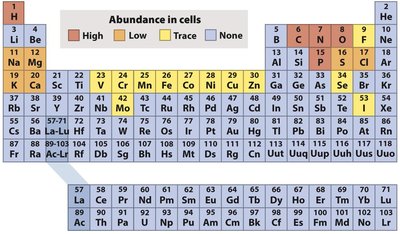
Additional info: The periodic table organizes elements by their atomic number and properties. In biology, the most abundant elements are hydrogen (H), carbon (C), nitrogen (N), and oxygen (O), often referred to as HONC.
Atomic Structure
Atoms consist of a central nucleus containing protons and neutrons, surrounded by electrons in shells.
Proton: Positively charged particle in the nucleus.
Neutron: Neutral particle in the nucleus.
Electron: Negatively charged particle in electron shells around the nucleus.
Atomic number: Number of protons in an atom; defines the element.
Atomic mass: Sum of protons and neutrons in the nucleus.
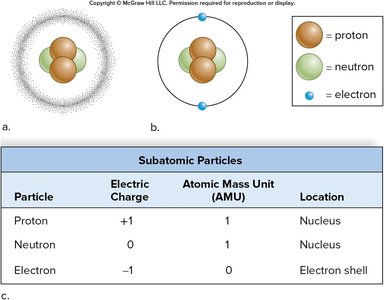
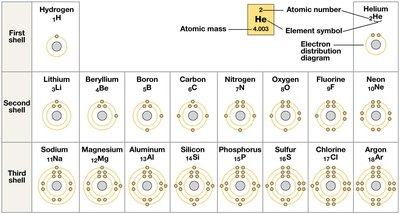
Additional info: The arrangement of electrons in shells determines the chemical behavior of an atom. The first shell holds up to 2 electrons, the second up to 8, and so on.
Electron Shells and Valence Electrons
The chemical reactivity of an atom is largely determined by the number of electrons in its outermost shell, known as valence electrons. Atoms are most stable when their outermost shell is full.
Valence shell: The outermost electron shell of an atom.
Valence electrons: Electrons in the outermost shell; involved in chemical bonding.
Atoms with incomplete valence shells tend to form chemical bonds to achieve stability.
Chemical Bonds
Chemical bonds are interactions between atoms that enable them to achieve stable electron configurations. The main types of chemical bonds in biology are covalent bonds and ionic bonds.
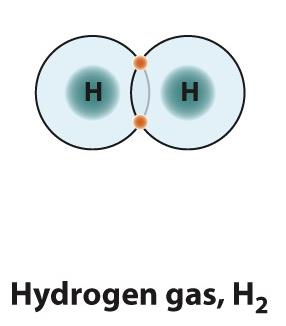
Covalent bond: A bond formed when two atoms share one or more pairs of electrons.
Ionic bond: A bond formed when one atom donates an electron to another, resulting in oppositely charged ions that attract each other.

Additional info: Covalent bonds are depicted as solid lines between atoms in molecular diagrams.
Covalent Bonding of HONC Elements
The elements hydrogen (H), oxygen (O), nitrogen (N), and carbon (C) are fundamental to biological molecules. Each forms a characteristic number of covalent bonds to achieve stability:
Element | Valence Electrons | Bonds Formed |
|---|---|---|
H | 1 | 1 |
O | 6 | 2 |
N | 5 | 3 |
C | 4 | 4 |
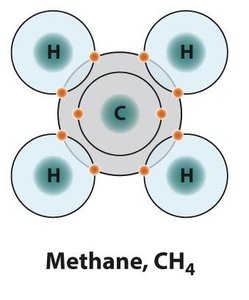
Example: In methane (CH4), carbon forms four covalent bonds with hydrogen atoms, filling its valence shell.
Types of Covalent Bonds: Polar and Non-Polar
Covalent bonds can be classified based on how equally electrons are shared between atoms:
Non-polar covalent bond: Electrons are shared equally between atoms (e.g., H2, CH4).
Polar covalent bond: Electrons are shared unequally, resulting in partial charges (e.g., H2O).
Electronegativity: The tendency of an atom to attract electrons in a bond. Higher electronegativity means stronger attraction.
Additional info: In water (H2O), oxygen is more electronegative than hydrogen, so electrons spend more time near oxygen, making the molecule polar.
Ionic Bonds
Ionic bonds form when one atom donates an electron to another, creating ions with opposite charges that attract each other.
Cation: Positively charged ion (loses electron).
Anion: Negatively charged ion (gains electron).
Ionic compound: A compound formed by ionic bonds (e.g., NaCl).
Example: Sodium (Na) donates an electron to chlorine (Cl), forming Na+ and Cl-, which combine to make table salt.
Determining Bond Type by Electronegativity Difference
The type of bond between two atoms can be predicted by the difference in their electronegativities:
If the difference is small (<0.5), the bond is non-polar covalent.
If the difference is moderate (0.5–1.7), the bond is polar covalent.
If the difference is large (>1.7), the bond is ionic.
Formula:
Example: For HCl, H = 2.1, Cl = 3.0, so (polar covalent bond).
Summary Table: Types of Chemical Bonds
Bond Type | Electron Behavior | Example |
|---|---|---|
Non-polar Covalent | Equal sharing | H2, CH4 |
Polar Covalent | Unequal sharing | H2O, NH3 |
Ionic | Electron transfer | NaCl |
Importance of Chemical Bonds in Biology
Chemical bonds are fundamental to the structure and function of biomolecules. The polarity of molecules, resulting from differences in electronegativity, imparts unique functional capabilities to biological molecules, influencing processes such as molecular recognition, solubility, and reactivity.
