 Back
The Chemical Context of Life: Atoms, Elements, and Chemical Bonds
Study Guide - Smart Notes
 Tailored notes based on your materials, expanded with key definitions, examples, and context.
The Chemical Context of Life
Introduction to Elements and Atoms
All matter, including living organisms, is composed of elements, which are substances that cannot be broken down into simpler substances by chemical means. Elements are made up of atoms, the smallest units of matter that retain the properties of an element.
Element: A pure substance consisting of only one type of atom.
Atom: The basic unit of an element, composed of protons, neutrons, and electrons.
Molecule: Two or more atoms joined together by chemical bonds.
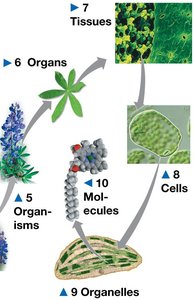
Example: Water (H2O) is a molecule made of two hydrogen atoms and one oxygen atom.
Atomic Structure
Atoms consist of a central nucleus containing protons and neutrons, surrounded by electrons in shells. The number of protons defines the atomic number and the element.
Proton: Positively charged particle in the nucleus.
Neutron: Neutral particle in the nucleus.
Electron: Negatively charged particle orbiting the nucleus in shells.
Atomic Number: Number of protons in the nucleus; unique to each element.
Atomic Mass: Sum of protons and neutrons in the nucleus.
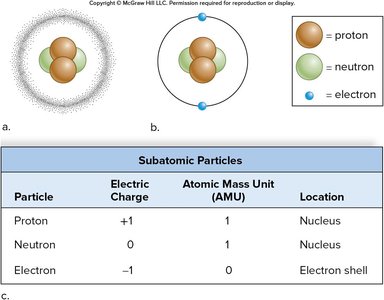
Example: Carbon has 6 protons, 6 neutrons, and 6 electrons.
Electron Shells and Stability
Electrons are arranged in shells around the nucleus. The chemical reactivity of an atom is determined by the electrons in its outermost shell, known as valence electrons. Atoms are most stable when their outermost shell is full.
The first shell holds up to 2 electrons; the second shell holds up to 8 electrons.
Atoms with incomplete outer shells tend to interact with other atoms to achieve stability.
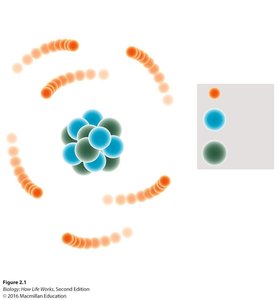
Example: Oxygen has 6 valence electrons and needs 2 more to fill its outer shell.
Chemical Bonds
Chemical bonds are interactions between the valence electrons of atoms, allowing them to achieve stable electron configurations. The main types of chemical bonds are covalent and ionic bonds.
Covalent Bond: Atoms share pairs of electrons to fill their outer shells.
Ionic Bond: One atom donates electrons to another, resulting in oppositely charged ions that attract each other.
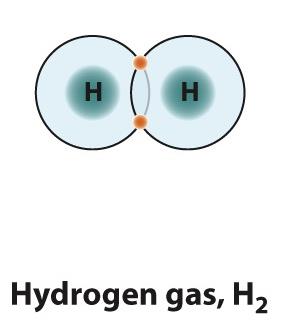
Example: In a water molecule, each hydrogen atom shares an electron with oxygen, forming covalent bonds.
Covalent Bonding of Key Biological Elements (HONC and P)
The elements hydrogen (H), oxygen (O), nitrogen (N), carbon (C), and phosphorus (P) are fundamental to biological molecules. Their bonding patterns are determined by the number of valence electrons and the number of bonds needed to achieve stability.
Element | Valence Electrons | Bonds Needed |
|---|---|---|
H | 1 | 1 |
O | 6 | 2 |
N | 5 | 3 |
C | 4 | 4 |
P | 5 | 5 |
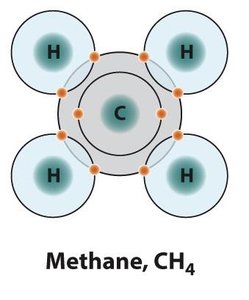
Example: Methane (CH4) has four covalent bonds between carbon and hydrogen.
Types of Covalent Bonds: Polar and Non-Polar
Covalent bonds can be classified based on how equally electrons are shared between atoms:
Non-Polar Covalent Bond: Electrons are shared equally between atoms (e.g., H2).
Polar Covalent Bond: Electrons are shared unequally, resulting in partial charges (δ+ and δ−) on the atoms (e.g., H2O).
Polarity refers to the presence of distinct positive and negative regions in a molecule due to unequal sharing of electrons.
Example: In water, oxygen is more electronegative than hydrogen, so electrons spend more time near oxygen, making it partially negative (δ−) and hydrogen partially positive (δ+).
Ionic Bonds
Ionic bonds form when one atom transfers electrons to another, creating ions with opposite charges that attract each other.
Cation: Positively charged ion (loses electrons).
Anion: Negatively charged ion (gains electrons).
Example: Sodium chloride (NaCl) forms when sodium donates an electron to chlorine.
Electronegativity and Bond Type
The type of bond formed between two atoms depends on the difference in their electronegativities:
If the difference is small, a non-polar covalent bond forms.
If the difference is moderate, a polar covalent bond forms.
If the difference is large, an ionic bond forms.
Formula: To determine bond type, calculate the difference in electronegativity (ΔEN):
Example: For HCl, H = 2.1, Cl = 3.0, so ΔEN = 0.9 (polar covalent bond).
Biological Importance of Chemical Bonds
The structure and function of biomolecules depend on the types of bonds they form. Polarity and charge differences influence molecular interactions, solubility, and biological activity.
Biomolecules such as proteins, nucleic acids, carbohydrates, and lipids rely on specific bonding patterns for their structure and function.
Polarity affects how molecules interact with water and other molecules in the cell.
Example: The polarity of water makes it an excellent solvent for biological reactions.
Summary Table: Subatomic Particles
Particle | Electric Charge | Atomic Mass Unit (AMU) | Location |
|---|---|---|---|
Proton | +1 | 1 | Nucleus |
Neutron | 0 | 1 | Nucleus |
Electron | -1 | 0 | Electron shell |
Key Concepts for Study
Elements are made up of atoms; atomic structure determines chemical properties.
Electron configuration and valence electrons dictate how atoms interact and bond.
Covalent and ionic bonds are essential for forming molecules necessary for life.
Polarity and electronegativity influence molecular interactions and biological function.
