Back
The Chemical Context of Life: Atoms, Elements, and Chemical Bonds
Study Guide - Smart Notes
 Tailored notes based on your materials, expanded with key definitions, examples, and context.
Chapter 2: The Chemical Context of Life
Introduction to Matter and Elements
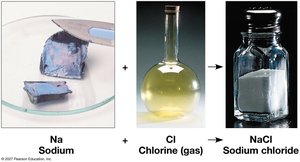
All living organisms are composed of matter, which is anything that occupies space and has mass. Matter is made up of elements, the simplest substances that cannot be broken down by chemical reactions. Compounds are substances consisting of two or more elements in a fixed ratio, often exhibiting emergent properties distinct from their constituent elements.
Element: A pure substance that cannot be decomposed into other substances by chemical means.
Compound: A substance formed from two or more elements combined in a fixed ratio.
Emergent Properties: New characteristics that arise when elements combine to form compounds.
The Elements of Life
Of the 92 naturally occurring elements, about 20–25% are essential for life. Four elements—carbon, hydrogen, oxygen, and nitrogen—make up approximately 96% of living matter. The remaining 4% consists mainly of calcium, phosphorus, potassium, and sulfur, with trace elements required in minute quantities.
Essential Elements: Elements required for an organism to survive, grow, and reproduce.
Trace Elements: Elements needed in very small amounts (e.g., iron, iodine).
Atoms and Subatomic Particles
Structure of Atoms
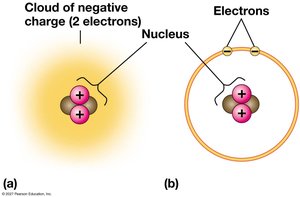
An atom is the smallest unit of an element that retains its properties. Atoms are composed of subatomic particles: neutrons (no charge), protons (positive charge), and electrons (negative charge). Neutrons and protons form the atomic nucleus, while electrons move in a cloud around the nucleus. The mass of protons and neutrons is nearly identical and measured in daltons; electrons are much lighter and usually ignored in atomic mass calculations.
Proton: Positively charged particle in the nucleus.
Neutron: Neutral particle in the nucleus.
Electron: Negatively charged particle in orbitals around the nucleus.
Atomic Number, Mass Number, and Isotopes
Atoms of different elements differ in their number of subatomic particles. The atomic number is the number of protons in the nucleus, while the mass number is the sum of protons and neutrons. Isotopes are atoms of the same element with different numbers of neutrons. Some isotopes are radioactive and decay spontaneously, emitting particles and energy.
Atomic Number (Z): Number of protons in the nucleus.
Mass Number (A): Number of protons plus neutrons.
Isotope: Atoms of the same element with different numbers of neutrons.
Radioactive Isotope: An isotope that decays, releasing radiation.
Applications of Radioactive Isotopes
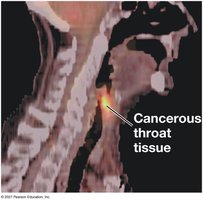
Radioactive isotopes are used as tracers in medicine to track atoms through metabolic processes and in imaging techniques such as PET scans, which can monitor cancer growth and metabolism.
Energy Levels and Electron Configuration
Potential Energy and Electron Shells
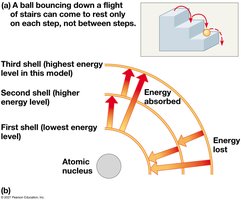
Energy is the capacity to cause change. Potential energy is stored energy due to position or structure. Electrons in atoms have different potential energies depending on their distance from the nucleus, organized into discrete energy levels called electron shells. Electrons can move between shells by absorbing or releasing energy in fixed amounts.
Potential Energy: Energy due to position or structure.
Electron Shell: A level of electrons at a characteristic average distance from the nucleus.
Electron Distribution and the Periodic Table
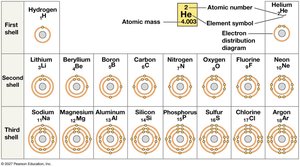
The chemical behavior of an atom is determined by the distribution of electrons in its shells, especially the outermost (valence) shell. The periodic table arranges elements by increasing atomic number and shows patterns in electron configuration.
Valence Electrons and Chemical Reactivity
Valence electrons are those in the outermost shell. Atoms with incomplete valence shells are chemically reactive, seeking to fill their shells by forming bonds. Atoms with full valence shells are inert (nonreactive).
Chemical Bonds and Interactions
Covalent Bonds
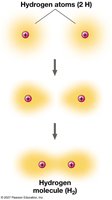
Covalent bonds involve the sharing of pairs of valence electrons between atoms. A molecule is formed when two or more atoms are held together by covalent bonds. Single bonds share one pair of electrons, while double bonds share two pairs. The bonding capacity of an atom is called its valence.
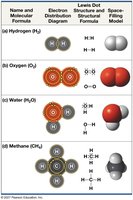
Nonpolar Covalent Bond: Electrons are shared equally between atoms.
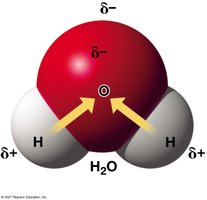
Polar Covalent Bond: Electrons are shared unequally, resulting in partial charges.
Electronegativity: The tendency of an atom to attract electrons in a bond.
Ionic Bonds
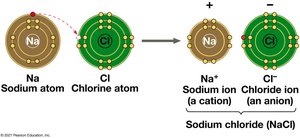
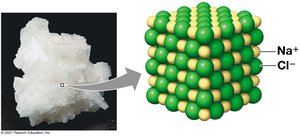
Ionic bonds form when one atom transfers electrons to another, creating oppositely charged ions (cations and anions) that attract each other. Ionic compounds, or salts, are stable in dry form but often dissociate in water.
Weak Chemical Interactions
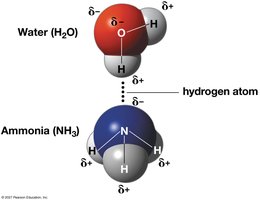
In addition to strong covalent and ionic bonds, weak interactions such as hydrogen bonds and van der Waals interactions play crucial roles in biological systems. These weak bonds are reversible and help maintain the structure and function of large biological molecules.
Hydrogen Bond: Attraction between a hydrogen atom covalently bonded to an electronegative atom and another electronegative atom (often oxygen or nitrogen).
Van der Waals Interactions: Weak attractions due to transient local partial charges.
Molecular Shape and Function
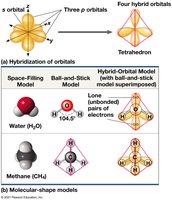
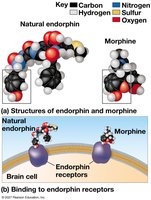
The shape of a molecule is determined by the arrangement of its atoms and the orbitals of its electrons. Molecular shape is critical for biological recognition and function, such as the binding of hormones or drugs to receptors.
Chemical Reactions
Making and Breaking Bonds
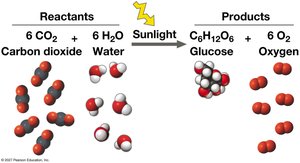
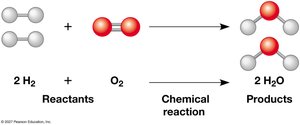
Chemical reactions involve the making and breaking of chemical bonds, transforming reactants into products. All chemical reactions are reversible, and equilibrium is reached when the forward and reverse reactions occur at the same rate.
Reactants: Starting substances in a chemical reaction.
Products: Substances formed as a result of a chemical reaction.
Chemical Equilibrium: State where the concentrations of reactants and products remain constant.
Photosynthesis: An Example of a Biological Chemical Reaction
Photosynthesis is a key chemical reaction in biology, where sunlight powers the conversion of carbon dioxide and water into glucose and oxygen. This process is fundamental to life on Earth.
General equation for photosynthesis: