 Back
The Chemical Context of Life: Atoms, Isotopes, and Chemical Bonds
Study Guide - Smart Notes
 Tailored notes based on your materials, expanded with key definitions, examples, and context.
The Chemical Context of Life
Atoms and Subatomic Particles
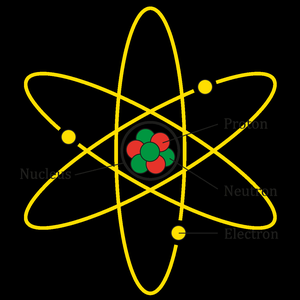
All matter is composed of atoms, which are the smallest units of elements that retain their chemical properties. Atoms are made up of three primary subatomic particles: protons, neutrons, and electrons.
Protons: Positively charged particles found in the nucleus; each has a mass of approximately 1 dalton.
Neutrons: Neutral particles (no charge) also located in the nucleus; each has a mass of approximately 1 dalton.
Electrons: Negatively charged particles that orbit the nucleus in electron shells; their mass is negligible compared to protons and neutrons.
Atomic Number, Atomic Mass, and Isotopes
The identity and properties of an element are determined by the number and arrangement of its subatomic particles.
Atomic Number (Z): The number of protons in the nucleus; defines the element.
Atomic Mass (A): The total number of protons and neutrons in the nucleus.
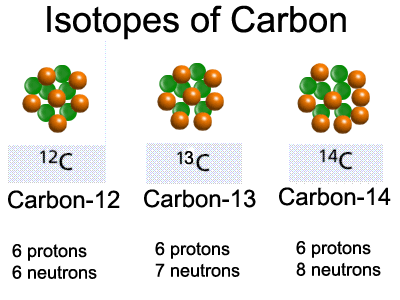
Isotopes: Atoms of the same element with different numbers of neutrons, resulting in different atomic masses but identical chemical properties.
Subatomic Particle | Location | Charge | Approximate Mass |
|---|---|---|---|
Proton | Nucleus | +1 | 1 dalton |
Neutron | Nucleus | 0 | 1 dalton |
Electron | Electron Shells | -1 | ~0 dalton |
Electron Shells and Energy Levels
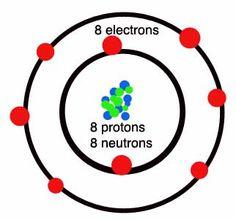
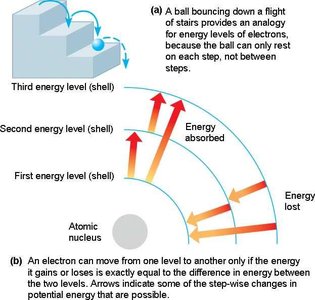
Electrons occupy specific energy levels or shells around the nucleus. The arrangement of electrons determines the chemical behavior of an atom.
Electron Shells: Regions around the nucleus where electrons are likely to be found. Each shell can hold a specific maximum number of electrons (e.g., 2 in the first shell, 8 in the second).
Valence Electrons: Electrons in the outermost shell; they determine the atom's chemical properties and reactivity.
Potential Energy: Electrons further from the nucleus have higher potential energy. Electrons can absorb or release energy to move between shells.
Ions and Isotopes
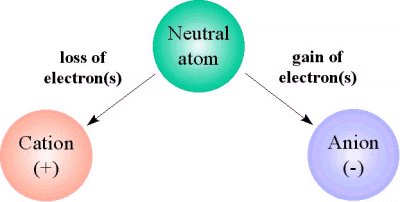
Atoms can gain or lose electrons to form ions, or have different numbers of neutrons to form isotopes.
Cation: An atom that has lost one or more electrons, resulting in a positive charge.
Anion: An atom that has gained one or more electrons, resulting in a negative charge.
Isotopes: Atoms of the same element with different numbers of neutrons.
Radioactive Isotopes and Their Applications
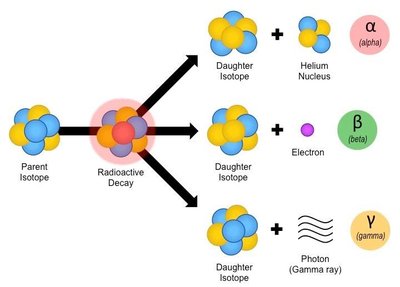
Some isotopes are unstable (radioactive) and decay over time, emitting radiation. These radioactive isotopes have important applications in science and medicine.
Radioactive Decay: The process by which unstable nuclei lose energy by emitting particles or radiation.
Types of Decay: Alpha (α), Beta (β), and Gamma (γ) decay, each with different properties and penetration abilities.
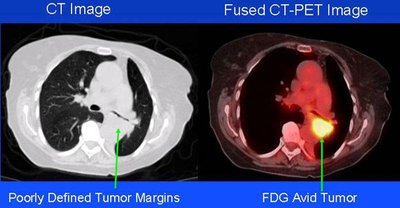
Applications: Radioactive tracers in medical imaging (e.g., PET scans), radiometric dating of fossils and rocks.
Radiometric Dating and Carbon Dating
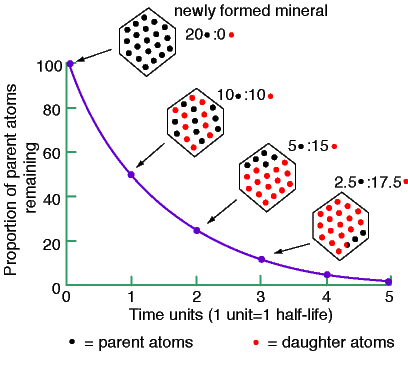
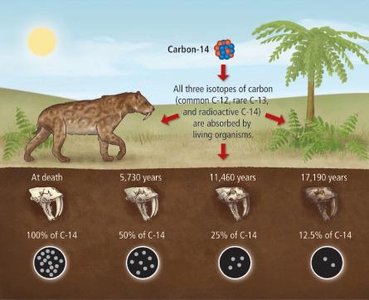
Radiometric dating uses the decay of radioactive isotopes to estimate the age of materials. Carbon-14 dating is especially useful in biology and anthropology for dating formerly living things.
Half-life: The time required for half of the radioactive atoms in a sample to decay.
Carbon-14 Dating: Measures the ratio of C-14 to C-12 in organic remains to estimate age up to about 50,000 years.
Other Isotopes: Isotopes with longer half-lives (e.g., Uranium-238) are used for dating rocks and geological events.
Chemical Bonds and Molecular Structure
Chemical Bonds: Types and Properties
Chemical bonds are forces that hold atoms together in molecules and compounds. The main types of chemical bonds are covalent, ionic, and hydrogen bonds, with additional weak interactions such as Van der Waals forces.
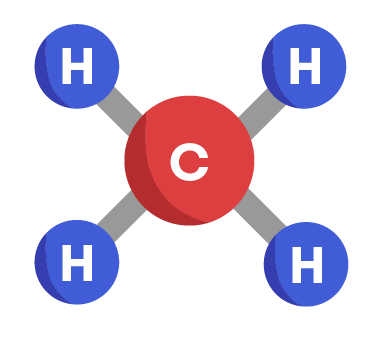
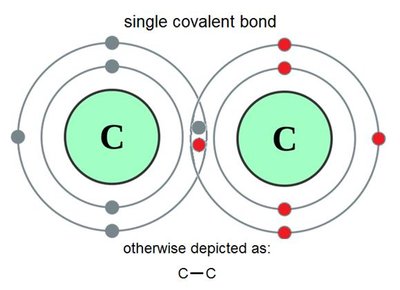
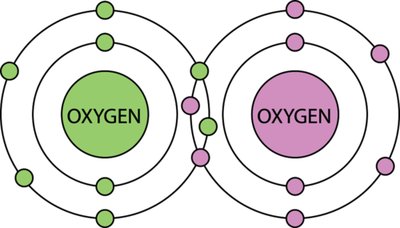
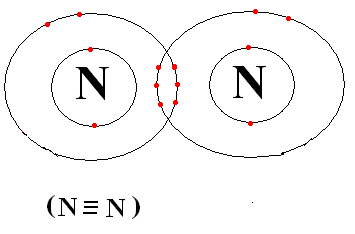
Covalent Bonds: Atoms share pairs of valence electrons. Can be single, double, or triple bonds depending on the number of shared electron pairs.
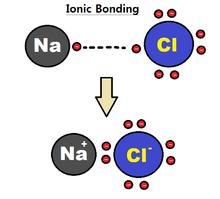
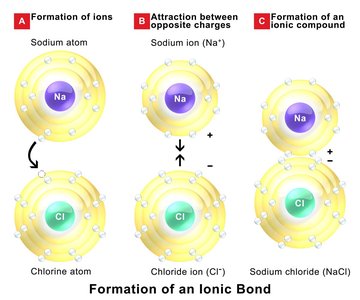
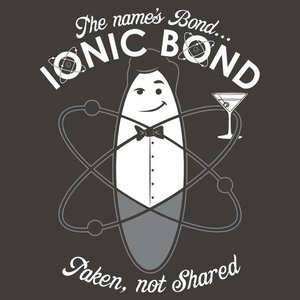
Ionic Bonds: Formed when one atom transfers electrons to another, resulting in oppositely charged ions that attract each other (e.g., NaCl).
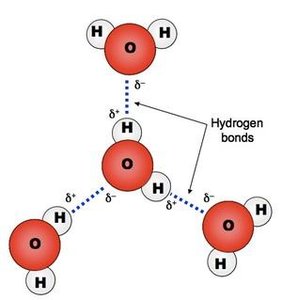
Hydrogen Bonds: Weak attractions between a hydrogen atom covalently bonded to an electronegative atom (like O or N) and another electronegative atom.
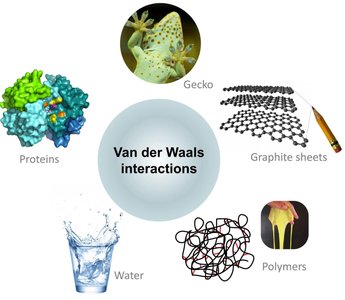
Van der Waals Interactions: Weak, transient attractions between molecules due to temporary shifts in electron density.
Bond Type | Strength | Example |
|---|---|---|
Covalent (single) | Strong | H-H in H2 |
Covalent (double) | Stronger | O=O in O2 |
Covalent (triple) | Strongest | N≡N in N2 |
Ionic | Strong (in dry conditions) | NaCl |
Hydrogen | Weak (individually) | Between water molecules |
Van der Waals | Very weak (individually) | Between nonpolar molecules |
Covalent Bonds: Nonpolar and Polar
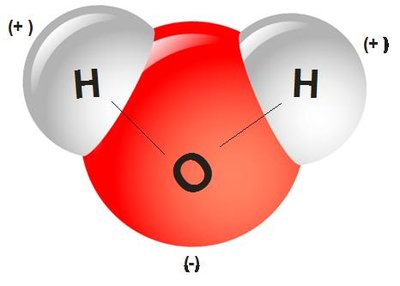
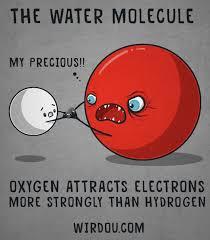
Covalent bonds can be nonpolar (equal sharing of electrons) or polar (unequal sharing, leading to partial charges).
Nonpolar Covalent Bond: Electrons are shared equally (e.g., H2, O2).
Polar Covalent Bond: Electrons are shared unequally, creating partial positive and negative charges (e.g., H2O).
Ionic Bonds and Compounds
Ionic bonds form when electrons are transferred from one atom to another, resulting in the formation of ions. The electrostatic attraction between cations and anions forms ionic compounds, commonly known as salts.
Example: Sodium (Na) donates an electron to chlorine (Cl), forming Na+ and Cl-, which combine to form NaCl.
Hydrogen Bonds and Van der Waals Interactions
Hydrogen bonds and Van der Waals interactions are weak individually but can be strong collectively. They play crucial roles in stabilizing the structures of DNA, proteins, and other biological molecules.
Hydrogen Bonds: Important in holding water molecules together and stabilizing the structures of proteins and nucleic acids.
Van der Waals Interactions: Weak attractions due to transient dipoles; significant in large molecules and surfaces (e.g., gecko feet, protein folding).
Energy in Chemical Bonds
Chemical bonds store energy, which is released or absorbed during chemical reactions. The strength of a bond determines the amount of energy involved.
Stronger bonds (e.g., triple covalent) release more energy when broken than weaker bonds (e.g., hydrogen bonds).
Chemical Reactions and Equilibrium
Chemical reactions involve the making and breaking of chemical bonds, transforming reactants into products. Reactions can be exothermic (release energy) or endothermic (absorb energy). In the absence of external influences, reactions tend toward equilibrium, where the rates of forward and reverse reactions are equal.
Exothermic Reaction: Releases energy (e.g., combustion).
Endothermic Reaction: Absorbs energy (e.g., photosynthesis).
Activation Energy: The minimum energy required to initiate a reaction.
Catalysts (Enzymes): Lower the activation energy, increasing reaction rates in biological systems.
Summary Table: Atoms, Ions, and Isotopes
Type | Difference |
|---|---|
Element | Number of protons |
Ion | Number of electrons |
Isotope | Number of neutrons |
Additional info: This guide covers the foundational chemical principles necessary for understanding biological molecules and processes, including atomic structure, isotopes, chemical bonding, and the energetic basis of chemical reactions.
