 Back
BackThe Chemical Context of Life: Atoms, Water, and Carbon
Study Guide - Smart Notes
 Tailored notes based on your materials, expanded with key definitions, examples, and context.
Chapter 2: The Chemical Context of Life
Introduction to Matter, Elements, and Compounds
Chemistry forms the basis for understanding biological structure and function. Living organisms are composed of matter, which consists of elements and compounds governed by chemical principles.
Matter: Anything that takes up space and has mass.
Element: A substance that cannot be broken down into other substances by chemical reactions.
Compound: A substance consisting of two or more different elements in a fixed ratio.
Essential elements: Carbon, hydrogen, oxygen, nitrogen, phosphorus, and sulfur (CHNOPS) are vital for life.
Trace elements: Required in minute amounts for proper biological function.
Atomic Structure and Isotopes
The properties of elements depend on the structure of their atoms, which are composed of subatomic particles.
Protons: Positively charged particles in the nucleus.
Neutrons: Neutral particles in the nucleus.
Electrons: Negatively charged particles orbiting the nucleus.
Atomic Number (Z): Number of protons in the nucleus.
Mass Number (A): Total number of protons and neutrons ().
Isotopes: Variants of an element with the same number of protons but different numbers of neutrons.
Radioactive isotopes: Unstable isotopes that decay, emitting energy; used in medicine and dating fossils.
Chemical Bonding
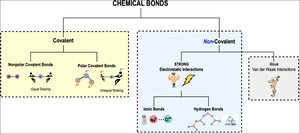
The formation and function of molecules depend on chemical bonding between atoms. Chemical bonds are forces that hold atoms together in compounds.
Ionic Bonds: Attraction between oppositely charged ions (cation and anion).
Covalent Bonds: Sharing of valence electrons between nonmetals; can be polar (unequal sharing) or nonpolar (equal sharing).
Hydrogen Bonds: Weak interactions between a hydrogen atom and a highly electronegative atom (F, O, N); collectively strong in large numbers.
Example: Water (H2O) is held together by polar covalent bonds and forms hydrogen bonds with other water molecules.
Chemical Reactions
Chemical reactions make and break chemical bonds, and are often reversible. Chemical equilibrium is reached when forward and reverse reactions occur at the same rate.
Chapter 3: Water and Life
Introduction to Water
Water is essential for life, supporting all living organisms and making Earth habitable. Its unique properties arise from its molecular structure and hydrogen bonding.
Water molecule: Small, polar molecule (H2O).
Hydrogen bonding: Responsible for water's emergent properties.
Emergent Properties of Water
Hydrogen bonding gives rise to four emergent properties crucial for life:
Cohesion: Water molecules stick together, enabling surface tension.
Adhesion: Water molecules stick to other substances, aiding capillary action.
Moderation of temperature: Water's high specific heat allows it to resist temperature changes, stabilizing environments.
Floating of ice: Ice is less dense than liquid water, allowing it to float.
Water as a solvent: Water's polarity makes it an excellent solvent for polar and ionic substances.
Solutions and Solubility
Solution: Homogeneous mixture of solute dissolved in solvent.
Aqueous solution: Water is the solvent.
Hydrophilic: Substances attracted to water; typically polar or charged.
Hydrophobic: Substances that repel water; typically nonpolar.
pH Scale, Acids, Bases, and Buffers
The pH scale measures the concentration of H+ ions in solution, affecting biological processes.
Acidic: pH < 7, H+ > OH-
Neutral: pH = 7, H+ = OH-
Basic: pH > 7, H+ < OH-
Buffers: Substances that resist changes in pH by accepting or donating H+ ions.
Chapter 4: Carbon and the Molecular Diversity of Life
Introduction to Carbon
Carbon is the most abundant element in living systems and forms the backbone of organic molecules. Its ability to form four covalent bonds makes it highly versatile.
Organic molecules: Contain covalently linked carbon and hydrogen atoms.
Hydrocarbons: Molecules made only of carbon and hydrogen.
Carbon skeletons: Can vary in length, branching, ring formation, and position of double bonds.
Isomers
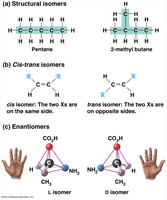
Isomers are compounds with the same molecular formula but different structures, resulting in different properties.
Structural isomers: Different covalent arrangements of atoms.
Cis-trans isomers: Same covalent arrangement, different spatial arrangement around a double bond.
Enantiomers: Mirror images; important in pharmacology as different enantiomers may have different biological effects.
Functional Groups
Functional groups are specific groups of atoms attached to carbon skeletons that confer distinct chemical properties.
Methyl group: -CH3
Hydroxyl group: -OH
Carbonyl group: -C=O
Carboxyl group: -COOH
Amino group: -NH2 (acts as a base)
Phosphate group: -PO43-
Sulfhydryl group: -SH
Carbon Bonding and Molecular Shape
The shape of a hydrocarbon depends on the hybridization of its carbon atoms:
sp3 hybridization: Tetrahedral shape, bond angles ~109.5° (single bonds).
sp2 hybridization: Planar shape, bond angles ~120° (double bonds).
sp hybridization: Linear shape, bond angles 180° (triple bonds).
Example: A six-carbon hydrocarbon with one double bond will be planar at the double bond and tetrahedral elsewhere.
