 Back
BackThe Chemical Context of Life: Elements, Atoms, and Chemical Bonds
Study Guide - Smart Notes
 Tailored notes based on your materials, expanded with key definitions, examples, and context.
Chapter 2: The Chemical Context of Life
Introduction
This chapter explores the fundamental chemical principles that underlie biological processes. Understanding the nature of elements, atoms, and chemical bonds is essential for grasping how living organisms are structured and how they function at the molecular level.
Elements and Compounds
Definition and Properties
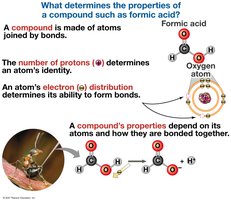
Element: A substance that cannot be broken down into other substances by chemical reactions. Each element is defined by its number of protons.
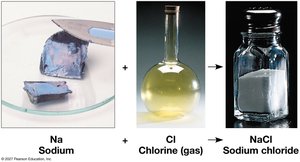
Compound: A substance consisting of two or more elements combined in a fixed ratio. Compounds have emergent properties distinct from their constituent elements.
Emergent Properties: New characteristics that arise when elements combine to form compounds, such as the difference between sodium, chlorine, and sodium chloride.
Elements Essential for Life
About 20–25% of the 92 natural elements are essential for life.
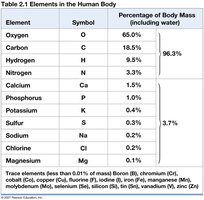
Four elements make up 96% of living matter: Carbon (C), Hydrogen (H), Oxygen (O), and Nitrogen (N).
Other important elements include calcium (Ca), phosphorus (P), potassium (K), and sulfur (S).
Trace elements are required in minute quantities (e.g., iron, zinc).
Element | Symbol | Percentage of Body Mass (including water) |
|---|---|---|
Oxygen | O | 65.0% |
Carbon | C | 18.5% |
Hydrogen | H | 9.5% |
Nitrogen | N | 3.3% |
Calcium | Ca | 1.5% |
Phosphorus | P | 1.0% |
Potassium | K | 0.4% |
Sulfur | S | 0.3% |
Sodium | Na | 0.2% |
Chlorine | Cl | 0.2% |
Magnesium | Mg | 0.1% |
Atoms and Subatomic Particles
Structure of Atoms
Atom: The smallest unit of an element that retains its properties.
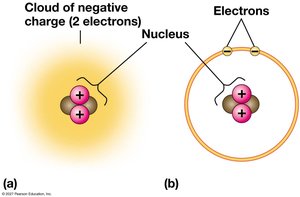
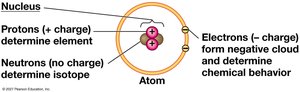
Composed of protons (positive charge), neutrons (no charge), and electrons (negative charge).
Protons and neutrons are located in the nucleus; electrons form a cloud around the nucleus.
Atomic mass is measured in daltons (Da).
Atomic Number, Mass Number, and Isotopes
Atomic number: Number of protons in the nucleus; defines the element.
Mass number: Sum of protons and neutrons in the nucleus.
Isotopes: Atoms of the same element with different numbers of neutrons.
Radioactive isotopes have unstable nuclei and can be used in biological research and medicine (e.g., PET scans).
Energy Levels and Electron Distribution
Energy and Potential Energy
Energy: The capacity to cause change.
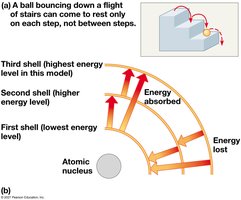
Potential energy: Energy possessed due to location or structure; electrons further from the nucleus have higher potential energy.
Electrons occupy specific energy levels or shells; energy changes occur in discrete steps.
Electron Shells and Chemical Properties
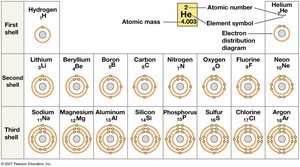
Electron distribution determines chemical behavior.
Valence electrons: Electrons in the outermost shell; determine reactivity.
Elements with full valence shells are inert (nonreactive).
Chemical Bonds
Covalent Bonds
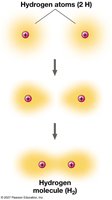
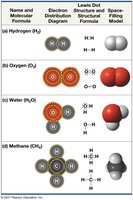
Covalent bond: Sharing of a pair of valence electrons between two atoms.
Can be single (one pair shared) or double (two pairs shared).
Molecule: Two or more atoms held together by covalent bonds.
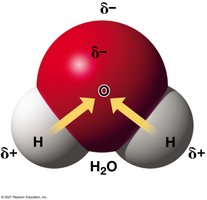
Electronegativity: An atom's attraction for shared electrons; determines bond polarity.
Nonpolar covalent bond: Electrons shared equally.
Polar covalent bond: Electrons shared unequally, resulting in partial charges.

Ionic Bonds
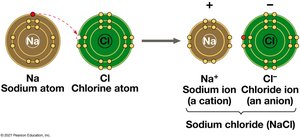
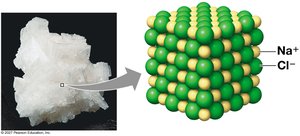
Ionic bond: Attraction between oppositely charged ions (cations and anions).
Formed when electrons are transferred from one atom to another.
Ionic compounds (salts): Stable in dry form, dissociate in water (e.g., NaCl).
Weak Chemical Interactions
Weak bonds (hydrogen bonds, van der Waals interactions) are crucial for the structure and function of biological molecules.
Allow for reversible interactions, important in processes like DNA replication and protein folding.
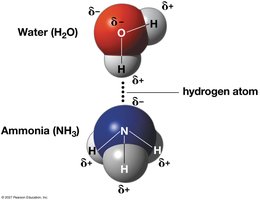
Hydrogen Bonds
Form when a hydrogen atom covalently bonded to one electronegative atom is attracted to another electronegative atom (usually O or N).
Responsible for many properties of water and the structure of biomolecules.
Chemical Reactions and Equilibrium
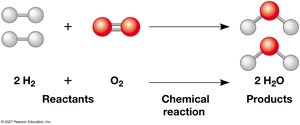
Chemical Reactions
Involve the making and breaking of chemical bonds.
Reactants: Starting materials.
Products: Resulting materials.
All reactions are reversible to some extent.
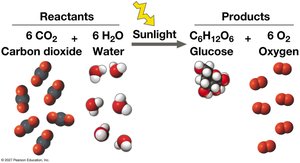
Photosynthesis as a Chemical Reaction
Photosynthesis converts carbon dioxide and water into glucose and oxygen using sunlight.
Chemical Equilibrium
Occurs when forward and reverse reactions proceed at the same rate.
Relative concentrations of reactants and products remain constant at equilibrium.
Summary Table: Key Terms and Concepts
Term | Definition |
|---|---|
Element | Substance that cannot be broken down by chemical means |
Compound | Substance of two or more elements in a fixed ratio |
Atom | Smallest unit of an element |
Isotope | Atoms of the same element with different numbers of neutrons |
Covalent bond | Sharing of electron pairs between atoms |
Ionic bond | Attraction between oppositely charged ions |
Hydrogen bond | Attraction between a hydrogen atom and an electronegative atom |
Valence electrons | Electrons in the outermost shell |
Chemical equilibrium | State where forward and reverse reactions occur at the same rate |
